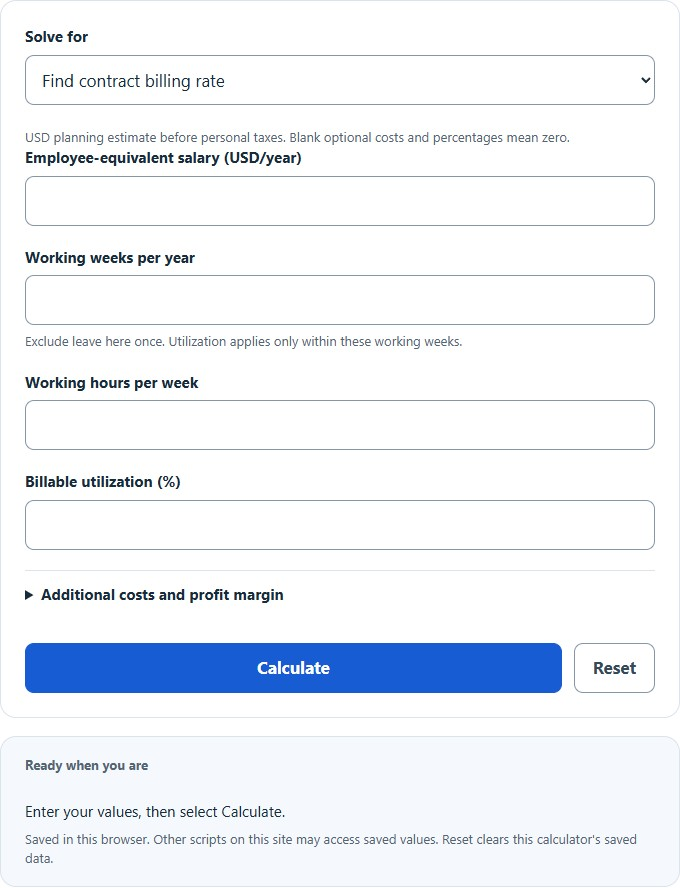
Estimate a contract billing rate, supported annual salary, or required billable utilization using your working schedule, additional benefits, expenses and revenue margin. Amounts are USD planning estimates before personal taxes.
Equivalent Contract Rate Formula
The loaded-cost model below uses your own costs and billable hours. It does not assume an average benefits factor or guarantee equivalent take-home pay.
Historical comparison only: the March 2025 BLS civilian data reported $47.92 total compensation and $32.92 wages per hour worked, a ratio of about 1.456. The 31.3% benefits share uses total compensation as its denominator. This aggregate is not a contractor default; BLS benefits include paid leave. Do not add leave wages already in annual salary or remove the same leave twice through weeks and utilization.
- Where r is the contract billing rate (USD/hour); S is annual salary and E is additional annual business expense (USD/year)
- W is working weeks/year, h is working hours/week, and u is the billable fraction of those hours. b is additional benefits/payroll costs as a fraction of salary; m is profit as a fraction of revenue (below 1).
Calculate annual cost S × (1 + b) + E, then divide by billable hours W × h × u and by (1 − m). Enter percentages as percentages in the calculator. Exclude leave from W once, and use u for nonbillable time within those working weeks. Additional costs must not repeat costs already included in salary or elsewhere.
| Yearly Salary (USD) | Contract Rate (USD/hr) |
|---|---|
| 40,000 | 32.94 |
| 50,000 | 41.18 |
| 60,000 | 49.41 |
| 65,000 | 53.53 |
| 70,000 | 57.65 |
| 75,000 | 61.76 |
| 80,000 | 65.88 |
| 85,000 | 70.00 |
| 90,000 | 74.12 |
| 95,000 | 78.24 |
| 100,000 | 82.35 |
| 110,000 | 90.59 |
| 120,000 | 98.82 |
| 130,000 | 107.06 |
| 140,000 | 115.29 |
| 150,000 | 123.53 |
| 160,000 | 131.76 |
| 175,000 | 144.12 |
| 200,000 | 164.71 |
| 250,000 | 205.88 |
| Historical illustration, rounded to 2 decimals: rate = salary × (1.456 / 1768) = salary × 14/17000. Here 1,768 = 2,080 × 85% is an assumed billing schedule, not a BLS working-hours standard. The historical aggregate factor is not a current default or a personalized benefits estimate. | |
How to Calculate Equivalent Contract Rate?
The following examples use 50 working weeks, 40 hours/week, 100% billable utilization, and zero additional benefits, expenses and margin. These are example assumptions, not prefilled personal inputs.
Example Problem #1:
- First, determine the total yearly salary ($).
- The annual salary is USD 50,000; the example billable hours are 50 × 40 × 1 = 2,000 hours.
- Finally, calculate the Equivalent Contract Rate using the equation above:
r = [S × (1 + b) + E] / [W × h × u × (1 − m)]
The values provided above are inserted into the equation below and computed.
r = [50,000 × (1 + 0) + 0] / [50 × 40 × 1 × (1 − 0)] = 25.00 USD/hour
Example Problem #2:
For this problem, the variables required are provided below:
annual salary = USD 100,000; use the same schedule and zero additional costs and margin as Example #1
Test your knowledge using the equation and check your answer with the calculator.
r = 100,000 / 2,000 = 50.00 USD/hour