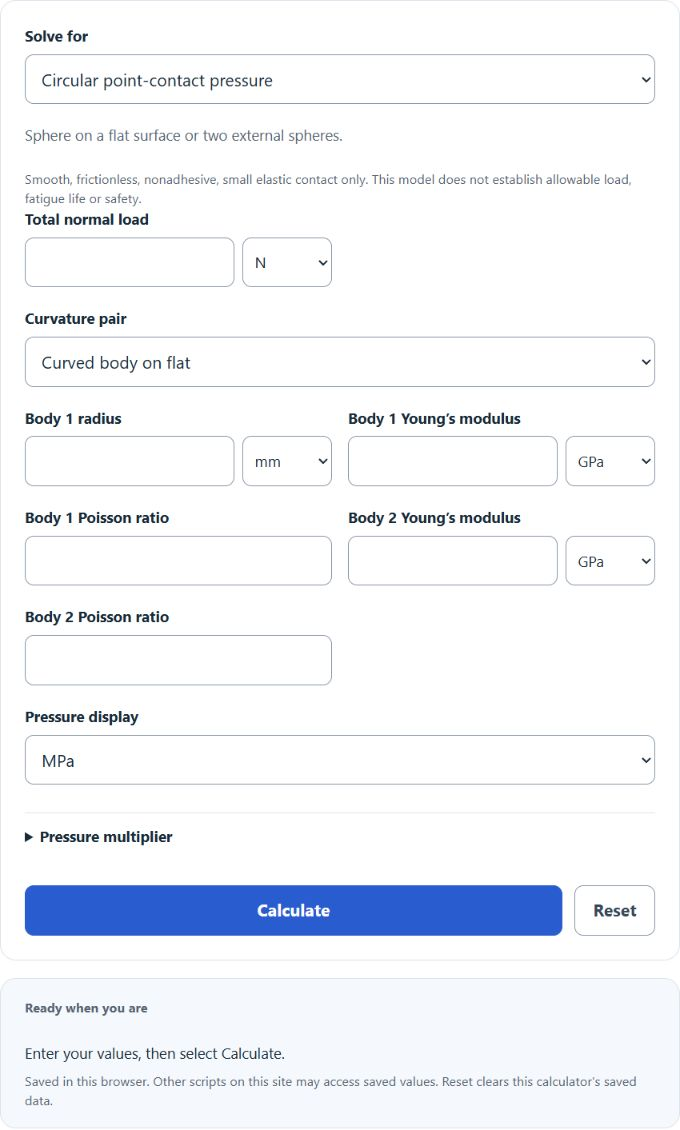
Calculate Hertzian pressure for circular point contact, parallel-cylinder line contact or a known circular contact radius, or find point-contact load for a user-supplied target pressure. This elastic model does not determine allowable load or safety.
- All Physics Calculators
- Contact Force Calculator
- Compressive Stress Calculator
- Normal Stress Calculator
- Bearing Load Calculator
- PSI to Force Calculator
Hertz Pressure Formula
The following formula is used to calculate the maximum Hertz (Hertzian) contact pressure for a circular contact area of radius a when the contact radius is known.
Variables:
- p0 is the maximum Hertz contact pressure (Pa)
- F is the load (N)
- a is the contact radius (m)
To calculate the maximum Hertz pressure, multiply the load by 3 and divide the result by 2π times the square of the contact radius. (Note: material properties such as Young’s modulus and Poisson’s ratio affect the contact radius predicted by Hertz theory, but once a is known they do not appear in the pressure formula above.)
What is Hertz Pressure?
Hertz pressure is a measure of the contact pressure between two elastic bodies in contact. It is named after the German physicist Heinrich Hertz, who developed the theory of contact mechanics. Hertz pressure is used to describe the stress distribution in the contact area of two bodies, such as a ball and a flat surface, or two spheres. This concept is important in various fields, including mechanical engineering, materials science, and tribology, as it helps in understanding the behavior of materials under load and in designing components that can withstand high contact pressures without failure.
How to Calculate Hertz Pressure?
The following steps outline how to calculate the Hertz Pressure.
- First, determine the load (F) applied to the contact.
- For a known circular contact radius, select Pressure from known circular contact radius and enter a. Otherwise enter the body radii, elastic moduli and Poisson ratios for the selected point or parallel-cylinder model.
- Finally, calculate the maximum Hertz Pressure using the formula p0 = (3F) / (2πa²).
- For the example below, use Pressure from known circular contact radius, 1000 N and 50 mm; the displayed 0.190986 MPa is approximately 1.91×10⁵ Pa. Point and line models require smooth, frictionless, nonadhesive small contact between homogeneous isotropic elastic bodies. The optional pressure multiplier is arithmetic only, not a safety assessment. General maximum-shear estimates are omitted because their coefficients depend on Poisson ratio.
Example Problem :
Use the following variables as an example problem to test your knowledge.
Load (F) = 1000 N
Maximum Hertz Pressure (p0) = ?
Contact Radius (a) = 0.05 m
Answer: p0 ≈ 1.91×10⁵ Pa (≈ 27.7 psi)