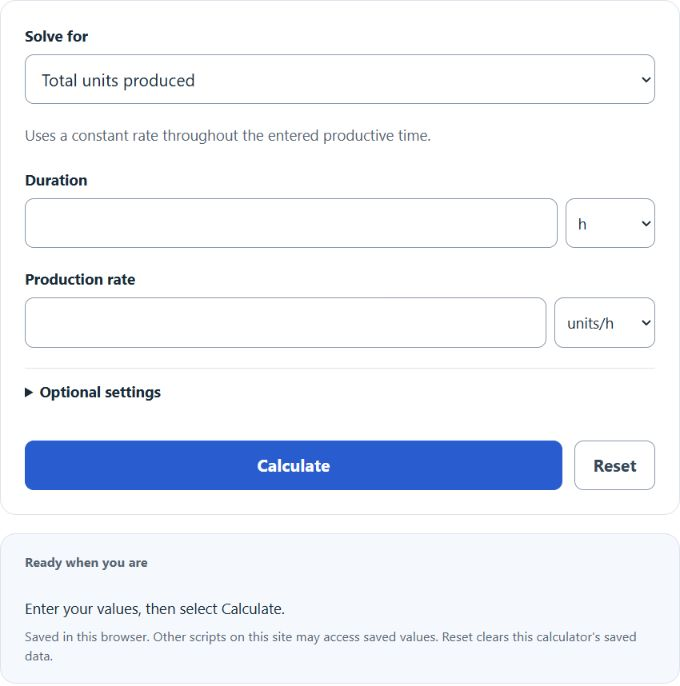
Calculate units from hours and minutes using a units-per-hour rate, or find the required hours or rate from total units and time.
Assumptions Read first
- Linear relationship: Units = (Units per Hour) × Hours. All times are converted to hours and all rates to units/hour internally.
- Rate is constant over the entire interval; no batching, ramp-up, downtime, or variable pacing is modeled.
- Choose the solve target, then complete its two visible required fields.
- Units is a plain count (dimensionless). Time and rate dropdowns perform standard conversions between seconds, minutes, and hours.
- Non-zero denominators are required: when solving for Hours, rate must not be zero; when solving for Units per Hour, time must not be zero (the tool will alert).
- General-purpose rate/quantity calculator; it does not account for schedules, breaks, or changing rates.
When to Use This Calculator
- Compute any of total units, duration, or rate when the other two are known.
- Convert between per‑second/per‑minute/per‑hour and seconds/minutes/hours while solving.
- Plan throughput (production, tasks, machine cycles) or simple process timing.
- Run quick sanity checks on time–rate–quantity relationships.
Input Definitions
- Units — total quantity (items, cycles, tasks, etc.). No unit conversion.
- Hours — duration; choose Seconds, Minutes, or Hours (auto-converted to hours).
- Units per Hour — constant rate; choose Units/Second, Units/Minute, or Units/Hour (auto-converted to units/hour).
- Formulas — Units = Rate × Time; Hours = Units ÷ Rate; Units per Hour = Units ÷ Time.
- Usage — Choose the solve target, enter its visible inputs and select Calculate; use Reset to clear all inputs.
- All Unit Converters
- Hours Per Unit Calculator
- Hours Per Part Calculator
- Units Per Hour Calculator
- Parts Per Hour Calculator
- Pieces Per Hour Calculator
- Production Rate Calculator
Hours to Units Formula
The hours to units relationship is a simple constant-rate calculation. If you know how long a process runs and how many units are completed each hour, you can find the total output by multiplying time by rate. The same relationship can also be rearranged to solve for hours or units per hour when the other two values are known.
- U
- Total units produced, processed, completed, or consumed
- H
- Total time expressed in hours
- R
- Rate in units per hour
How to use the calculator
- Choose the value you want to solve for: units, hours, or units per hour.
- Enter the other two known values.
- If your time is in minutes or seconds, select that unit so the calculator can convert it to hours automatically.
- If your rate is in units per minute or units per second, select that rate unit so it can be converted to units per hour.
- Click calculate to return the missing value.
Time and rate conversions used by the calculator
Because the core equation uses hours, shorter time intervals and alternate rate units need to be converted before solving.
- Minutes to hours: divide by 60
- Seconds to hours: divide by 3,600
- Units/minute to units/hour: multiply by 60
- Units/second to units/hour: multiply by 3,600
Quick examples
Example 1: Find total units
A machine runs for 5.5 hours at 8 units per hour.
Total output is 44 units.
Example 2: Find hours required
You need to produce 150 units at a rate of 25 units per hour.
The job will take 6 hours.
Example 3: Find units per hour from minutes
90 units are completed in 45 minutes. First convert 45 minutes to hours.
The effective rate is 120 units per hour.
Common applications
- Manufacturing output planning
- Warehouse picking and packing rates
- Assembly line throughput checks
- Service ticket or task completion pacing
- Machine cycle estimation
- Staffing and labor productivity comparisons
Reference table: units produced at 60 units/hour
| Time | Decimal Hours | Total Units |
|---|---|---|
| 15 minutes | 0.25 | 15 |
| 30 minutes | 0.50 | 30 |
| 45 minutes | 0.75 | 45 |
| 1 hour | 1.00 | 60 |
| 1 hour 30 minutes | 1.50 | 90 |
| 2 hours | 2.00 | 120 |
| 2 hours 30 minutes | 2.50 | 150 |
| 4 hours | 4.00 | 240 |
Important assumptions
- The calculation assumes a constant rate over the full time period.
- It does not account for breaks, downtime, setup time, batch changes, or changing speed.
- When solving for hours, the rate must be greater than zero.
- When solving for units per hour, the time entered must be greater than zero.
- The term units can represent items, parts, orders, cycles, tasks, or any other countable output.
Hours to units vs. hours per unit
These two ideas are related, but they answer different questions:
- Hours to units tells you how many total units can be completed over a period of time.
- Hours per unit tells you how much time is needed to complete one unit.
If you know one metric, you can convert to the other by taking the reciprocal when the units are aligned consistently.
Tips for accurate results
- Use average rate only when output is reasonably steady.
- Convert all time inputs carefully, especially partial hours.
- Round final answers only after completing the full calculation.
- For labor planning, separate productive time from idle time if you need a truer operating rate.