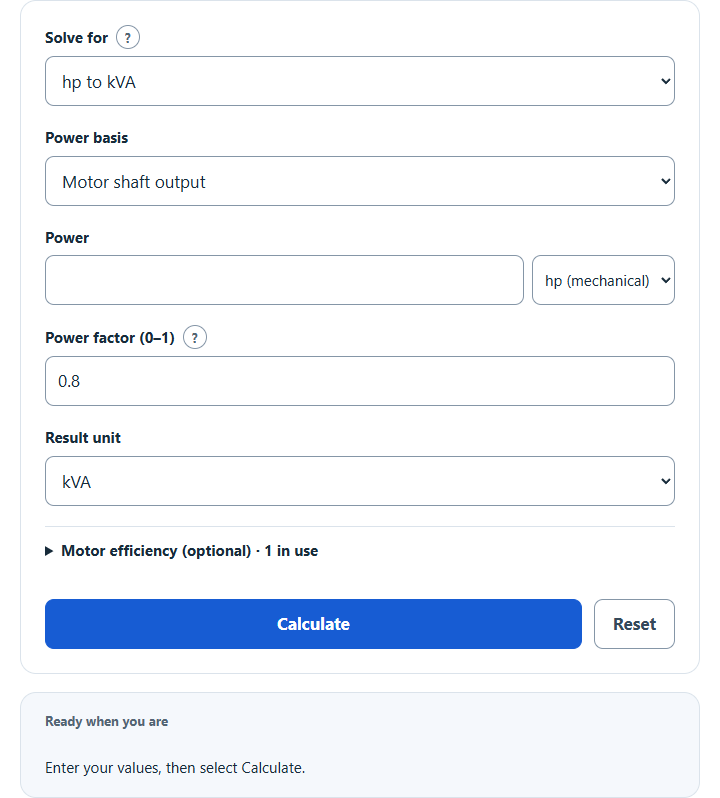
Convert hp to kVA using a typical 0.8 power factor or your motor’s own power factor and efficiency, or convert kVA back to hp or kW.
- All Unit Converters
- CC to HP Calculator
- WHP to HP Calculator
- HP to Amps Calculator
- HP to Voltage Calculator
- RWKW to HP Calculator
- HP to Torque Calculator
- HP to Joules Calculator
Calculator Functions
| Function | What it does | What it requires |
|---|---|---|
| hp to kVA | Converts motor horsepower to the apparent power drawn from the supply | Requires the power in hp or kW and the power factor |
| kVA to hp (or kW) | Converts apparent power to the horsepower or kilowatts it can supply | Requires the apparent power in kVA or MVA and the power factor |
| Power factor from hp and kVA | Finds the power factor that links a motor power to an apparent power | Requires the power in hp or kW and the apparent power in kVA or MVA |
Every function asks for the power basis. Motor shaft output treats the horsepower as mechanical output and applies the optional motor efficiency, which is 100% if left blank. Electrical real input treats the horsepower as power already drawn from the supply, so efficiency is not applied. Power factor starts at 0.8 and can be any value from 0 to 1. Results can be shown in kVA or MVA, and in hp or kW.
HP to kVA Formulas
(PF × η) [2]
| kVA | Apparent power |
| hp | Mechanical horsepower |
| PF | Power factor, real power ÷ apparent power [1] |
| η | Motor efficiency as a decimal, 1 for an ideal motor or for electrical real input |
One mechanical horsepower is 745.6999 W [3], so hp × 0.7457 is the shaft power in kW. Dividing by efficiency gives the electrical input in kW [2], and dividing that by the power factor gives kVA, because power factor is the ratio of real power to apparent power [1]. The same formula serves single-phase and three-phase motors. The number of phases changes the current for a given kVA, not the kVA.
hp to kVA
The formula above applies directly. A 10 hp motor at a 0.8 power factor and 100% efficiency draws 10 × 0.7457 ÷ 0.8 = 9.321 kVA. At 90% efficiency the same motor draws 10 × 0.7457 ÷ (0.8 × 0.9) = 10.357 kVA.
kVA to hp (or kW)
A 20 kVA supply at a 0.8 power factor delivers 20 × 0.8 = 16 kW, which is 16 ÷ 0.7457 = 21.456 hp at 100% efficiency.
Power factor from hp and kVA
A 10 hp load on 9.5 kVA at 100% efficiency has a power factor of 7.457 ÷ 9.5 = 0.785. A result above 1 is rejected, because real power cannot exceed apparent power.
HP to kVA Table
| hp | kVA at PF 0.8 | kVA at PF 0.9 | kW |
|---|---|---|---|
| 1 | 0.932 | 0.829 | 0.746 |
| 2 | 1.864 | 1.657 | 1.491 |
| 3 | 2.796 | 2.486 | 2.237 |
| 5 | 4.661 | 4.143 | 3.728 |
| 7.5 | 6.991 | 6.214 | 5.593 |
| 10 | 9.321 | 8.286 | 7.457 |
| 15 | 13.982 | 12.428 | 11.185 |
| 20 | 18.642 | 16.571 | 14.914 |
| 25 | 23.303 | 20.714 | 18.642 |
| 30 | 27.964 | 24.857 | 22.371 |
| 40 | 37.285 | 33.142 | 29.828 |
| 50 | 46.606 | 41.428 | 37.285 |
| 60 | 55.927 | 49.713 | 44.742 |
| 75 | 69.909 | 62.142 | 55.927 |
| 100 | 93.212 | 82.856 | 74.570 |
| 150 | 139.819 | 124.283 | 111.855 |
| 200 | 186.425 | 165.711 | 149.140 |
| 300 | 279.637 | 248.567 | 223.710 |
The table assumes 100% motor efficiency. For a real motor, divide the kVA by the efficiency as a decimal: at 90%, 10 hp at PF 0.8 is 9.321 ÷ 0.9 = 10.357 kVA.
Limits of This Estimate
- This is a steady running figure. Starting current is several times higher, so it does not size a generator, transformer or supply.
- Efficiency and power factor depend on load. Most motors are most efficient near 75% of rated load, and both figures fall when a motor runs lightly loaded [2]. Standard motors of 10 to 300 hp average about 86% to 94.5% efficiency at full load [2]. Use the nameplate values when they are known.
- The 0.8 power factor is a common assumption, not a property of every motor.
- The conversion uses mechanical horsepower. Metric horsepower is smaller, 735.4988 W [3].
Sources
- U.S. Department of Energy, Motor Challenge fact sheet, Reducing Power Factor Cost (DOE/GO-10096-286): power factor as real power divided by apparent power
- U.S. Department of Energy, Motor Challenge fact sheet, Determining Electric Motor Load and Efficiency (DOE/GO-10097-517): input kW from rated horsepower and efficiency, and how efficiency and power factor change with load
- NIST Guide to the SI (SP 811), Appendix B.8, Factors for Units Listed Alphabetically: watts in one mechanical and one metric horsepower