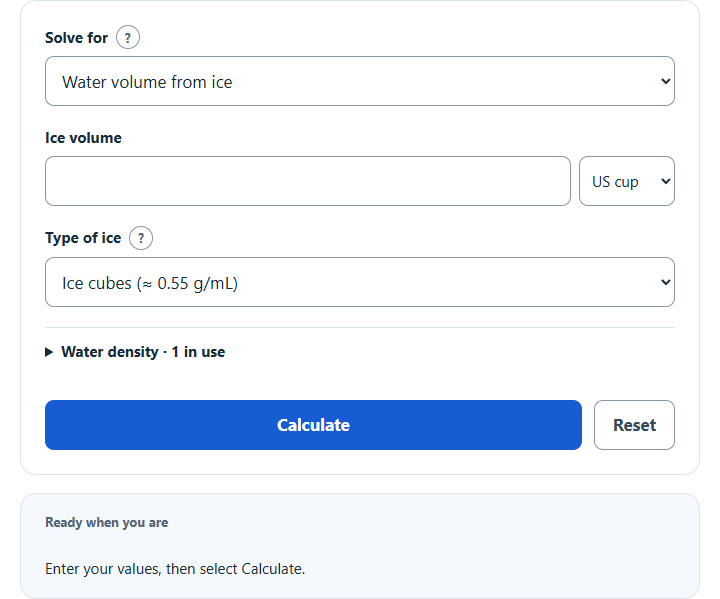
Convert ice to water: enter cups, mL or gallons of ice cubes, crushed or solid ice to estimate the melted water volume, or find the ice from water.
- All Unit Converters
- Water Volume Calculator
- Liquid Volume Calculator
- Frozen Water Expansion Calculator
- Ice Weight Calculator
- Water Mass Calculator
Water Volume from Ice Volume Formula
The following formula is used to calculate the Water Volume from Ice Volume.
- Where WV is the Water Volume from Ice Volume (in3)
- IV is the ice volume (in3)
Multiply ice volume by ice density divided by water density. For solid ice, 0.917 g/mL and 1 g/mL give WV = IV × 0.917; loose ice cubes (about 0.55 g/mL with air gaps) give roughly WV = IV × 0.55.
| Ice Volume (mL) | Water Volume (mL) |
|---|---|
| 15 | 13.755 |
| 30 | 27.510 |
| 45 | 41.265 |
| 59 | 54.103 |
| 60 | 55.020 |
| 90 | 82.530 |
| 118 | 108.206 |
| 120 | 110.040 |
| 150 | 137.550 |
| 177 | 162.309 |
| 180 | 165.060 |
| 200 | 183.400 |
| 237 | 217.329 |
| 240 | 220.080 |
| 300 | 275.100 |
| 355 | 325.535 |
| 473 | 433.741 |
| 500 | 458.500 |
| 946 | 867.482 |
| 1000 | 917.000 |
| * Rounded to 3 decimals. Assumes solid ice density ≈ 0.917 g/mL and water density ≈ 1.00 g/mL. Relationship: 1 mL ice → 0.917 mL water. | |
Water from ice weight
Choose Water from ice weight when you know the mass of the ice. Melting changes volume but conserves mass, provided none of the water is lost. Enter grams, kilograms, mass ounces, or pounds, and choose the water-volume unit.
Water volume (mL) = ice mass (g) ÷ water density (g/mL). Using 1 g/mL, 1 kg of ice gives about 1 L of water; 10 lb gives about 4.536 L. A 62 g piece of ice still has 62 g of water after melting. The USGS water-density reference explains why density changes with temperature and dissolved substances. The water-density setting is editable.
How much water is in a number of ice cubes?
Choose Water from cube count, enter the count, and supply the amount per cube. Cubes vary by tray and machine. For your own cubes, melt several without losing water and divide the measured water volume by the count, or weigh several and divide their mass by the count. Enter melted-water volume, not the frozen cube’s volume or the space occupied by a cup of loose cubes.
Water volume = cube count × measured melted-water volume per cube. If you use mass instead, total mass = cube count × mass per cube, then water volume = total mass ÷ water density. For example, 5 cubes that each produce 20 mL yield 100 mL, about 3.38 US fl oz.
The optional named presets use Hoshizaki IM manufacturer examples: XS 6 g, S 13 g, M 17 g, L 23 g, and XL 31 g per cube. These are estimates for those machine cube sizes, not standard household-tray sizes. Three 23 g example cubes give about 69 mL at 1 g/mL. Use a measured custom value for your own ice.
How to Calculate Water Volume from Ice Volume?
The following example problems outline how to calculate Water Volume from Ice Volume.
Example Problem #1:
- First, determine the ice volume (in3).
- The ice volume (in3) is given as 30.
- Finally, calculate the Water Volume from Ice Volume using the equation above:
WV = IV * (ice density / water density)
The values given above are inserted into the equation below:
WV = 30 × 0.917 = 27.51 (in3)
Example Problem #2:
The variables needed for this problem are provided below:
ice volume (in3) = 55
Entering these values and solving gives:
WV = 55 × 0.917 = 50.435 (in3)