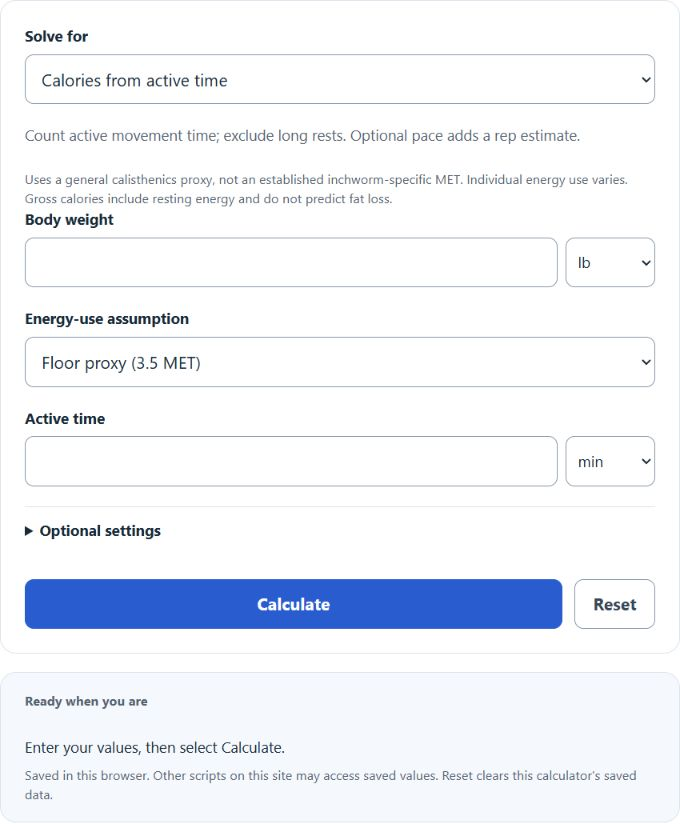
Estimate calories burned doing inchworms from your body weight and active time, or from reps and seconds per rep, using standard calisthenics MET values.
Inchworm Calories Burned Formula
Use active time and an explicitly selected MET assumption. For repetitions, first calculate minutes = reps × measured seconds per rep / 60.
Energy above standard resting expenditure uses this version:
- BW is your body weight
- Reps is your total number of inchworms
- Timing from reps requires your measured average seconds per complete rep
- The default is a general floor calisthenics proxy of 3.5 MET; custom MET is available
Inchworm Calorie Chart
Illustrative assumptions only: general floor calisthenics at 3.5 MET and 6 seconds per complete rep. Ten reps then equal one active minute. These are gross energy estimates, not measured inchworm-specific values.
| Body weight | 10 reps | 20 reps | 30 reps |
|---|---|---|---|
| 120 lb | 3.3 kcal | 6.7 kcal | 10.0 kcal |
| 150 lb | 4.2 kcal | 8.3 kcal | 12.5 kcal |
| 180 lb | 5.0 kcal | 10.0 kcal | 15.0 kcal |
| 210 lb | 5.8 kcal | 11.7 kcal | 17.5 kcal |
What Is the Inchworm Exercise?
The inchworm is a bodyweight movement that starts from standing, folds forward, walks the hands out to a plank, then walks the feet back in. It is commonly used in warm-ups, conditioning circuits, and mobility work because each rep trains the shoulders, chest, core, hamstrings, calves, and hip mobility at the same time.
- Primary movement pattern: hip hinge to plank and back
- Main areas involved: shoulders, chest, core, hamstrings, calves
- Pace varies: time your own complete reps
- Best uses: warm-ups, bodyweight conditioning, mobility circuits
Example Calculation
For illustration, 150 lb = 68.0388555 kg. At the 3.5 MET general-floor proxy and 6 seconds per rep, 20 reps take 2 active minutes:
That is approximately 8.3 gross kcal and 6.0 kcal above standard resting expenditure. Individual expenditure varies; these figures do not predict fat loss.