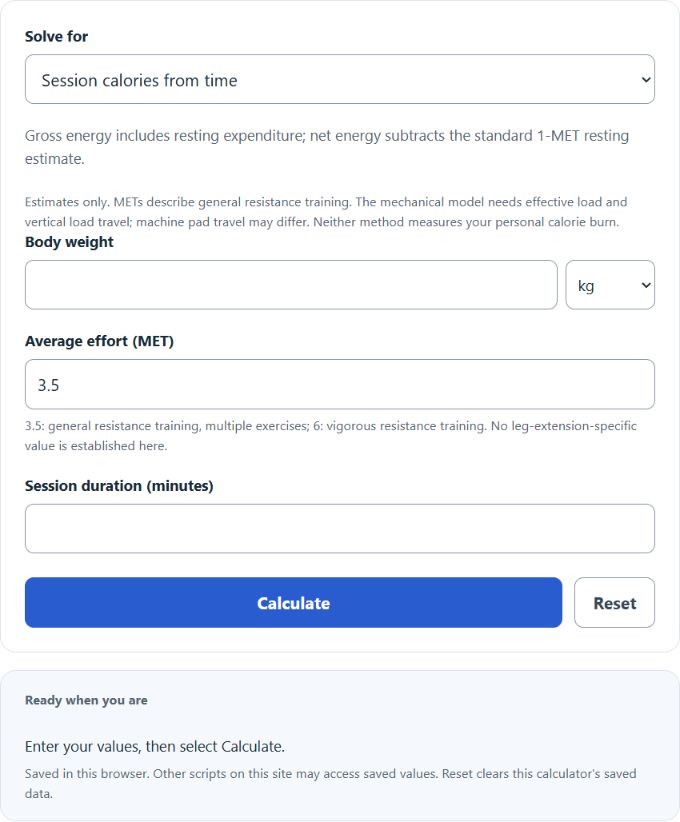
Estimate calories burned on the leg extension machine from your body weight and workout time, using a standard MET value for resistance training.
Leg Extension Energy Models
The session model uses gross kcal = MET × 3.5 × body weight (kg) ÷ 200 × minutes. Net energy uses MET minus 1. The 2024 Adult Compendium lists 3.5 MET for multiple resistance exercises and 6 MET for vigorous resistance training; neither is a leg-extension-specific measurement. The separate mechanical model below retains an editable 18-inch vertical-load-rise assumption.
Use effective moving mass and its vertical rise, accounting for the machine mechanism. An ankle-pad arc or the number printed on a weight stack may not describe the actual load-motion product. Efficiency and lowering allowance are explicit editable assumptions; blank values use 20% and 10%. This model excludes rest, setup and other body movement.
- E = modeled metabolic energy (kcal), not measured whole-session calories
- m = effective moving mass (kg); W = its equivalent in pounds
- R = total repetitions; η = assumed positive-work efficiency (%); a = extra lowering energy (%)
- d = vertical load rise (m); D = the same rise in feet
Example: 100 lb effective load, 10 repetitions and 18 inches vertical rise at the stated 20%/10% assumptions give approximately 2.67 kcal in the mechanical model. Do not add this to the separate MET session estimate.
Mechanical Model Energy Per 10 Reps
| Loaded Weight | Model kcal for 10 Reps | Model kcal per Rep |
|---|---|---|
| 50 lb | 1.34 | 0.134 |
| 100 lb | 2.67 | 0.267 |
| 150 lb | 4.01 | 0.401 |
| 200 lb | 5.35 | 0.535 |
What Is a Leg Extension?
The leg extension is a machine-based isolation exercise that trains knee extension. It primarily targets the quadriceps, especially the rectus femoris, vastus lateralis, vastus medialis, and vastus intermedius.
Leg Extension Quick Facts
- Main muscle group: quadriceps
- Primary joint action: knee extension
- Common training ranges: 10 to 15 reps for moderate sets, 15 to 20 reps for lighter burn sets
- At fixed assumptions, effective load, repetition count and vertical load rise increase mechanical model energy; this does not establish actual total calorie burn
- MET session estimates apply an average activity rate; mechanical estimates require the machine load-motion relationship
How to Use the Calculator
- Choose session calories, a mechanical load model, a comparison, or a target-time/repetition solve.
- Enter the fields shown for that method. For a mechanical model, use effective load and vertical load rise; sets and repetitions are whole numbers.
- Review the assumptions, then select Calculate. Open Calculation details for formulas. Target time and repetitions are model results, not workout recommendations.