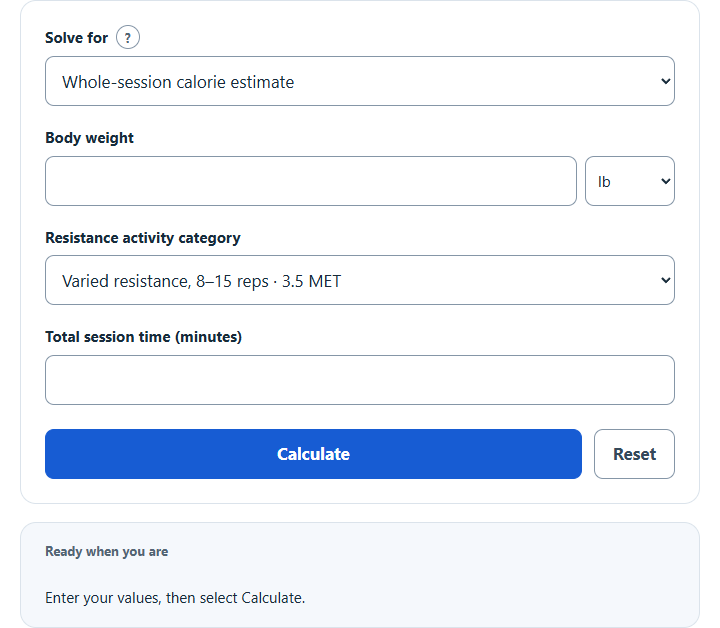
Estimate calories burned on leg day from body weight, workout time and intensity, or split lifting and rest time for a closer estimate.
How the Leg Day Workout Calorie Calculator Works
The simple workflow offers 3.5-, 5.0-, and 6.0-MET leg-training categories. The split workflow applies the chosen lifting value only to active minutes and 1.3 MET to entered standing rest.
Formula: simple kcal = selected session MET x 3.5 x kg / 200 x minutes; split kcal = active segment + 1.3-MET rest segment
What the Results Show
The primary result is the gross calorie estimate or the time required for a target. Supporting results show energy above standard 1-MET rest, gross calorie rate, the selected activity value, and substituted calculation steps. Above-standard-rest energy subtracts 1 MET, not the 1.3-MET standing-rest category.
Calculator-Specific Detail
Split and inverse modes separate assumed active lifting and standing-rest energy and report a session-average MET. Whole-session mode applies the chosen category to the full duration. A zero active share represents standing only; zero duration/target is reported explicitly.
Assumptions and Limitations
Choose the simple method only when the Compendium category reasonably represents the full entered session. Use the split method to model explicitly entered rest timing; that segmentation is a user assumption, not a validated universal leg-day protocol. The 2024 Adult Compendium covers ages 19–59 and describes population activity costs, so an individual’s result can vary with technique, conditioning, rest behavior, and equipment. Inverse time is a mathematical estimate, not a workout recommendation.
Browse the complete Strength Training calorie calculator collection or return to the Sports & Fitness Calculators hub.
Sources
2024 Adult Compendium of Physical Activities: Conditioning Exercise codes 02054 (3.5 MET), 02052 (5 MET), 02050 (6 MET), and Inactivity code 07040 (standing quietly, 1.3 MET).
Herrmann, Willis, Ainsworth, et al. 2024 Adult Compendium of Physical Activities: A third update of the energy costs of human activities. Journal of Sport and Health Science, 2024.