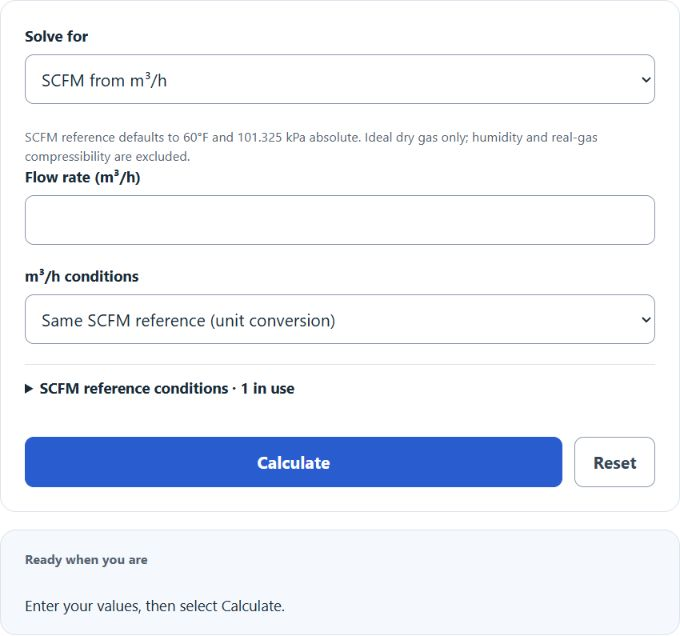
Convert between m³/h and SCFM in either direction, choosing matching reference conditions or an ideal-gas pressure and temperature correction. Also view equivalent ft³/h, L/s and L/min at the metric-flow conditions.
Quick Overview: m³/h to scfm
To convert cubic meters per hour to standard cubic feet per minute, use:
scfm = m³/h × 35.3147 ÷ 60 ≈ m³/h × 0.5886
- 1 m³/h ≈ 0.59 scfm
- 10 m³/h ≈ 5.89 scfm
- 50 m³/h ≈ 29.43 scfm
- 100 m³/h ≈ 58.86 scfm
This conversion is based on the fixed relationship between cubic meters and cubic feet and the time conversion from hours to minutes. The fixed factor applies only when both flow volumes refer to identical conditions. Select Normal, Standard metric or Actual for an ideal dry-gas correction.
- SCCM Calculator
- cfm to rpm Converter
- cfm to btu Converter
- CC/REV to GPM Calculator
- All Unit Converters
m³/h to scfm Formula
The following unit-only formula applies when the m³/h flow uses the same temperature and absolute pressure as the SCFM reference. For different conditions, multiply this factor by (P / Pref) × (Tref / T), using absolute pressure and kelvin. The calculator defaults to 60°F and 101.325 kPa absolute; alternative references are available.
The inverse form of the equation is:
Variables:
- SCFM is the standard cubic feet per minute
- m³/h is the flow rate in cubic meters per hour
- 35.3147 converts cubic meters to cubic feet
- 60 converts hours to minutes
To calculate scfm, multiply the flow rate in m³/h by 35.3147 and then divide by 60. This simplifies to an approximate factor of 0.5886, so 1 m³/h is approximately equal to 0.5886 scfm.
What is m³/h to scfm Conversion?
Converting m³/h to scfm is a common task in process engineering, compressed air systems, gas handling, and HVAC design. Equipment specifications and datasheets may use either SI or imperial flow units, so understanding the conversion makes it easier to compare capacities, size components, and verify operating conditions. Because the conversion is based on volume and time, it is geometric in nature when the same standard conditions are assumed.
In many applications, scfm refers to cubic feet per minute measured at agreed standard conditions such as 14.7 psia and 60°F. Under those same standard conditions, the m³/h to scfm factor is the same regardless of whether the medium is air, nitrogen, oxygen, natural gas, or steam.
How to Calculate m³/h to scfm?
For the steps, example and table below, assume both flow volumes use identical reference conditions. Otherwise select the appropriate metric-flow basis, enter actual gas conditions if needed, and select Calculate; the calculator applies the ideal dry-gas correction.
- First, determine the flow rate in cubic meters per hour (m³/h).
- Next, multiply the value by 35.3147 to convert cubic meters to cubic feet.
- Then, divide the result by 60 to convert hours to minutes.
- Finally, the result is the equivalent flow rate in scfm.
Example Problem :
Use the following variables as an example problem to test your knowledge.
Flow Rate = 100 m³/h
SCFM = (100 × 35.3147) ÷ 60 = 58.86 scfm
m³/h to scfm Conversion Table
The table below lists example conversions using the formula scfm = m³/h × 35.3147 ÷ 60, with results rounded to two decimal places.
| Flow (m³/h) | Factor to scfm | Flow in scfm |
|---|---|---|
| 10 m³/h | × 0.5886 | 5.89 scfm |
| 25 m³/h | × 0.5886 | 14.71 scfm |
| 50 m³/h | × 0.5886 | 29.43 scfm |
| 100 m³/h | × 0.5886 | 58.86 scfm |
| 250 m³/h | × 0.5886 | 147.14 scfm |
| 500 m³/h | × 0.5886 | 294.29 scfm |
| 1000 m³/h | × 0.5886 | 588.58 scfm |
In practice, manufacturers may specify compressors, blowers, piping systems, and gas handling equipment in either m³/h or scfm depending on the region or industry standard. Use the 0.5886 factor only for matching reference conditions. Check temperature, absolute pressure and dry-gas basis before comparing ratings from different sources.