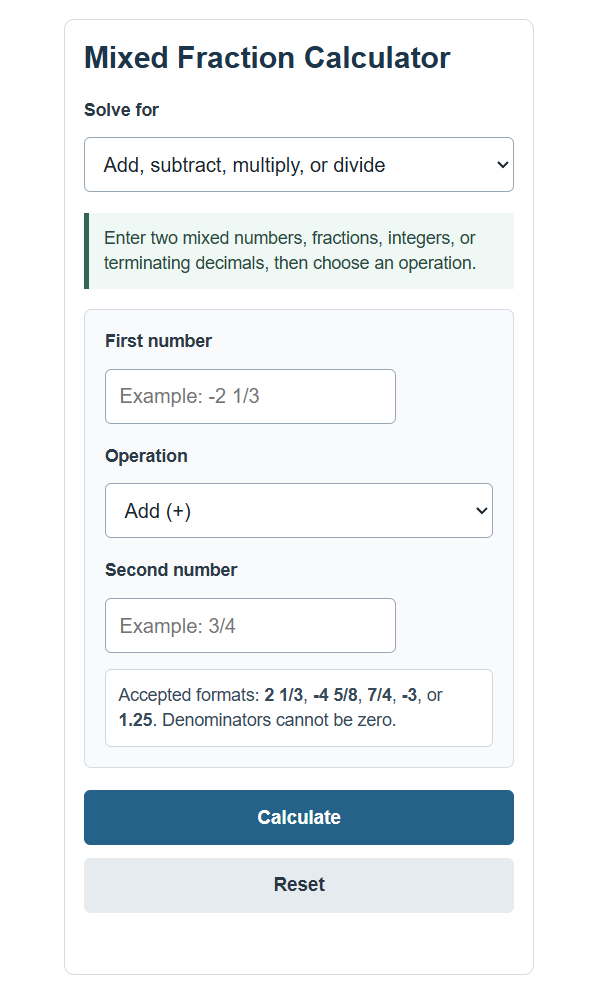
Calculate with mixed fractions by adding, subtracting, multiplying, dividing, simplifying, or converting them to improper fractions and decimals.
- All Math & Numbers Calculators
- Comparing Calculator
- Fraction To Percent Calculator
- Add Time Calculator – Add & Subtract Hours and Minutes
- Mixed Number Calculator
- Equivalent Fractions Calculator
- Remainder Calculator
Mixed Fraction Formula
A mixed fraction (or mixed number) is written as a whole number next to a proper fraction, such as 2 3/4. Before you can add, subtract, multiply, or divide mixed fractions, each one is converted to an improper fraction using the formula below.
I = (W * D + N) / D
- I is the improper fraction (numerator over the same denominator D).
- W is the whole number part of the mixed fraction.
- N is the numerator of the fraction part.
- D is the denominator of the fraction part.
Once both values are improper fractions, the operation is applied with these rules:
Add/Subtract: a/b +/- c/d = (a*d +/- c*b) / (b*d)
Multiply: a/b * c/d = (a*c) / (b*d)
Divide: a/b / c/d = (a*d) / (b*c)
The calculator converts each mixed fraction to an improper fraction, performs the chosen operation, divides the numerator and denominator by their greatest common divisor to simplify, and then converts the result back to a mixed fraction when the numerator is larger than the denominator. The simplify mode reduces a single number to lowest terms and shows it as an improper fraction and a decimal, while the compare mode reports which of two mixed fractions is larger by comparing their decimal values.
Mixed to Improper Fraction Reference
This table shows how common mixed fractions convert to improper fractions and decimals so you can sanity check a result.
| Mixed Fraction | Improper Fraction | Decimal |
|---|---|---|
| 1 1/2 | 3/2 | 1.5 |
| 2 3/4 | 11/4 | 2.75 |
| 3 1/3 | 10/3 | 3.333 |
| 5 2/5 | 27/5 | 5.4 |
| 4 7/8 | 39/8 | 4.875 |
Operation Quick Rules
| Operation | What to do after converting to improper fractions |
|---|---|
| Add | Find a common denominator, add the numerators, then simplify. |
| Subtract | Find a common denominator, subtract the numerators, then simplify. |
| Multiply | Multiply the numerators and multiply the denominators, then simplify. |
| Divide | Flip the second fraction and multiply, then simplify. |
Example Problems
Example 1: Add 2 1/2 and 1 3/4.
Convert each to an improper fraction: 2 1/2 becomes (2 * 2 + 1) / 2 = 5/2, and 1 3/4 becomes (1 * 4 + 3) / 4 = 7/4. Use the common denominator 4: 5/2 = 10/4, so 10/4 + 7/4 = 17/4. Convert back to a mixed fraction: 17/4 = 4 1/4.
Example 2: Multiply 1 1/3 by 2 1/2.
Convert each to an improper fraction: 1 1/3 becomes (1 * 3 + 1) / 3 = 4/3, and 2 1/2 becomes (2 * 2 + 1) / 2 = 5/2. Multiply across: (4 * 5) / (3 * 2) = 20/6. Simplify by dividing by the greatest common divisor 2: 10/3. Convert back to a mixed fraction: 10/3 = 3 1/3.
FAQ
What is the difference between a mixed fraction and an improper fraction?
A mixed fraction has a whole number written next to a proper fraction, such as 3 1/2. An improper fraction writes the same value with a numerator larger than its denominator, such as 7/2. They represent the same amount, and the calculator converts between the two forms for you.
How do you simplify the answer?
Divide both the numerator and the denominator by their greatest common divisor. For example, 20/6 has a greatest common divisor of 2, so it reduces to 10/3. The calculator does this step automatically so every result is shown in lowest terms.
Can the calculator handle negative mixed fractions?
Yes. Enter a negative whole number to make the entire mixed fraction negative. The sign is applied to the converted improper fraction before the operation runs, so subtraction and division with negative values return the correct result.