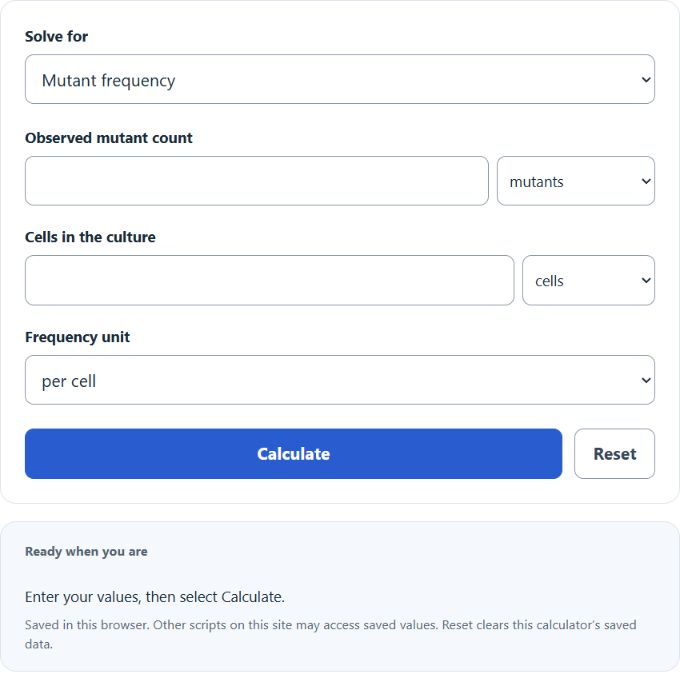
Calculate mutation frequency, mutant count, or cells per culture from any two values, and estimate Poisson probabilities from cells and mutant frequency under a simple rare-event approximation; this does not estimate a mutation rate per generation.
Related Calculators
- HWE Calculator
- Evolution Index Calculator
- Recombination Frequency Calculator
- Genetic Linkage Distance
- All Biology Calculators
Mutation Frequency (Mutant Fraction) Formula
The following two example problems outline the steps and information needed to calculate the mutation frequency (mutant fraction) from a simple count ratio.
- Where MF is the mutation frequency (mutants per cell; a dimensionless fraction)
- m is the number of mutants observed (e.g., mutant colonies/cells counted)
- N is the number of cells per culture
To calculate the mutation frequency, divide the number of mutants observed by the number of cells per culture.
How to Calculate Mutation Frequency?
The following example problems outline how to calculate mutation frequency.
Example Problem #1:
- First, determine the number of mutants observed.
- The number of mutants observed is given as 100.
- Next, determine the number of cells per culture.
- The number of cells per culture is provided as 6,000.
- Finally, calculate the mutation frequency using the equation above:
MF = m/N
The values provided above are inserted into the equation below and computed.
MF = 100/6,000 = 0.0167 (mutants per cell)
Example Problem #2:
For this problem, the variables required are provided below:
number of mutants observed = 500
number of cells per culture = 1,500
Test your knowledge using the equation and check your answer with the calculator.
MF = m/N = ?