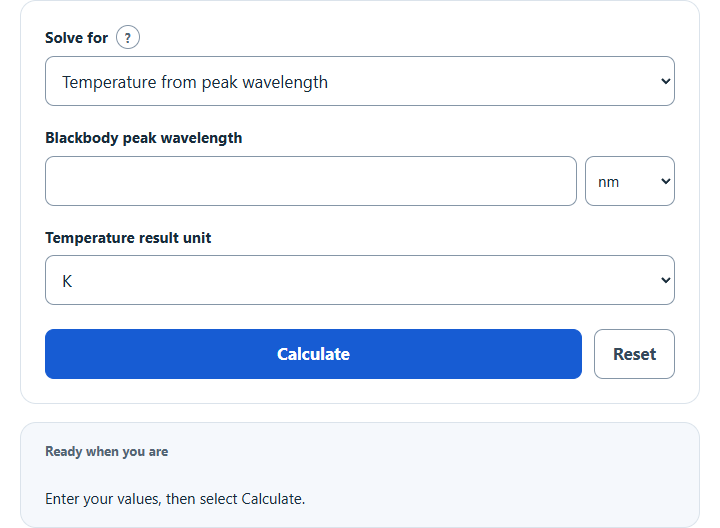
Convert a peak wavelength in nm to temperature in kelvin with Wien’s law, or find the peak wavelength from a temperature in K, °C or °F.
- All Physics Calculators
- Color Temperature Calculator
- Wavelength to Energy Calculator
- Energy to Wavelength Calculator
- Hertz to nm Calculator
- Frequency to Energy Calculator
Calculator Functions
| Function | What it does | What it requires |
|---|---|---|
| Temperature from peak wavelength | Finds the temperature of a blackbody from the wavelength where its emission peaks | Requires the peak wavelength in nm, μm or m |
| Peak wavelength from temperature | Finds the wavelength where a blackbody at a given temperature emits most strongly | Requires the temperature in K, °C or °F, above absolute zero |
The temperature result can be shown in K, °C or °F and the wavelength result in nm, μm or m. Each result also shows the temperature in kelvin.
nm to Temperature Formulas
| T | Blackbody temperature (K) |
| b | Wien wavelength displacement constant, taken as 2,898,000 nm·K |
| λ | Wavelength of peak emission (nm) |
This is Wien's displacement law: the peak wavelength times the temperature is a constant, so a hotter body peaks at a shorter wavelength. The exact constant is 2.897771955 × 10⁻³ m·K, or about 2,897,772 nm·K [1]. The calculator rounds it to 2,898,000, which makes its answers 0.008% higher than the exact constant would.
Temperature from peak wavelength
The formula above applies directly. A peak at 500 nm gives 2,898,000 ÷ 500 = 5,796 K, which is 5,522.85 °C. A wavelength in micrometers is multiplied by 1,000 first, so a 1 μm peak gives 2,898 K. Results in other units use °C = K − 273.15 and °F = (K − 273.15) × 9 ÷ 5 + 32.
Peak wavelength from temperature
This is the main formula rearranged. A body at 5,800 K peaks at 2,898,000 ÷ 5,800 = 499.66 nm, in visible light. A body at 20 °C is at 293.15 K and peaks at 9,885.72 nm, or 9.89 μm, in the infrared. A temperature at or below absolute zero is rejected.
Limits of This Estimate
- The law describes a blackbody, an ideal emitter. A laser line, an LED color or a single emission line has a wavelength but no temperature of this kind, so a wavelength from one of those gives a meaningless result.
- The peak is that of a spectrum plotted per unit wavelength. The same body plotted per unit frequency peaks at a different place, with a different constant.
- Real surfaces are not perfect blackbodies, so a temperature taken from a measured peak is an approximation.
Sources
- National Institute of Standards and Technology, CODATA Value: Wien wavelength displacement law constant: the constant b and its exact value