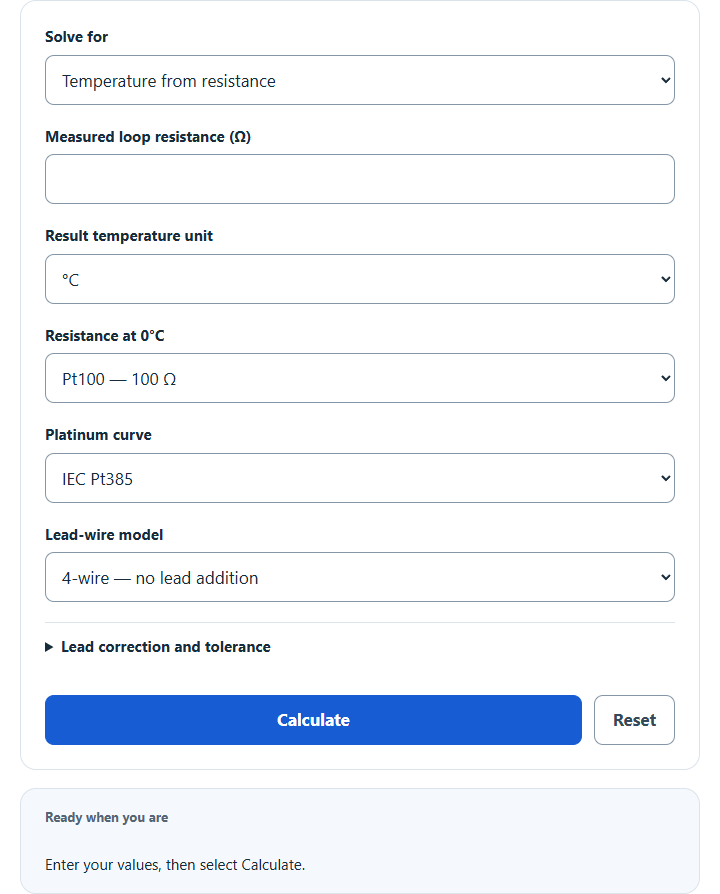
Convert ohms to temperature for a Pt100, Pt500 or Pt1000 RTD: enter the measured resistance to get °C or °F, or find the resistance at a given temperature.
Related Calculators
- Absolute Temperature Calculator
- Ohm’s Law Calculator
- Btu To Watts Calculator
- Current To Energy Calculator
- Amps To Electrons Per Second Calculator
- All Unit Converters
Ohms To Temperature Formula
This calculator models platinum RTDs, not NTC thermistors. The Callendar–Van Dusen equation relates element resistance R(t) to temperature t in °C.
- t is temperature in °C; the widget also converts °F and K.
- R₀ is element resistance at 0°C: 100, 500, 1,000 Ω, or a custom value.
- For IEC Pt385: A = 3.9083 × 10⁻³, B = −5.775 × 10⁻⁷ and C = −4.183 × 10⁻¹².
- R(t) is RTD element resistance in ohms, after subtracting the modeled lead contribution.
- The explicitly named Pt3926 curve uses A = 3.9848 × 10⁻³, B = −5.87 × 10⁻⁷ and C = −4 × 10⁻¹²; IEC tolerance classification is not inferred for this curve.
For inverse conversion, the widget solves this monotonic equation numerically. Its model ranges are −200 to 850°C for Pt385 and a conservative −200 to 630°C for the documented Pt3926 curve; the actual sensor rating can be narrower. For two identical leads, subtract twice one lead resistance. For three-wire measurements, subtract the signed net residual specified for the actual circuit. Four-wire mode assumes ideal lead compensation.
| Resistance (Ω) | Temperature (°C) |
|---|---|
| 18.52008 | -200 |
| 60.25584 | -100 |
| 80.30628 | -50 |
| 100.00000 | 0 |
| 109.73466 | 25 |
| 119.39713 | 50 |
| 138.50550 | 100 |
| 157.32512 | 150 |
| 175.85600 | 200 |
| 212.05150 | 300 |
| 247.09200 | 400 |
| 280.97750 | 500 |
| 313.70800 | 600 |
| 345.28350 | 700 |
| 375.70400 | 800 |
| 390.48112 | 850 |
| * Nominal Pt100 element resistance rounded to five decimals; no lead addition. A table of nominal values does not establish a sensor’s temperature rating or tolerance class. | |
What is Ohms To Temperature?
Definition:
For this tool, Ohms To Temperature means inferring a platinum RTD’s temperature from its resistance, known R₀, selected curve and explicit lead correction. An NTC beta equation describes a different sensor type and must not be substituted for this RTD model.
How to Calculate Ohms To Temperature?
Example Problem:
Example: infer temperature from a four-wire IEC Pt100 reading.
Select Temperature from resistance, Pt100, IEC Pt385 and 4-wire. Enter 138.5055 Ω.
The Pt100 has R₀ = 100 Ω at 0°C. No lead addition is applied in this ideal four-wire example.
Select Calculate; the inverse gives 100°C. Check the forward substitution:
R(100) = 100[1 + 0.0039083 × 100 − 0.0000005775 × 100²]
R(100) = 138.5055 Ω
Temperature = 100°C = 212°F = 373.15 K
Reset clears this calculator’s saved calculation. Class tolerance describes a qualifying sensor’s interchangeability limit, not total installed accuracy.
FAQ
Which RTD curve should I select?
Use the curve specified by the sensor manufacturer. Pt385 and Pt3926 use different coefficients and are not interchangeable; R₀ alone does not identify the curve.
Why are R₀ and lead correction necessary?
R₀ fixes the nominal resistance scale. Two-wire leads add resistance; three-wire residual error depends on circuit balance. Four-wire mode assumes ideal lead compensation. Calibration, self-heating and instrument error remain additional effects.
Can this calculator establish sensor accuracy?
No. It models platinum RTDs only. IEC AA/A/B/C estimates are shown only within the selected construction’s supported range for a qualifying Pt385 sensor. AA/A thermometer conformity requires three- or four-wire measurement. Custom R₀ and Pt3926 do not establish an IEC class.