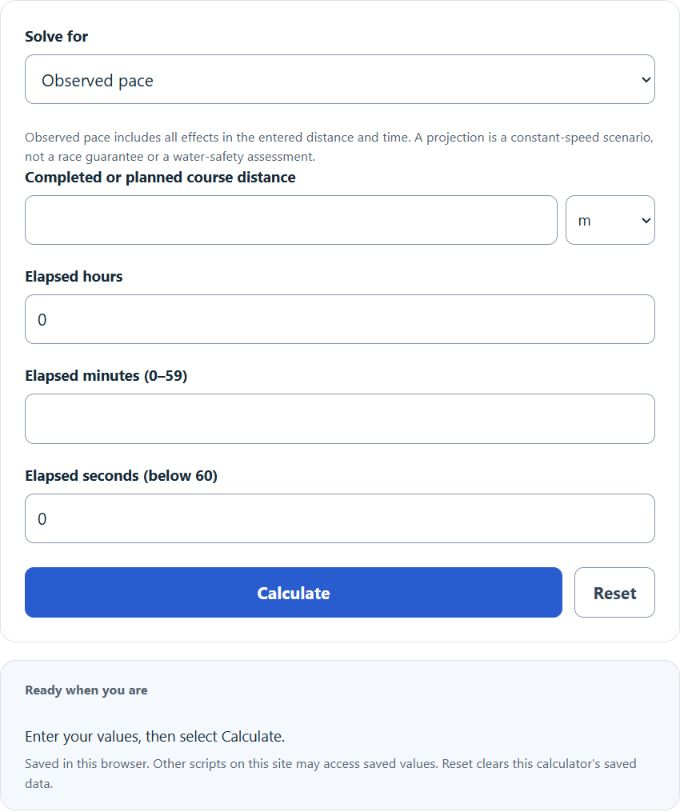
Calculate observed open-water pace or build a transparent finish-time scenario from still-water pace, navigation distance, current, and sighting delay.
How the Open Water Pace Calculator Works
The observed mode converts completed distance to meters, divides by elapsed time for speed, and then reports pace per 100 meters and 100 yards. Use the distance represented by the elapsed time: nominal course distance and a GPS-tracked actual path answer different pace questions. The projection mode starts with still-water speed and applies only the scenario adjustments entered. One yard is exactly 0.9144 meters, one mile is 1,609.344 meters, and one knot is 1,852 meters per hour.
| Scenario input | Effect in the model | Default |
|---|---|---|
| Extra navigation distance (%) | Increases the effective distance | 0% |
| Aiding or opposing current | Adds to or subtracts from still-water speed | None, 0 m/s |
| Total sighting delay (s) | Adds directly after moving time | 0 s |
Current model
The advanced current option assumes a constant flow exactly parallel to the entire effective path. Ground speed equals still-water speed plus aiding current or minus opposing current; nonpositive ground speed is rejected. Finish time equals course distance multiplied by (1 + navigation percentage / 100), divided by ground speed, plus total sighting delay. Return legs, cross-current steering, changing tides, waves, wind and drafting need a different or leg-by-leg model. This is not a route-safety assessment.
Navigation and sighting
Extra navigation distance represents a longer actual path than the nominal course. Sighting delay is entered separately so its effect remains visible instead of being hidden in a single adjustment percentage.
Sources
Sources: NOAA National Ocean Service, What Is a Current? and Currents Tutorial; National Institute of Standards and Technology, SP 811 conversion factors, current editions.