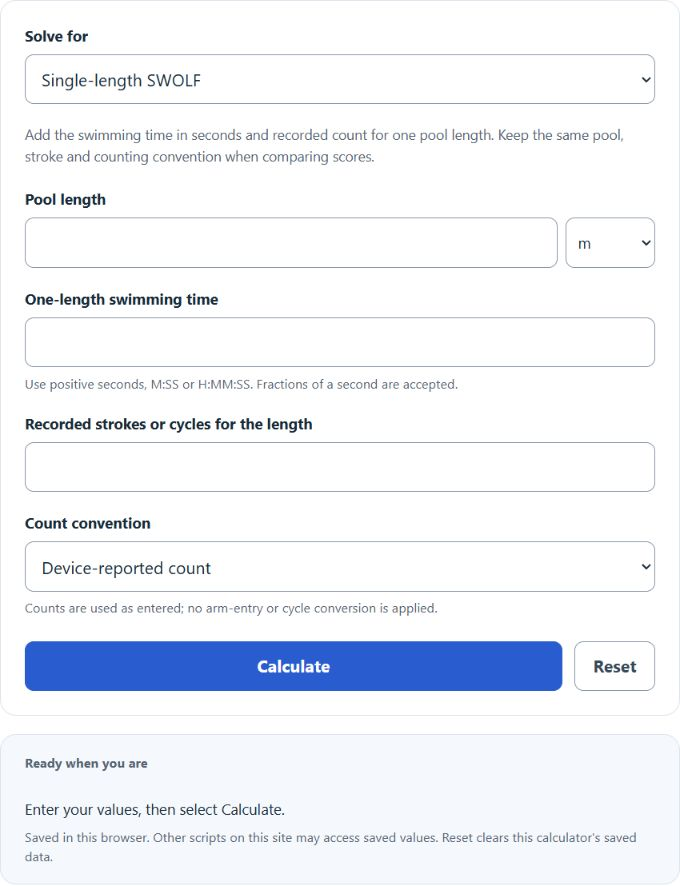
Calculate a SWOLF score for one pool length or average a complete interval while keeping pool length and stroke-count convention explicit.
How the SWOLF Calculator Works
SWOLF combines elapsed seconds and a consistently recorded stroke or stroke-cycle count. For one length, add the two values. For a multi-length interval, add the swimming-time and recorded-count totals and divide by completed lengths. Exclude rest time when comparing with a swim-only device score. Enter a positive time as seconds, M:SS or H:MM:SS, with optional fractional seconds. Colon seconds must be below 60, and colon minutes must be below 60 when hours are present. Leading minutes or hours are not capped at 24 hours; the parsed time and derived results must remain finite. Recorded counts may be zero but must be nonnegative whole numbers; completed lengths must be positive whole numbers. Counts and length counts are limited to safely representable integers, at most 9,007,199,254,740,991.
| Result | Calculation | Best use |
|---|---|---|
| Single-length SWOLF | Length seconds + recorded count | Quick repeat comparison in one pool |
| Average interval SWOLF | (Total seconds + total count) / lengths | Smoothing variation across a set |
| Distance | Pool length × completed lengths | Confirming the interval entered |
How to compare scores
Keep the pool length, stroke, equipment, and counting method the same. A lower value can reflect less time, fewer recorded strokes, or both, but it does not by itself explain why a swim changed.
Example
An eight-length interval completed in 240 seconds with 120 recorded counts averages 30 seconds and 15 counts per length. The average SWOLF is 45.
Sources
Sources: Garmin Swim 2 owner’s manual, Swim Terminology (length, interval, watch-arm stroke count and SWOLF) and Data Fields (average interval SWOLF and swim time excluding rest); accessed October 23, 2026. The interval calculation is the arithmetic mean from totals covering the same completed lengths, before display rounding; it does not reproduce undocumented device rounding or count-detection behavior.