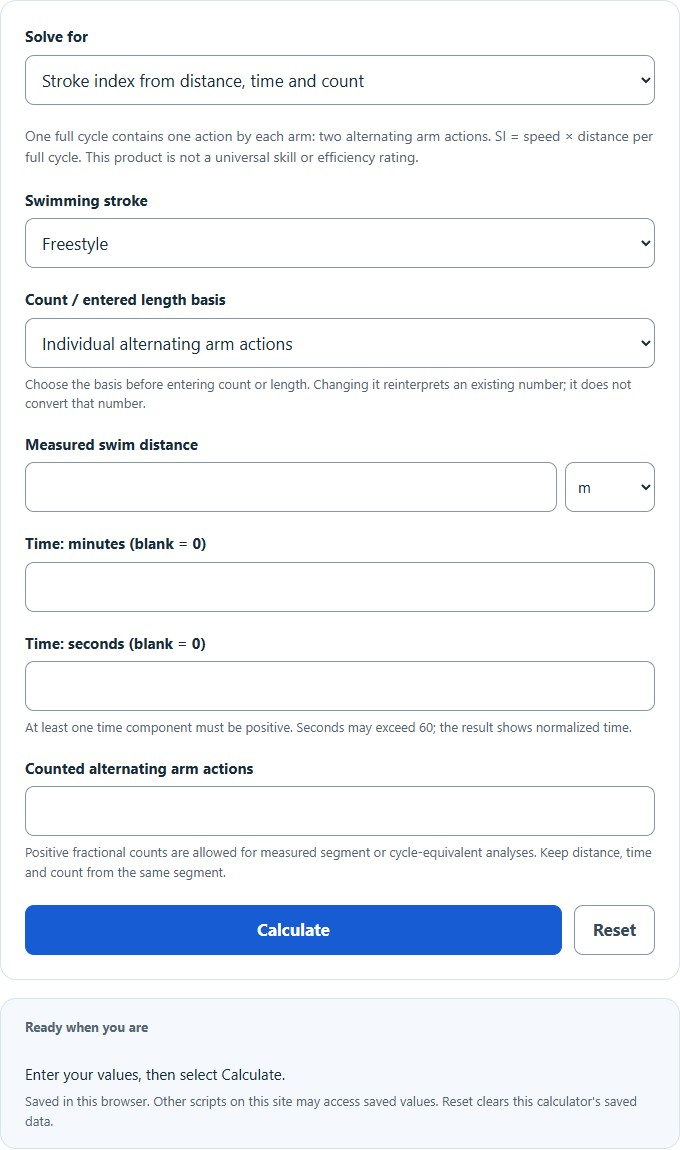
Calculate swim stroke index from distance, time and a consistent count, or from speed and length. Target mode finds required full-cycle length and exact continuous/whole-count bounds; it does not guarantee physical attainability.
Swim Stroke Index Formula
SI = v * DPS * M
v = D / T
DPS = D / N
- SI is the stroke index in meters squared per second (m²/s)
- v is the average swimming speed in meters per second (m/s)
- DPS is distance per counted action or cycle in meters; multiplying by M converts it to distance per full stroke cycle
- M is 2 for alternating freestyle/backstroke arm-action counts and 1 for full-cycle counts. In breaststroke/butterfly, one simultaneous paired-arm action is one cycle, not two separately counted hands.
- D is the swim distance in meters (m)
- T is the swim time in seconds (s)
- N is the positive count from the same measured segment. Fractional cycle-equivalent counts may be appropriate for segment analysis; the convention must be explicit.
All three modes use the academic definition SI = speed × distance per full stroke cycle; see the stroke-length and index equations in the research study. Swim mode converts the count to full-cycle equivalents, while direct mode converts the entered length basis. Target mode uses full-cycle length = SI / speed. It reports an exact continuous cycle bound, its whole-cycle floor and, for alternating strokes, the independent floor of twice that bound for whole arm actions with partial-cycle endpoints. A floor of zero means no positive whole-cycle budget, not an instruction to take zero cycles. Blank time components mean 0; their total must be positive. Seconds above 60 are normalized. Yards convert exactly to meters, while pace remains per 100 of the input distance unit.
Vendor-Reported Stroke Index Observations
The retained values below are reported in TritonWear’s stroke-index analysis. They are contextual vendor observations, not universal population norms, elite cutoffs or a grading scale for this calculator. Results depend on the swimmer, stroke, distance and measurement protocol; the original swimming research also distinguishes such conditions. The arithmetic here uses full cycles and SI units of m²/s.
| Stroke | Reported low | Reported average | Reported high | Cycle multiplier |
|---|---|---|---|---|
| Freestyle | 1.22 | 3.06 | 4.87 | 2 |
| Backstroke | 1.17 | 2.89 | 4.70 | 2 |
| Breaststroke | 0.94 | 2.15 | 3.34 | 1 |
| Butterfly | 1.31 | 2.51 | 3.76 | 1 |
TritonWear’s cited 2017 World Championships analysis reported SI 4.74 for the first 50 m of Caeleb Dressel’s 100 m butterfly and 6.00 for the first 50 m of Sun Yang’s 400 m freestyle; its Lilly King breaststroke example reported 2.79. These are specific vendor race/segment analyses, not whole-race or universal elite benchmarks. The article discusses the interaction of speed, cycle length and cycle rate rather than a rule to maximize SI.
The grid below is a quick lookup for freestyle in a 25-meter pool. Find your usual arm strokes per length and your pace per 100 meters, and read off the stroke index the formula produces. It assumes even pacing and ignores the push-off distance, so treat it as a comparison grid rather than a lab measurement.
| Arm strokes per 25 m | 1:10 /100 m | 1:20 /100 m | 1:30 /100 m | 1:45 /100 m | 2:00 /100 m |
|---|---|---|---|---|---|
| 14 | 5.10 | 4.46 | 3.97 | 3.40 | 2.98 |
| 16 | 4.46 | 3.91 | 3.47 | 2.98 | 2.60 |
| 18 | 3.97 | 3.47 | 3.09 | 2.65 | 2.31 |
| 20 | 3.57 | 3.13 | 2.78 | 2.38 | 2.08 |
| 22 | 3.25 | 2.84 | 2.53 | 2.16 | 1.89 |
Example Problems
Example 1. For 100 m freestyle in 1:30 with 64 alternating arm actions, speed is 100 / 90 ≈ 1.1111 m/s and the count is 32 full cycles. Cycle length is 100 / 32 = 3.125 m. Using the unrounded quantities gives SI = 125 / 36 ≈ 3.4722 m²/s. No universal competitive ranking follows from this value.
Example 2. For 50 m butterfly in 35 seconds with 22 simultaneous paired-arm actions, the count is 22 full cycles. Speed is 50 / 35 ≈ 1.4286 m/s and cycle length is 50 / 22 ≈ 2.2727 m. The unrounded product gives SI = 250 / 77 ≈ 3.2468 m²/s. The two hands in each paired action are not counted separately.
Frequently Asked Questions
What is a good stroke index? There is no universal cutoff established here. The vendor observations above are contextual examples. Compare consistently measured swims at a comparable pace, distance, stroke and counting convention; a larger product alone does not prove improved metabolic efficiency, technique or race performance.
Should I count arm actions or full cycles? For freestyle/backstroke, two alternating arm actions form one full cycle. For breaststroke/butterfly, one simultaneous paired-arm action is one cycle; the vendor’s convention guide explains that distinction. Device conventions vary: this Garmin manual counts a stroke when the device arm completes a full cycle. Check the actual device/manual and use matching distance, time and counts. Changing the calculator’s basis reinterprets an existing count or length; it does not convert that number automatically.
Is a higher stroke index always better? No universal optimum follows from SI. Speed, cycle length and rate interact, and changing one may change the others. Target-mode count bounds assume the entered speed stays fixed; fewer modeled cycles do not guarantee that speed can be maintained. A sub-cycle continuous bound can still describe a fractional segment, while a whole-cycle count of at least one may be impossible at the requested target.