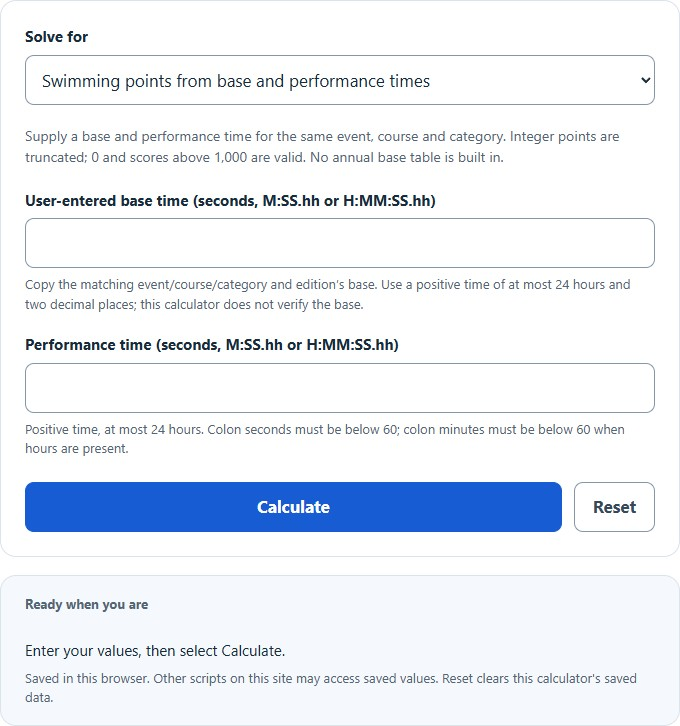
Calculate a cubic swimming-points score from a base time you supply, or find the slowest hundredth that earns at least a target score.
How the Swimming Points Calculator Works
This calculator compares a performance time with a base time for the same course, event, and category. It does not include an annual base-time table. You supply the current value from the source governing your comparison, which keeps the calculation useful without freezing an expiring dataset into the page.
Swimming Points Formula
Points = floor(1,000 × base time³ ÷ performance time³). Equal times produce 1,000 points. A faster performance produces more than 1,000, while a slower performance produces fewer. The official-style integer is truncated rather than rounded.
The calculator parses both times as integer centiseconds and evaluates the cubic fraction with BigInt arithmetic. This preserves integer precision and avoids a floating-point boundary changing the final point.
| Base time | Performance time | Points | Interpretation |
|---|---|---|---|
| 46.40 | 46.40 | 1,000 | Matches base |
| 46.40 | 50.00 | 799 | Slower than base |
| 46.40 | 45.00 | 1,096 | Faster than base |
| 23.61 | 25.00 | 842 | Different event-scale example |
Choosing the Correct Base Time
Match every dimension of the performance: pool course, event distance, stroke, relay or individual status, category, and the table's validity period. A base time copied from another course or event can generate a precise-looking but meaningless score. Enter each input time as seconds, M:SS.hh or H:MM:SS.hh with at most two decimal places, positive and no longer than 24 hours. Colon seconds must be below 60, and colon minutes must be below 60 when hours are present.
Reverse Target Mode
Target mode solves the exact inequality requested points × time³ ≤ 1,000 × base time³ with an integer search. It returns the slowest positive hundredth earning at least the requested score, and proves that one hundredth slower earns fewer points. Because the final score is an integer and the time moves in hundredths, some point numbers can be skipped; the actual score at the result may exceed the target. Targets must be whole numbers from 1 to 1,000,000. If even 0.01 seconds cannot earn the target, no positive hundredth is available. A computed target time may exceed 24 hours; the 24-hour limit applies to input times. This mathematical at-least threshold is not a claim to reproduce an official published inverse procedure or target-time table.
Worked Example
With a 46.40-second base and 50.00-second performance, the calculation is floor(1,000 × 4,640³ ÷ 5,000³) = 799 points. The centisecond integers are cubed directly; the calculator does not round an intermediate decimal.
Assumptions and Limitations
The score is a mathematical comparison to the entered base time, not a race result, qualification, ranking, or guarantee that the base value is current. Annual tables and their validity periods change. Confirm the source before using the result in selection, meet, or reporting decisions.
Sources
World Aquatics, Swimming Points. The official page displays “Last updated 25/02/2026”; accessed October 23, 2026. It defines the cubic formula and current truncation convention, with annual base tables separated by event, category and SCM/LCM course. The calculator uses a base time entered by the user and does not bundle those tables.