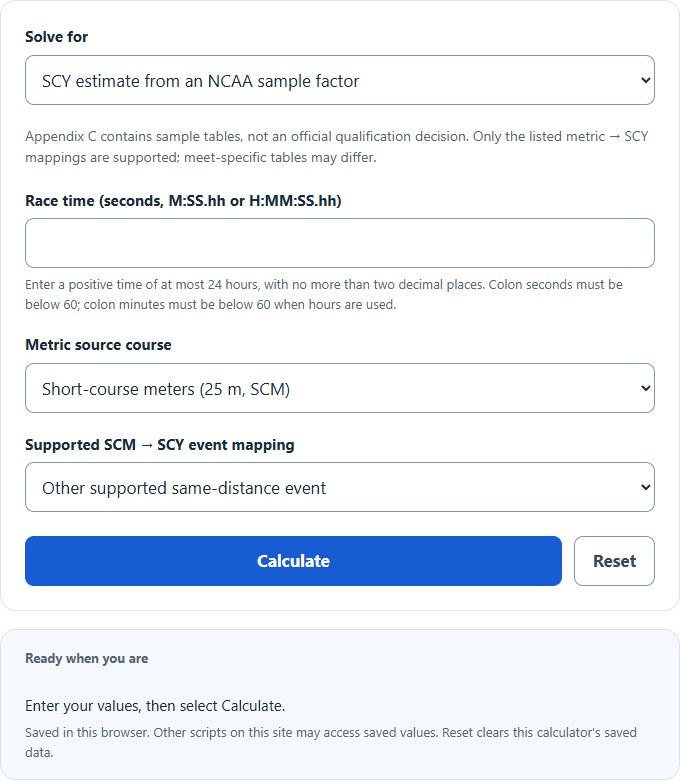
Convert a supported metric-course swim time to a short-course-yards estimate using the current NCAA Rules Book sample table, or apply a custom factor supplied by your meet or organization.
How the Swim Time Conversion Calculator Works
This calculator offers two deliberately separate workflows. The NCAA sample-table workflow estimates a short-course-yards time from a supported short-course-meters or long-course-meters performance. The custom workflow applies a factor you enter from a meet, conference, team, or governing organization.
Sample-Table Formula
SCY estimate in centiseconds = floor(metric time in centiseconds × factor numerator ÷ factor denominator). The calculator stores both the time and factor as integers, then truncates below the hundredth exactly once. This avoids a binary floating-point result changing 16:02.88 to 16:02.87.
The custom workflow instead multiplies the integer centiseconds by the exact entered decimal factor and rounds half up to the nearest hundredth exactly once. For example, 0.01 seconds × 1.5 = 0.015 seconds becomes 0.02 seconds. The factor must be greater than 0 and no greater than 10, and source and target courses must differ. Its result is only as authoritative as the direction-specific factor supplied by the user.
| Workflow | Supported direction | Factor source | Hundredth handling |
|---|---|---|---|
| NCAA sample table | SCM or LCM to SCY | 2025–26 and 2026–27 Rules Book Appendix C | Truncate |
| Custom factor | Any different SCY, SCM, or LCM pair | User-entered | Round half up to nearest hundredth |
Choosing the Inputs
Select the exact pool course, category, and event shown in the source table. Long-course 50-meter butterfly, backstroke, and breaststroke options are intentionally absent because the cited sample table does not provide them. Enter a positive race time of no more than 24 hours as seconds, minutes and seconds, or hours, minutes, and seconds, with at most two decimal places. Colon seconds must be below 60, and colon minutes must be below 60 when hours are present. The output may exceed 24 hours when a custom factor increases the time. If final hundredth handling produces 0.00 from a positive input, that is a display-resolution result, not an actual zero-duration swim.
Worked Examples
A 4:00.00 short-course-meters 400-meter time uses the 1.143 factor: floor(24,000 × 1,143 ÷ 1,000) = 27,432 centiseconds, or 4:34.32. A 2:16.71 long-course-meters men's 200 breaststroke uses 0.858 and becomes 1:57.29 after truncation.
Interpreting the Estimate
Course conversions normalize broad performance differences caused by pool length and turns; they do not recreate a swim in another pool. Starts, turns, underwater phases, pacing, meet conditions, and the conversion table selected by an organization can all change the appropriate comparison.
Assumptions and Limitations
The NCAA Rules Book describes Appendix C as sample conversion tables and notes that championship or organizer-selected factors may differ. Never use this result by itself to claim entry, seeding, qualification, a record, or an official converted time. Verify the rules and edition governing the actual meet.
Sources
NCAA Men’s and Women’s Swimming and Diving Rules Book, 2025–26 and 2026–27 edition, Appendix C sample conversion tables, printed pages 119–120; current online edition updated October 1, 2026, accessed October 23, 2026. Check the actual meet’s divisional prechampionship manual and entry instructions, because its conversion factors may differ from these sample tables.