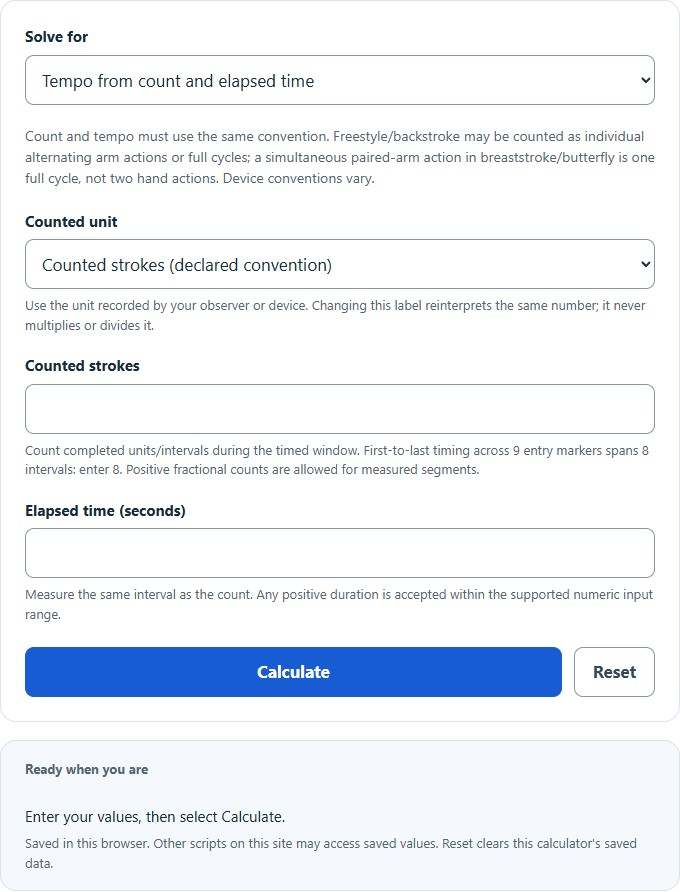
Convert counted strokes or complete cycles into tempo, find the period between counted units, or estimate pace from tempo and distance per unit.
How the Stroke Tempo Calculator Works
Tempo is a frequency: completed counted units divided by elapsed seconds, multiplied by 60. Its inverse is the number of seconds per counted unit. Match the count to the timed window: timing from the first to the last of 9 hand-entry markers spans 8 intervals, so enter 8 rather than 9. For 8 completed intervals in 7 seconds, tempo is 480 / 7 ≈ 68.5714 units/min and period is 7 / 8 = 0.875 s/unit. Positive fractional counts can describe consistently measured segments.
| Mode | Required inputs | Primary output |
|---|---|---|
| Tempo from count | Counted units and elapsed seconds | Strokes/min or cycles/min |
| Period from tempo | Tempo with explicit convention | Seconds per stroke or cycle |
| Pace estimate | Tempo and distance per counted unit | Time per 100 m or 100 yd |
Strokes and cycles are different units
For freestyle and backstroke, one full cycle contains two alternating arm actions. For breaststroke and butterfly, one simultaneous paired-arm action is one full cycle, not two separately counted hands. Device conventions vary: the Garmin manual counts a stroke when the device arm completes a full cycle. Select the unit actually recorded by your observer or device. The calculator changes labels, without silently multiplying or dividing a stroke count, tempo or length when you change the counted-unit selection.
Using the pace estimate
The distance-per-unit mode uses speed = distance per counted unit × tempo / 60, because tempo is entered per minute. Length and tempo must use the same counted unit; a per-cycle length must not be combined with a per-arm-action tempo. This is the dimensional relationship used in the original swimming study’s speed, stroke-rate and stroke-length equation. Pace is time per 100 of the selected distance unit, meters or yards; the calculator also shows speed in m/s using exactly 1 yd = 0.9144 m. Times for 50, 100 and 200 units are calculated from unrounded values, then clock displays round half up to hundredths with minute/hour carry. A positive time below the displayed hundredth uses scientific seconds. The estimate assumes constant tempo and distance per unit. Starts, walls, turns, underwater travel, drag, fatigue and technique changes can make actual swim time differ.
Sources
Sources: Stuart McDougal, High Turnover vs. the Right Turnover, U.S. Masters Swimming, June 19, 2015; the original swimming study and Garmin manufacturer manual linked above.