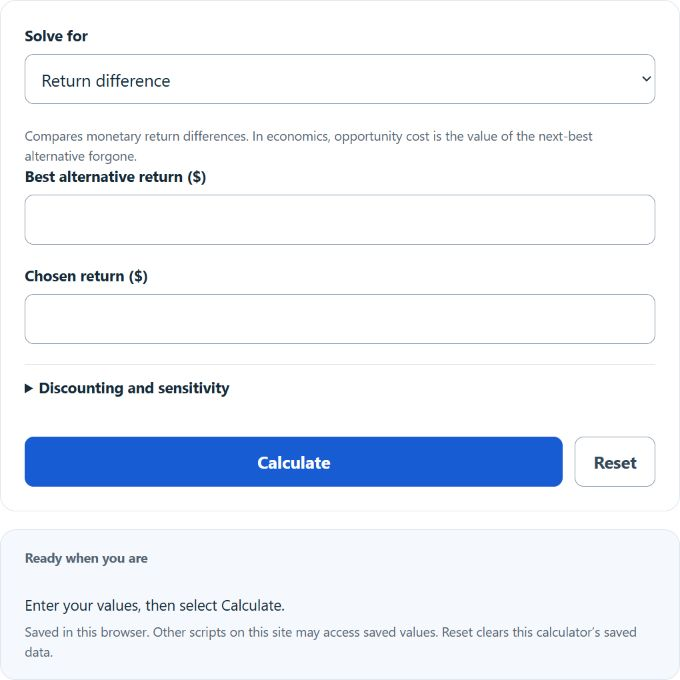
Calculate opportunity cost between two options, investments, spending, or projects using returns, fees, taxes, inflation, time horizon, NPV, and IRR.
- All Personal Finance Calculators
- All Cost Calculators
- Expected Opportunity Loss Calculator
- Cost Benefit Analysis Calculator
- Marginal Cost Calculator
- Marginal Revenue Calculator
- Economic Equilibrium Calculator
Opportunity Cost Formula
The following formula measures the monetary return disadvantage of the chosen option. In economics, opportunity cost is the value of the next-best alternative forgone, which can also include nonmonetary benefits.
- Where OC is the monetary return difference ($)
- RB is the return on the best option ($)
- RC is the return on the chosen option ($)
To calculate the opportunity cost, subtract the return of the chosen option from the return of the best option.
How to Calculate Opportunity Cost?
The following example problems outline how to calculate Opportunity Cost.
Example Problem #1:
- First, determine the return on the best option ($). The return on the best option ($) is given as 5,000.
- Next, determine the return on the chosen option ($). The return on the chosen option ($) is provided as 3,000.
- Finally, calculate the Opportunity Cost using the equation above:
OC = RB - RC
The values given above are inserted into the equation below:
OC = 5,000 - 3,000 = 2,000 ($)
Example Problem #2:
The variables needed for this problem are provided below:
return on the best option ($) = 2,500
return on the chosen option ($) = 500
Entering these values and solving gives:
OC = 2,500 - 500 = 2000 ($)