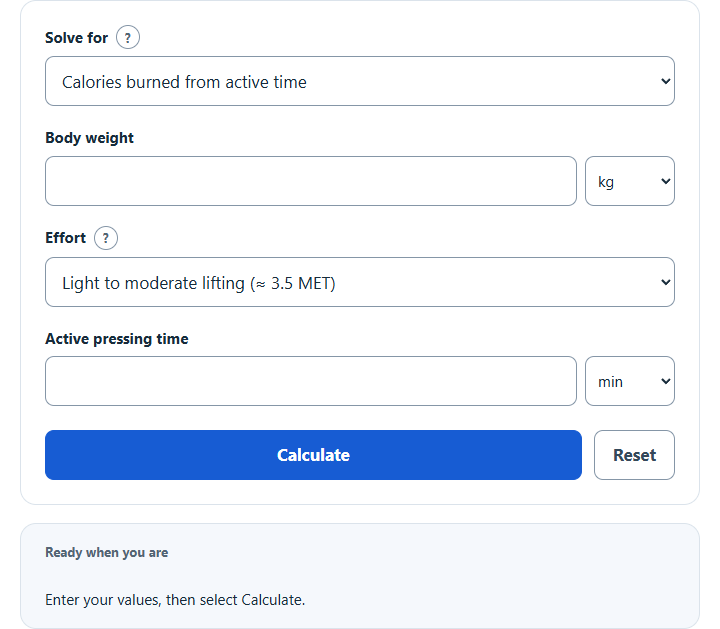
Estimate calories burned doing the overhead or shoulder press from your body weight and active time or reps, using typical MET values or your own.
Overhead Press Calories Burned Formula
The calculator uses the standard MET conversion. Pick a typical intensity or enter a custom MET; general resistance-training MET references are not measurements of a particular overhead-press variation:
- MET = assumed metabolic intensity. The Adult Compendium gives general resistance references such as 3.5 and 6 MET; neither is overhead-press-specific.
- Body mass = your body mass in kilograms, converted from pounds when selected.
- Active minutes = active pressing duration, or total repetitions divided by active repetitions per minute.
Gross energy includes the resting-energy component for the entered active interval. It is not a total workout estimate. Optional combined load and upward travel estimate training volume and positive external mechanical work; that work is not converted to metabolic calories or added to the MET estimate. Time for a calorie target is arithmetic, not a workout prescription.
Illustrative Active-Time Energy Estimates
| Active time | Gross energy at 70 kg and assumed 5 MET |
|---|---|
| 4 min | 24.5 kcal |
| 10 min | 61.25 kcal |
| 20 min | 122.5 kcal |
| 30 min | 183.75 kcal |
What Counts as Load?
- Barbell press: enter the full barbell weight.
- Dumbbell press: add both dumbbells together.
- Machine or Smith press: enter the resistance you move on each rep.
- Repetition mode: enter total repetitions and active pace. Rest between sets is excluded.
- Mechanical outputs: combined load × repetitions gives kg-reps. Load × 9.80665 × upward travel × repetitions gives joules of positive external lifting work; it excludes lowering, body movement and physiological efficiency.
What Is an Overhead Press?
The overhead press is a vertical pressing exercise where the weight starts near shoulder height and finishes overhead. It trains the deltoids, triceps, upper chest, upper back, and core, and standing variations usually involve more full-body bracing than seated variations.
Example Calculation
For a 70 kg person using an assumed 5 MET for 40 repetitions at 10 active repetitions per minute, active time is 4 minutes. The conditional estimate is:
This model estimates 24.5 gross kcal during the 4 active minutes, excluding rest and recovery. It does not establish that your workout burns that amount. MET references are population values, not precise individual measurements. See the 2024 Adult Compendium resistance entries, its energy conversion and individual-estimation limitations.