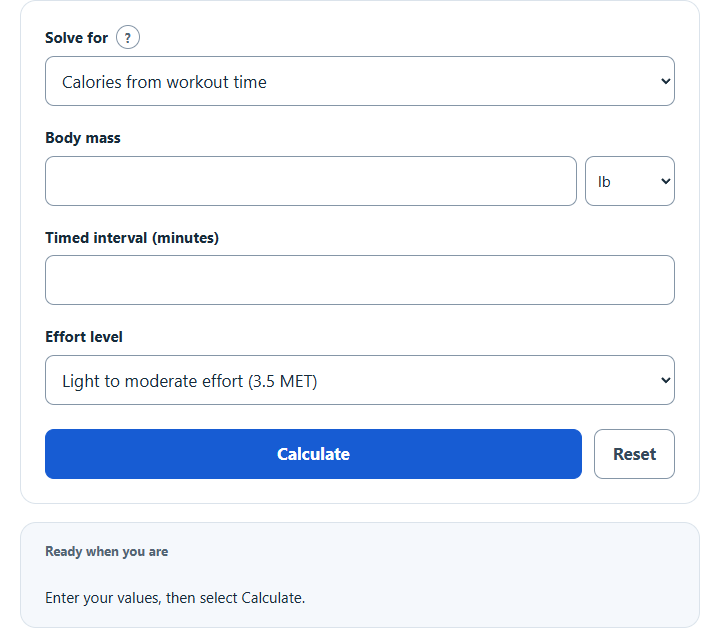
Estimate calories burned doing seated shoulder presses from your body weight and workout time, using typical weight-training MET values.
Seated Shoulder Press Energy Models
Choose Time and MET scenario or External work and assumed efficiency. MET mode uses body mass, elapsed minutes and a broad resistance-training scenario. Work mode uses actual moving external mass, whole lifting repetitions, measured vertical rise and a declared efficiency assumption. The two outputs answer different questions and must not be added together.
Time and MET Scenario
Gross kcal = MET × 3.5 × body mass (kg) ÷ 200 × minutes. This includes resting energy; it is not net exercise calories.
The oxygen-cost convention is 3.5 mL O₂/(kg·min) at 1 MET. Assuming approximately 5 kcal per liter O₂ produces this conversion and 1.05 kcal/(kg·hour) at 1 MET; it differs slightly from the shorthand 1 kcal/(kg·hour). The 3.5 and 6 MET choices are broad resistance-training categories, not measured shoulder-press values. The 5 MET choice is illustrative only: Compendium code 02052 describes squats/deadlifts, not generic moderate shoulder pressing. Include rest only if the scenario describes the whole timed interval.
Positive External Work Model
Positive work (J) = mass (kg) × 9.80665 × vertical rise (m) × repetitions. Mechanical kcal = work ÷ 4184. Conditional work-based kcal = mechanical kcal ÷ efficiency fraction; 4184 J is one thermochemical kcal.
- Mass = actual combined external mass raised in each counted repetition, in kg after conversion
- Repetitions = positive whole lifting cycles at the entered mass and travel
- Vertical rise = measured vertical displacement of the external load per repetition, in meters after conversion; efficiency must be greater than 0% and at most 100%
Illustrative External-Work Examples
These examples assume 1.5 ft of vertical rise per repetition and 20% mechanical efficiency. Those are illustrative inputs, not a universal press path or measured efficiency. Results are conditional equivalents for positive external work, not total session calories. The calculator also compares 15%, 20% and 25% efficiency assumptions.
| Total mass | Reps | Equivalent kcal |
|---|---|---|
| 25 lb | 20 | 1.2152 |
| 50 lb | 30 | 3.6455 |
| 80 lb | 40 | 7.7772 |
| 100 lb | 50 | 12.1518 |
What Counts as Load?
- Dumbbells: add both dumbbells together.
- Barbell: include the bar plus all plates.
- Machine shoulder press: determine actual moving external mass and its vertical rise. A selected resistance label alone may not supply these because of pulleys, levers, counterweights or mechanical advantage.
- Total reps: count whole positive lifting cycles using the entered mass and travel. When mass or travel changes, calculate those groups separately within the same external-work model.
What Is a Seated Shoulder Press?
The seated shoulder press is an overhead pressing exercise performed from a bench or machine seat. It emphasizes the deltoids and triceps while limiting leg drive, which makes upper-body pressing volume easier to track from set to set.
Main Muscles Used
- Anterior deltoid
- Lateral deltoid
- Triceps
- Upper chest
- Upper traps
Example
For actual combined external mass of 50 lb, 30 whole lifting repetitions, vertical rise 1.5 ft per repetition and an assumed 20% efficiency, the work calculation is:
Work ≈ 3050.5904 J; mechanical energy ≈ 0.729109 thermochemical kcal; conditional equivalent = 0.729109 ÷ 0.20 ≈ 3.6455 kcal. Calculations use unrounded values.
The 3.6455 kcal result is conditional on that efficiency and covers modeled positive external work only. Lowering, stabilization, body-segment work, internal work, rest, machine losses and individual physiology are omitted; no afterburn is estimated. Separately, a gross MET scenario for an 80 kg person over 20 minutes at 3.5 MET gives 98 kcal, including resting energy. That broad scenario is not a measurement of the shoulder-press exercise, and the two estimates must not be added.