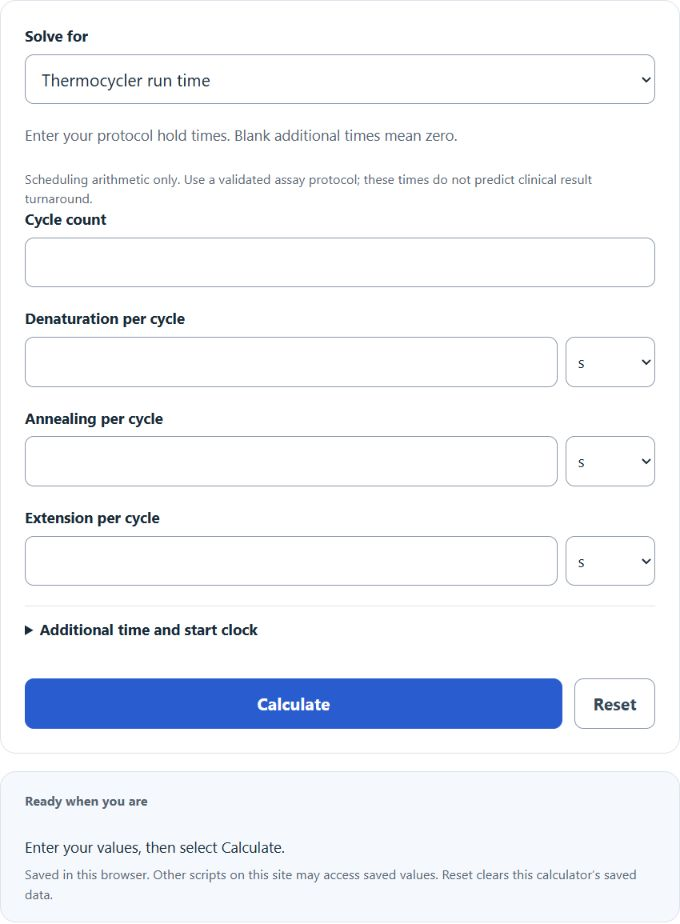
Calculate thermocycler run time, amplicon-based extension time, or complete cycles within a lab time budget with ramp, read, fixed overhead, and finish clock.
Related Calculators
- Hemolysis Index Calculator
- T3 T4 Ratio Calculator
- LDL-C/ApoB Ratio Calculator
- Adherence Calculator
- All Health and Medical Calculators
PCR Test Hours Formula
Choose Parallel test workload to estimate elapsed time for identical tests processed one at a time on identical machines. Thermocycler run time and extension calculations use separately entered protocol times.
Units: You can enter time values in hours, minutes, or seconds. The calculator converts units automatically before applying the formula.
Variables:
- H is the PCR test hours
- T is the total number of tests
- t is the time per test (in any supported unit; the calculator converts units automatically)
- M is the number of testing machines
Divide the test count by the machine count, round up to complete sequential tests on the busiest machine, then multiply by the time per test. This model excludes PCR batch capacity, queues, setup and reporting.
What is a PCR Test?
A PCR (Polymerase Chain Reaction) test is a type of nucleic acid amplification test (NAAT) used to detect genetic material from a pathogen. For RNA viruses (like SARS‑CoV‑2), the RNA is first converted to DNA (reverse transcription), then amplified to detectable levels. PCR/NAAT methods are generally highly sensitive, but results can be affected by when the sample is collected, the specimen type and quality, collection technique, and lab factors—so a negative test does not always rule out infection. If you have symptoms or a known exposure, follow current CDC/local health guidance and your clinician’s advice.
How to Calculate PCR Test Hours?
The following steps outline how to calculate the PCR Test Hours.
- First, determine the total number of tests (T).
- Next, determine the time per test (t) in hours.
- Next, determine the number of testing machines (M).
- Finally, calculate elapsed hours as H = ceil(T / M) × t. The example below gives 50 hours; if tests do not divide evenly, the busiest machine determines completion.
- After inserting the values and calculating the result, check your answer with the calculator above.
Example Problem :
Use the following variables as an example problem to test your knowledge.
Total number of tests (T) = 1000
Time per test (t) = 0.5 hours
Number of testing machines (M) = 10