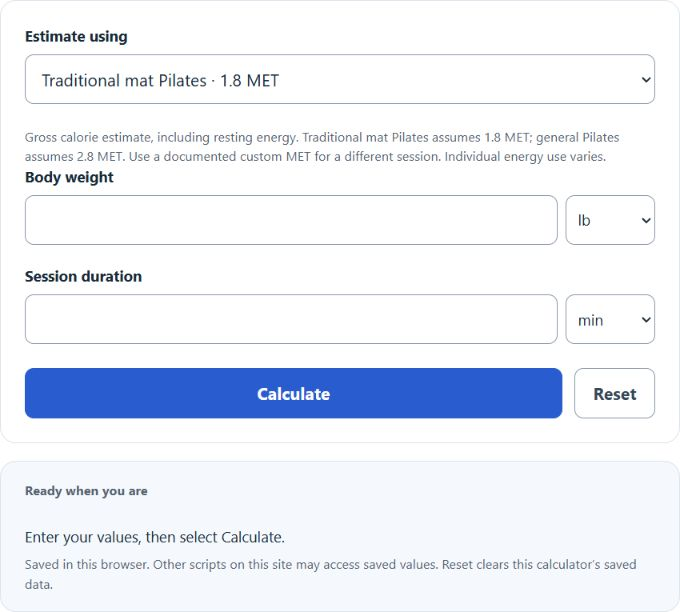
Estimate gross calories during a Pilates mat workout from weight in lb or kg, duration, and a documented activity MET. Traditional mat Pilates uses 1.8 MET; a custom option covers other session assumptions.
- Pilates Calorie Calculator
- Sit-Ups Calories Burned Calculator
- Push Up Calories Calculator
- Flow Yoga Calorie Calculator
Pilates Mat Workout Calories Burned Formula
This calculator estimates gross energy expenditure, including resting energy, from body weight, session duration and an activity MET. The 2024 Adult Compendium lists traditional mat Pilates at 1.8 MET (02103) and general Pilates at 2.8 MET (02105). Individual expenditure varies; these categories do not establish a fixed gentle/power-class calorie burn.
- C = calories burned
- W = body weight in kilograms
- D = workout duration in minutes
- F = MET × 3.5 / 200 kcal per kg per minute: 0.0315 for traditional mat Pilates, 0.049 for general Pilates, or a custom MET assumption
Typical Calories Burned During Mat Pilates
The table below uses the traditional mat Pilates assumption of 1.8 MET. Values are gross kcal rounded to whole numbers; actual individual expenditure can differ.
| Body Weight | 30 Minutes | 45 Minutes | 60 Minutes |
|---|---|---|---|
| 120 lb | 51 kcal | 77 kcal | 103 kcal |
| 150 lb | 64 kcal | 96 kcal | 129 kcal |
| 180 lb | 77 kcal | 116 kcal | 154 kcal |
| 210 lb | 90 kcal | 135 kcal | 180 kcal |
What Is a Pilates Mat Workout?
Mat Pilates is a floor-based workout built around core control, posture, breathing, mobility, and muscular endurance. Sessions commonly include movements such as roll-ups, bridges, leg circles, side kicks, planks, and spinal articulation drills.
What Changes Your Calorie Burn?
- Body weight: Higher body weight increases calories burned per minute.
- Workout length: Longer sessions raise total calorie burn directly.
- Workout pace: Effort can change energy use, but a class label alone does not determine a precise MET value.
- Exercise selection: Core sequences, planks, teaser variations, and continuous transitions raise demand.
- Rest time: Fewer pauses keep calorie burn higher across the full session.
Example Calculation
A 150-lb person weighs 68.0388555 kg. For 30 minutes using traditional mat Pilates at 1.8 MET:
The estimated gross energy expenditure is 64.3 kcal, including resting energy; it is not a measurement of that person’s calorie burn.