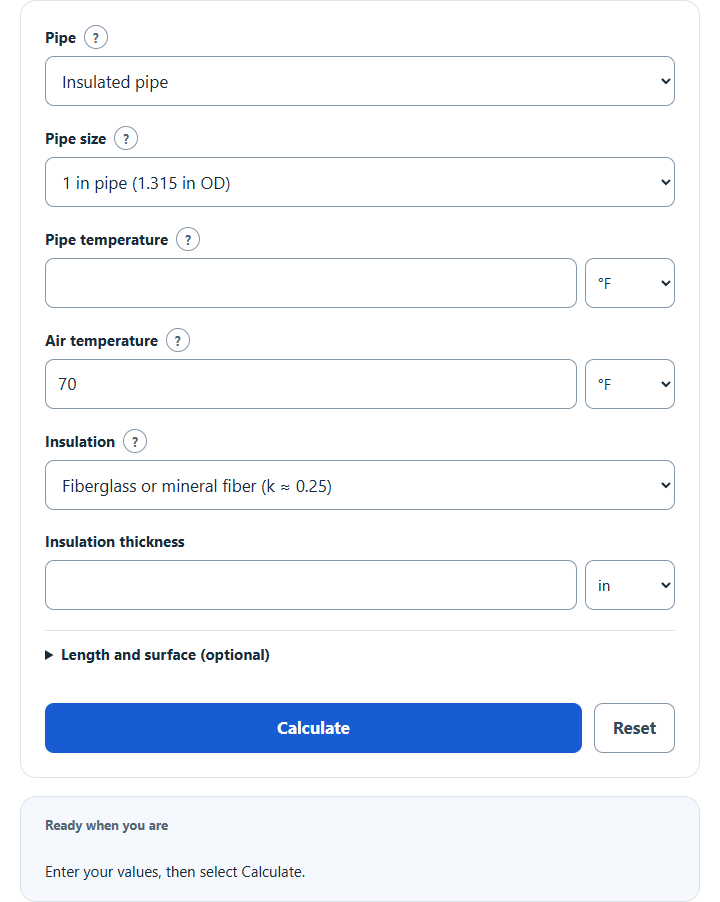
Calculate pipe heat loss per foot for an insulated or bare pipe from the pipe size, temperatures, and insulation type and thickness, in Btu/h or watts.
- All Construction Calculators
- Heat Loss R-Value Calculator
- Duct Heat Loss Calculator
- Vessel Heat Loss Calculator
- Insulation Surface Temperature Calculator
- Insulation K Value Calculator
- Thermal Resistance Calculator
Calculator Functions
The calculator estimates the steady heat loss from a pipe in Btu/h per foot and W/m, and the total for a run if you enter its length. Select a function to open it in the calculator.
| Function | Use it when | You enter |
|---|---|---|
| Insulated pipe | The pipe has insulation, or you are choosing a thickness | Pipe size, pipe and air temperatures, insulation type and thickness |
| Bare pipe | The pipe is uninsulated | Pipe size, pipe and air temperatures |
Pipe sizes from ½ in to 12 in fill in the outside diameter [2], and a custom diameter covers copper tube and other sizes. Temperatures can be in °F or °C. A pipe colder than the air is reported as heat gain. The insulated result also shows the insulation surface temperature and the reduction compared with the same pipe left bare.
Pipe Heat Loss Formulas
| q | Heat loss per unit length of pipe (W/m, shown also in Btu/h per ft) |
| ΔT | Pipe temperature minus air temperature |
| Ri | Resistance of the insulation layer |
| Rs | Resistance between the outer surface and the air |
| r₁ | Pipe outside radius, which is the inside radius of the insulation |
| r₂ | Outside radius of the insulation, r₁ plus the thickness |
| k | Thermal conductivity of the insulation |
| h | Surface coefficient for convection and radiation combined. The calculator uses 1.0 Btu/h·ft²·°F if you leave it blank [2] |
Insulated pipe
The formula above applies directly. Heat flows outward through a growing area, so the insulation resistance depends on the logarithm of the radius ratio and not on thickness alone [1]. The same 1 in of insulation therefore resists less on a large pipe than on a small one. The surface temperature is the air temperature plus q × Rs.
Each insulation choice uses the highest conductivity its material standard allows, in Btu·in/(h·ft²·°F): 0.25 for fiberglass or mineral fiber, 0.28 for elastomeric foam, 0.35 for polyethylene foam, 0.20 for polyisocyanurate and 0.41 for calcium silicate [3]. Enter a custom conductivity if you have the manufacturer's value.
Bare pipe
D is the pipe outside diameter, so π × D is the surface area per unit length. The surface coefficient starts at 2.5 Btu/h·ft²·°F, which reproduces published losses for bare steel pipe at 180 to 280 °F in still air to within roughly 20% [2]. A 2 in pipe at 180 °F in 80 °F air comes out near 155 Btu/h per ft, against a published 141.
Limits of This Estimate
- The surface coefficient is not a constant. It changes with surface temperature, air movement, pipe orientation and surface finish [2]. Wind raises it, and bare pipes above about 300 °F lose more than the 2.5 default predicts.
- Insulation conductivity rises with temperature. The presets are rated near room temperature [3], so losses from steam and other hot lines run higher than shown unless you enter a conductivity for the operating temperature.
- The pipe wall is taken to be at the fluid temperature along the whole run. Fittings, valves, hangers, gaps and wet insulation add losses the formula leaves out.
- The result is a steady-state heat flow. It does not give the temperature drop of the fluid along the pipe or the time for a pipe to cool or freeze.
Sources
- Massachusetts Institute of Technology, Thermodynamics and Propulsion notes, 17.2 Combined Conduction and Convection: heat flow from an insulated pipe with a surface coefficient
- National Insulation Association, Mechanical Insulation Design Guide, Design Data: pipe outside diameters, surface coefficient and bare steel pipe heat losses
- National Insulation Association, Mechanical Insulation Design Guide, Materials and Systems: conductivity of pipe insulation materials