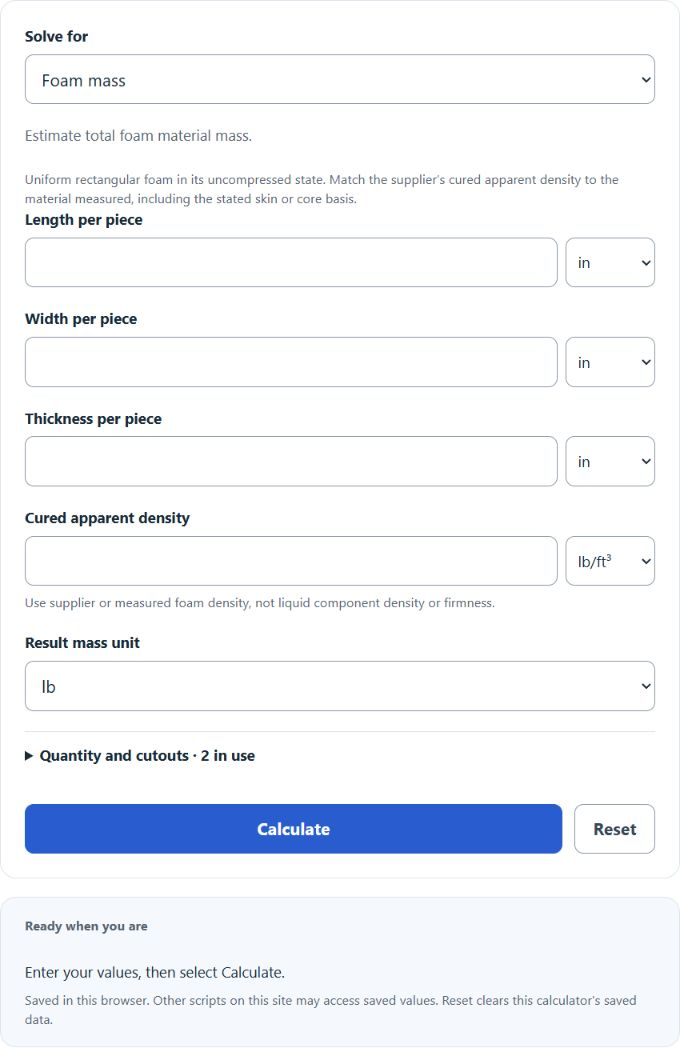
Calculate polyurethane foam weight from dimensions and cured density, or solve for density, length, width, or thickness in metric and imperial units.
Related Calculators
- Plastic Weight Calculator
- Rigid Foam Board Calculator
- Spray Foam Insulation Calculator
- PLA Weight Calculator
- Porosity Calculator
- Load Per Square Foot Calculator
- All Construction Calculators
How to Calculate Polyurethane Foam Weight
Polyurethane foam mass is determined by finished foam volume and cured apparent density. Use the actual supplier or measured density for the material, not liquid component density or firmness. Foam volume already includes its cells; the net-volume adjustment is only for removed material such as cutouts. Flexible foam dimensions should describe its uncompressed state. Match the skin/core basis of the density data to the geometry measured, and add facings, adhesive, hardware or absorbed water separately. References: Polyurethane Foam Association density guidance and ISO 845’s apparent-density scope.
Core Formula
If the volume is already known, use:
Where:
- Wt = foam weight
- Len = foam length
- Wid = foam width
- Thk = foam thickness
- Den = foam density
- Vol = total net foam volume
- Q = whole number of equal pieces (default 1)
- f = retained net-volume percentage divided by 100 (default 1 for 100%)
For an illustrative density assumption of 1.2 lb/ft³, enter all three dimensions in feet in the following manual equation. This is an example, not a universal foam density or a calculator default:
Rearranged Equations
If one value is missing, you can solve for it directly:
Unit Pairing Guide
The most important rule is to keep your dimensions and density in a compatible unit system.
| Dimensions | Density | Output Weight |
|---|---|---|
| ft | lb/ft³ | lb |
| m | kg/m³ | kg |
| cm | g/cm³ | g |
If your dimensions are measured in inches but your density is in lb/ft³, convert the volume to cubic feet first:
Quick Reference Conversions
| Conversion | Value |
|---|---|
| 1 ft | 12 in |
| 1 m | 100 cm |
| 1 ft³ | 1728 in³ |
| 1 m³ | 35.3147 ft³ |
| 1 lb | 0.453592 kg |
| 1 lb/ft³ | 16.0185 kg/m³ |
Example
Suppose one uncut foam piece (Q = 1, f = 1) is 3 ft long, 4 ft wide, and 0.5 ft thick, using an illustrative density of 1.2 lb/ft³.
The foam weight is 7.2 lb.
How to Use the Calculator Correctly
- Measure the length, width, and thickness of the foam.
- Select each input’s own unit; the calculator converts dimensions, density and mass independently. The manual equations and unit-pairing table require consistent units.
- Enter the foam density from the material data sheet whenever accuracy matters.
- Calculate the result, then convert the final weight if needed for shipping, lifting, or purchasing.
For Cutouts, Holes, and Irregular Pieces
If the foam is not a full rectangle, subtract the missing volume before calculating weight:
For layered assemblies made from multiple foam pieces or densities, total the weights of each piece:
Common Mistakes to Avoid
- Using inches for dimensions with lb/ft³ density without converting volume.
- Confusing density with firmness, compression rating, or load capacity.
- Using nominal sheet size instead of the actual trimmed dimensions.
- Forgetting to subtract cutouts, grooves, channels, or drilled holes.
- Ignoring facers, skins, adhesive layers, fabric covers, or attached hardware that add extra weight.
Practical Notes
- Higher density foam weighs more even when the dimensions stay the same.
- A small increase in thickness can change total weight significantly because thickness directly increases volume.
- For packaging and upholstery, use actual finished dimensions after cutting and shaping.
- For insulation boards and laminated panels, include any facing or coating weight separately if you need a more complete estimate.
- When ordering multiple identical pieces, multiply the single-piece weight by the total quantity.