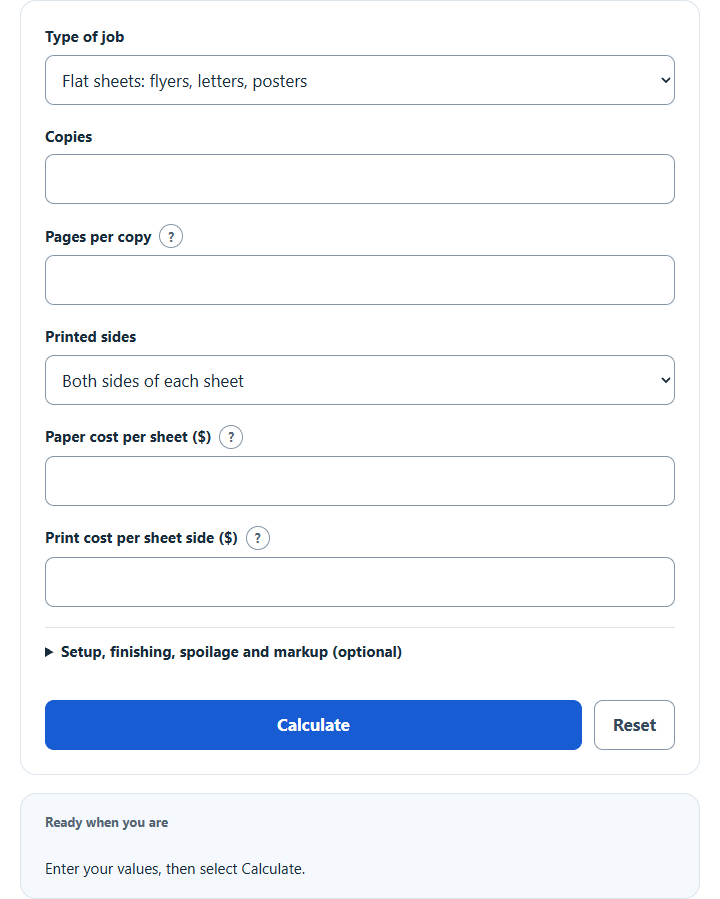
Estimate a print job from pages, copies, paper and print cost per sheet, setup and finishing, and get the total cost, cost per copy and quote price.
- All Business Finance Calculators
- Printing Cost Per Page Calculator
- Offset Printing Calculator
- Banner Cost Calculator
- Ink Coverage Calculator
- Ink Usage Calculator
Calculator Functions
The calculator prices a print run: the total job cost, the cost per copy, the sheets of paper to buy and, with a markup, the price to quote.
| Function | Use it when | You enter |
|---|---|---|
| Print job cost | You are quoting or budgeting flyers, letters, posters, booklets or a magazine on a digital press, copier or offset press | Type of job, copies, pages per copy, paper cost per sheet and print cost per sheet side |
Type of job is either flat sheets, printed on one or both sides, or a booklet or magazine stapled at the fold. The optional settings add a one-time setup cost, a finishing cost per copy, the number of pieces cut from each sheet, a spoilage allowance and a markup. For banners and other large-format work priced by area, use the Banner Cost Calculator.
Print Job Cost Formulas
| C | Print job cost ($) |
| S | One-time setup cost ($) |
| N | Sheets of paper, including spoilage |
| p | Paper cost per sheet ($) |
| I | Printed sheet sides, including spoilage |
| c | Print cost per sheet side ($) |
| n | Copies |
| f | Finishing cost per copy ($) |
Cost per copy is C ÷ n. Setup is paid once, so the cost per copy falls as the run gets longer. That is why a process with a high setup cost and a low cost per sheet, such as offset printing, pays off on long runs, and one with little setup, such as digital printing, on short runs.
Sheets for flat jobs
I = n × P ÷ u
P is the pages per copy, s is 1 for one-sided and 2 for two-sided printing, and u is the number of finished pieces cut from one sheet. P ÷ s is rounded up to whole sheets per copy, so a 3-page two-sided handout takes 2 sheets and 3 printed sides. N and I are then rounded up to whole numbers.
Sheets for booklets and magazines
I = 2 × N
Each folded sheet of a stapled booklet carries 4 pages, 2 on each side, so P ÷ 4 is rounded up to whole sheets and a 30-page booklet is printed as 32 pages with 2 left blank. The cover counts as 4 of the pages. The paper cost is for the full sheet before folding, which is twice the size of the finished page.
Spoilage and markup
Quote = C × (1 + m ÷ 100)
w is the spoilage allowance in percent. It adds sheets for setup and misprints to both the paper and the printing, rounded up to whole sheets. m is the markup in percent, added to the job cost to give a price to quote and a price per copy.
Limits of This Estimate
- The result is only as good as the costs you enter. Paper, ink, click charges and finishing prices differ from shop to shop and change with paper weight, color and coverage.
- Every sheet is priced the same. For a booklet with a heavier cover, use the average sheet cost or run the cover and the inside pages as two jobs and add them.
- Labor, machine time, shipping and sales tax are not separate lines. Put them in the setup cost, the finishing cost or the markup.