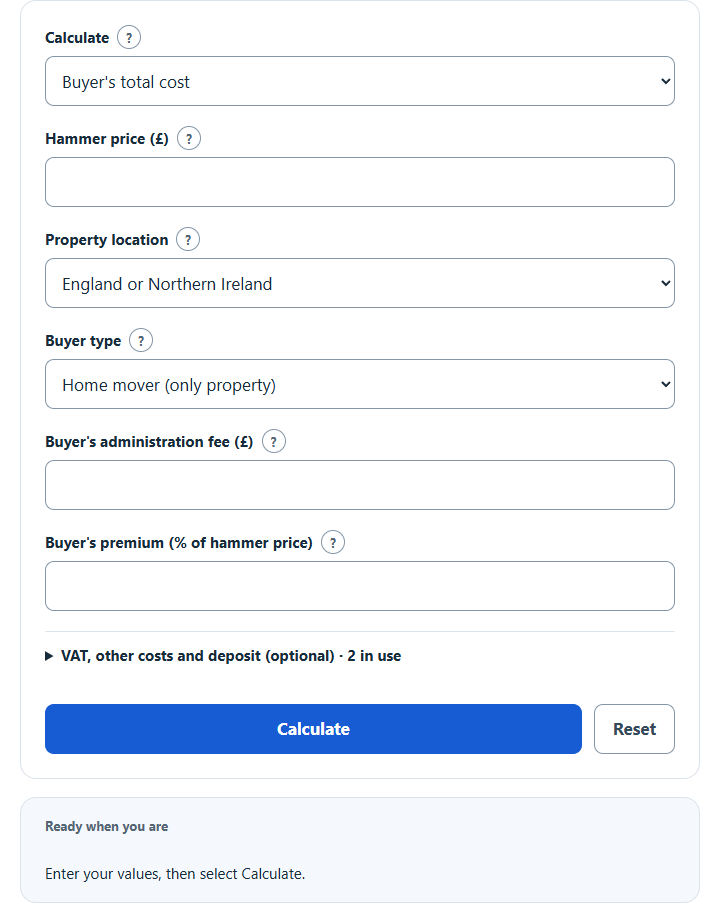
Calculate the total cost of buying a UK property at auction, with stamp duty, buyer’s fees and deposit, or a seller’s proceeds after commission and VAT.
- All Mortgage and Homeownership Calculators
- Auction Cost Calculator
- Auction Premium Calculator
- Reserve Price Calculator
- Home Sale Proceeds Calculator
- Closing Cost Percentage Calculator
Calculator Functions
The calculator adds up what a UK property auction costs in pounds: the tax and fees a buyer pays on top of the hammer price, or what a seller keeps after the auctioneer’s charges. Select a function to open it in the calculator.
| Function | Use it when | You enter |
|---|---|---|
| Buyer’s total cost | You plan to bid, or have won a lot, and want the full cost | Hammer price, property location, buyer type and the auctioneer’s buyer fees |
| Seller’s net proceeds | You are putting a property into an auction | Sale price, commission rate and entry fee |
Optional settings add VAT to fees quoted without it, legal and other costs, a deposit other than 10%, a minimum commission and a mortgage to repay. The buyer result also lists the tax band by band.
Property Auction Fees Formulas
| T | Total cost to buy (£) |
| P | Hammer price, the winning bid (£) |
| S | Property tax on the price: Stamp Duty Land Tax in England and Northern Ireland, LBTT in Scotland or Land Transaction Tax in Wales (£) |
| F | The auctioneer’s buyer fees, including VAT (£) |
| C | Legal, survey and other costs (£) |
Buyer’s total cost
Each tax is charged on the portion of the price that falls in each band, and the portions are added together. A £295,000 home in England bought by a home mover is taxed at 0% on the first £125,000, 2% on the next £125,000 and 5% on the last £45,000, which comes to £4,750 [1]. The calculator uses these residential rates, checked on 12 November 2026.
| England and Northern Ireland: portion of the price | Home mover | Additional property |
|---|---|---|
| Up to £125,000 | 0% | 5% |
| £125,001 to £250,000 | 2% | 7% |
| £250,001 to £925,000 | 5% | 10% |
| £925,001 to £1.5 million | 10% | 15% |
| Above £1.5 million | 12% | 17% |
A first-time buyer in England or Northern Ireland pays nothing up to £300,000 and 5% from £300,001 to £500,000. Above £500,000 the relief is lost and the home mover rates apply to the whole price [1]. The additional property rates apply when the price is £40,000 or more and you will own more than one home [2].
| Scotland: portion of the price | LBTT rate |
|---|---|
| Up to £145,000 | 0% |
| £145,001 to £250,000 | 2% |
| £250,001 to £325,000 | 5% |
| £325,001 to £750,000 | 10% |
| Above £750,000 | 12% |
In Scotland a first-time buyer’s 0% band runs to £175,000, which saves up to £600 [3]. An additional property of £40,000 or more also pays the Additional Dwelling Supplement, 8% of the whole price [4].
| Wales: portion of the price | Main rate | Higher rate |
|---|---|---|
| Up to £180,000 | 0% | 5% |
| £180,001 to £225,000 | 0% | 8.5% |
| £225,001 to £250,000 | 6% | 8.5% |
| £250,001 to £400,000 | 6% | 10% |
| £400,001 to £750,000 | 7.5% | 12.5% |
| £750,001 to £1.5 million | 10% | 15% |
| Above £1.5 million | 12% | 17% |
Wales has no first-time buyer relief, so first-time buyers pay the main rates. The higher rates [5] apply to an additional property of £40,000 or more [8].
A is the buyer’s administration fee and b is the buyer’s premium as a share of the hammer price. v is 0.2 when the fees are quoted without VAT, because the standard VAT rate is 20% [6], and 0 when the fees you enter already include it. The auctioneer should confirm all of its fees before the auction [7].
D is the deposit paid when the hammer falls and d is the deposit rate, normally 10%. The rest of the price, P − D, is due at completion, which is 20 working days after the auction under the RICS Common Auction Conditions [7]. The deposit is part of the price, so it is not added to the total.
Seller’s net proceeds
N is what the seller keeps, P is the sale price, C is the legal pack and other costs, and M is any mortgage repaid from the sale. F is the auctioneer’s fees: the commission, P × r, or the minimum commission if that is larger, plus the entry fee. v is 0.2 when 20% VAT is added to the fees [6]. The commission and any extra charges are set out in the auctioneer’s terms of appointment [7].
Limits of This Estimate
- The tax is for a UK-resident individual buying one freehold or existing leasehold home. Companies, non-UK residents (who usually pay 2% more in England and Northern Ireland [1]), mixed-use or commercial lots, new leases with rent, and several properties bought together follow other rules.
- Rates and thresholds change at budgets. The tables above were checked on 12 November 2026, and the rate that applies is the one in force on the day the purchase completes.
- Auction fees vary by auctioneer and by lot. Enter the figures from the catalogue, the special conditions or your terms of appointment, and check whether each one includes VAT.
- Some lots are sold with VAT on the price itself [7], and some special conditions make the buyer pay the seller’s costs. Add those under other costs. A seller’s Capital Gains Tax is not included.
Sources
- GOV.UK, Stamp Duty Land Tax: Residential property rates: standard rates, first-time buyer relief, the worked example and the non-resident surcharge
- HM Revenue and Customs, Higher rates of Stamp Duty Land Tax: additional property rates and the £40,000 threshold
- Revenue Scotland, LBTT: Residential property: Scottish rates and first-time buyer relief
- Revenue Scotland, The Additional Dwelling Supplement (ADS): the 8% supplement and when it applies
- Welsh Revenue Authority, Land Transaction Tax rates and bands: Welsh main and higher residential rates
- GOV.UK, VAT rates: the 20% standard rate
- Royal Institution of Chartered Surveyors, A clear, impartial guide to Property auctions: the 10% deposit, completion after 20 working days, and how buyer and seller fees are set
- Welsh Revenue Authority, Higher rates of Land Transaction Tax: overview: when the Welsh higher rates apply