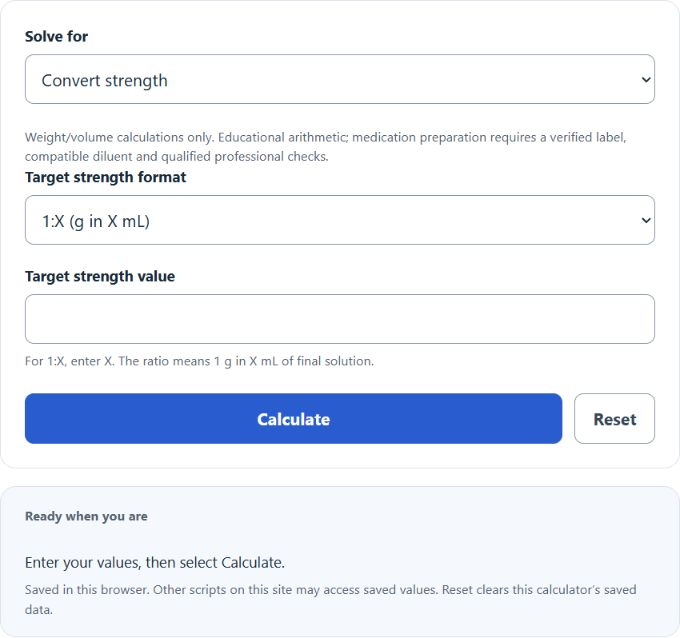
Convert weight/volume ratio strength, percent w/v and mg/mL, or calculate solute mass and stock volume. These are educational calculations, not verified medication preparation or dosing instructions.
- All Math and Numbers Calculators
- Solution Strength Calculator
- Weight/Volume Percent Calculator
- Molarity Calculator
- PPM Calculator
- Percent Solution Calculator
- mg/mL to Molarity Calculator
Ratio Strength (w/v) & Concentration Formula
Variables:
- C is the mass/volume concentration (for example, g/mL)
- W is the solute weight (mass) (for example, g)
- V is the total solution volume (for example, mL)
- For w/v ratio strength written as 1:X, X = V/W after using compatible units (for example, mL per g)
To calculate mass/volume concentration, divide the solute weight by the total solution volume. To express the same strength as a pharmacy-style ratio strength (w/v), write it as 1 : (V/W) (e.g., 1 g in X mL).
How to Calculate Ratio Strength?
The following steps outline how to calculate the Ratio Strength.
- First, determine the solute weight (mass) (e.g., g).
- Next, determine the total solution volume (e.g., mL).
- Next, gather the formulas from above: C = W / V and (for w/v ratio strength) 1:X where X = V / W.
- Finally, calculate the concentration (W/V). If you need pharmacy ratio strength, compute X = V/W and write the result as 1:X.
- After inserting the variables and calculating the result, check your answer with the calculator above.
Example Problem :
Use the following variables as an example problem to test your knowledge.
total weight (g) = 74
total volume (mL) = 80
Concentration (W/V): C = 74 / 80 = 0.925 g/mL.
Equivalent ratio strength (w/v): X = 80 / 74 ≈ 1.0811, so the ratio strength is approximately 1 : 1.0811 (i.e., 1 g in 1.0811 mL).
Frequently Asked Questions (FAQ)
What is Ratio Strength in pharmaceutical calculations?
Ratio strength is a way of expressing concentration as 1:X. For w/v ratio strength, it typically means 1 g of solute in X mL of final solution (for example, 1:1000 = 1 g in 1000 mL). For v/v ratio strength, it means 1 mL of solute in X mL of final solution.
Why is understanding Ratio Strength important?
Strength conversion is one part of a preparation calculation. A concentration result alone does not establish a correct dose, compatibility, stability or sterility; qualified professionals must verify the product label and preparation procedure.
Can Ratio Strength be applied to both solids and liquids?
Yes. Ratio strength is commonly used for w/v (solid-in-liquid) and can also be used for v/v (liquid-in-liquid). The units/interpretation should be clearly specified (w/v vs v/v).
How does Ratio Strength differ from Percentage Strength?
Ratio strength expresses concentration as 1 in X (e.g., 1:1000), while percentage strength expresses concentration as parts per 100 (e.g., % w/v, % w/w, or % v/v). For w/v, they are directly related: 1:X equals (100/X)% w/v (for example, 1:1000 = 0.1% w/v).