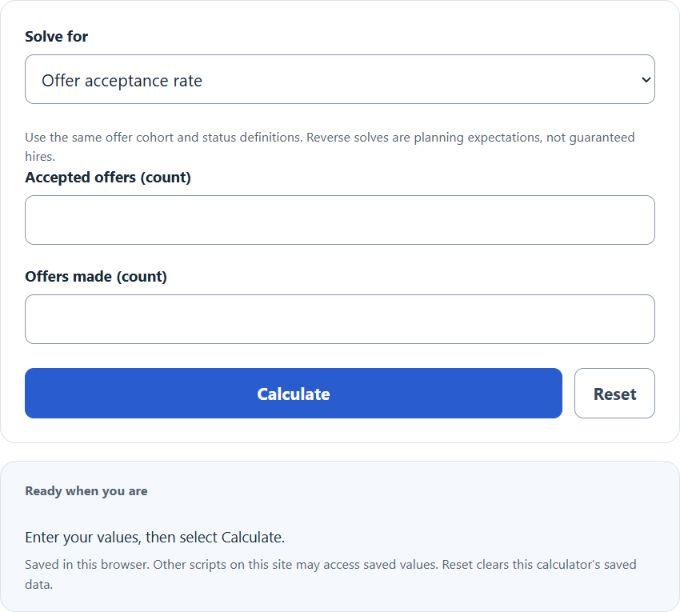
Calculate recruitment rate from total offers accepted and total offers made, or select a reverse planning solve using an expected acceptance rate.
Related Calculators
- Employee Stability Index Calculator
- Annualized Turnover Calculator
- Employment Rate Calculator
- Employment Duration Calculator
- Length of Service Calculator
- Absence Rate Calculator
- All Business Calculators
Recruitment Rate Formula
The recruitment rate shows what percentage of employment offers are accepted. It is an offer acceptance metric; it does not by itself identify why candidates accept or decline.
In this formula:
- RR = recruitment rate as a percentage
- A = total number of offers accepted
- OM = total number of offers made
A higher recruitment rate generally means a larger share of candidates accepted your offers. A lower rate may indicate issues with compensation, role fit, hiring speed, job expectations, location, or competition from other employers.
How to Calculate Recruitment Rate
- Count the total number of offers made during the period being analyzed.
- Count how many of those offers were accepted.
- Divide accepted offers by total offers made.
- Multiply the result by 100 to convert it to a percentage.
For the most accurate result, use the same date range or hiring cohort for both numbers. For example, compare offers made and offers accepted from the same month, quarter, team, or job family.
Example
If a company makes 60 offers and 48 are accepted, the recruitment rate is:
This means 80% of offers were accepted, or 4 out of every 5 offers were accepted. Acceptance does not itself confirm a completed hire.
Rearranged Forms of the Formula
If you know the recruitment rate and one other value, you can solve for the missing quantity.
Accepted offers from rate and total offers made:
Total offers made from accepted offers and rate:
These forms describe planning expectations, which may be fractional. Round expected offers up for a whole-offer planning count; actual outcomes are not guaranteed. For example, if you want 30 accepted offers and your expected recruitment rate is 75%, you can estimate the number of offers that must be made.
Why Recruitment Rate Matters
- Measures offer effectiveness: Helps show whether candidates view the role and package as attractive.
- Improves hiring forecasts: Supports planning for how many offers are needed to reach headcount targets.
- Identifies bottlenecks: A falling rate may signal issues late in the recruiting funnel.
- Supports benchmarking: Useful when comparing departments, job types, recruiters, or time periods.
- Guides budgeting: Low acceptance rates can increase recruiting costs and time-to-fill.
How to Interpret the Result
- Higher recruitment rate: Usually suggests stronger alignment between candidate expectations and the final offer.
- Lower recruitment rate: May indicate weak compensation, slow approvals, poor communication, unclear job scope, or strong market competition.
- 100% recruitment rate: Every offer made was accepted.
- 0% recruitment rate: No offers made were accepted.
Context matters. Senior roles, niche technical positions, highly competitive labor markets, and relocation-based jobs often produce different recruitment rates than entry-level or high-volume hiring.
Common Factors That Affect Recruitment Rate
- Base salary, bonus structure, and benefits
- Remote flexibility, schedule, and location requirements
- Employer brand and candidate perception
- Interview speed and decision turnaround time
- Clarity of duties, growth path, and reporting structure
- Competing offers from other employers
- Recruiter communication and candidate experience
Common Mistakes
- Using mismatched periods: Accepted offers and offers made should come from the same dataset.
- Dividing by zero: If no offers were made, the rate is undefined.
- Mixing statuses: Be consistent about whether rescinded, pending, or expired offers are included.
- Ignoring segmentation: Company-wide averages can hide low rates in specific teams or roles.
- Comparing unlike roles: Acceptance behavior can differ significantly by industry, seniority, and geography.
Related Hiring Metric
The not-accepted share is the percentage of offers in the cohort that were not accepted. It equals a decline rate only if all remaining offers were declined:
Tracking acceptance and not-accepted shares can help describe a cohort. Pending, rescinded and expired offers should not automatically be treated as candidate declines.