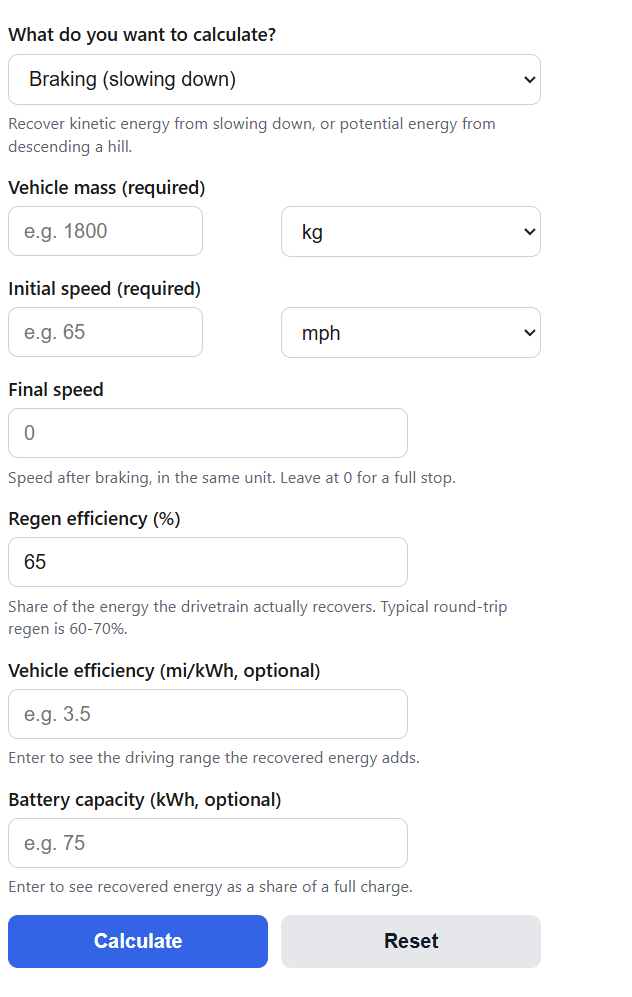
Use this regenerative braking energy calculator to estimate the energy an EV recovers when braking or descending a hill, and the driving range it adds back.
Regenerative Braking Energy Formula
Regenerative braking recovers energy that would otherwise be lost as heat in the friction brakes. When a vehicle slows down, the calculator estimates the kinetic energy released and multiplies it by the drivetrain’s regen efficiency:
E = 0.5 * m * (v1^2 - v2^2)
When a vehicle descends a hill, it instead recovers gravitational potential energy:
E = m * g * h
In both cases only a fraction of that energy actually reaches the battery. The recovered energy and its value in watt-hours are:
Er = E * eff
 Wh = Er / 3600
Variables:
- E is the available energy, in joules (kinetic when braking, potential when descending)
- m is the vehicle mass, in kilograms
- v1 is the initial speed and v2 is the final speed, both in meters per second
- g is gravitational acceleration, 9.81 m/s^2
- h is the elevation drop, in meters
- eff is the regen efficiency as a decimal (65% = 0.65)
- Er is the recovered energy in joules, and Wh is that energy in watt-hours (divide joules by 3600)
Pick a mode at the top of the calculator. In “Braking (slowing down)” mode you enter the vehicle mass, the speed before and after braking, and the regen efficiency, and the tool returns the kinetic energy recovered. In “Descent (downhill)” mode you enter the mass and the elevation drop instead. If you add an optional vehicle efficiency the tool estimates the driving range the recovered energy adds, and if you add a battery capacity it shows the recovery as a share of a full charge.
To turn recovered energy into added range, divide the watt-hours by 1000 and multiply by your vehicle’s efficiency in miles per kilowatt-hour:
Range added (mi) = (Wh / 1000) * (mi per kWh)
Energy Recovered When Braking to a Stop
This table shows the energy a 1,800 kg electric vehicle recovers when braking from each speed to a full stop, assuming 65% regen efficiency. Energy rises with the square of speed, so slowing from highway speeds recovers far more than city stops.
| Initial speed | Speed (m/s) | Energy recovered (Wh) | Energy recovered (kWh) |
|---|---|---|---|
| 20 mph | 8.9 | 13 | 0.013 |
| 30 mph | 13.4 | 29 | 0.029 |
| 40 mph | 17.9 | 52 | 0.052 |
| 50 mph | 22.4 | 81 | 0.081 |
| 60 mph | 26.8 | 117 | 0.117 |
| 70 mph | 31.3 | 159 | 0.159 |
Even a hard 70 mph stop returns only about 0.16 kWh, a small slice of a 60-80 kWh pack. Regen pays off through thousands of small recoveries over a drive, not a single big one.
Example Problems
Example 1: Energy recovered braking from highway speed.
An 1,800 kg EV slows from 65 mph to a full stop with 65% regen efficiency. Converting 65 mph gives 29.06 m/s, so the kinetic energy is 0.5 * 1800 * 29.06^2 = 759,900 J. Multiplying by 0.65 recovers 493,900 J, and dividing by 3600 gives about 137 Wh, or 0.137 kWh. At a vehicle efficiency of 3.5 mi/kWh, that adds roughly 0.48 miles of range.
Example 2: Energy recovered on a descent.
The same 1,800 kg EV descends 300 m of elevation at 65% regen efficiency. The potential energy is 1800 * 9.81 * 300 = 5,297,400 J. Multiplying by 0.65 recovers 3,443,000 J, and dividing by 3600 gives about 957 Wh, or 0.957 kWh. At 3.5 mi/kWh that adds about 3.3 miles of range on the way down.
Frequently Asked Questions
How much energy does regenerative braking recover?
It depends on how much speed or height you shed and how efficient the drivetrain is. A typical EV recovers only 60-70% of the available kinetic or potential energy, because the motor, inverter, and battery each lose a share as heat. Slowing from 70 mph to a stop in a 1,800 kg car returns roughly 0.16 kWh, so the benefit comes from repeating that recovery many times over a drive.
Can regen braking fully recharge an EV?
No. Regen can only return energy the vehicle already spent gaining speed or climbing, and it always gives back less than that because of drivetrain losses, so it can never add net charge on flat ground. Long, steep descents are the exception: a car coming down a mountain can add a meaningful few percent to the pack, but it will still arrive with less charge than it started the climb with.
Does regen braking work better in the city or on the highway?
City driving benefits more. Stop-and-go traffic means constant braking, and each slowdown is a chance to recover energy that would otherwise be lost to the friction brakes. Highway cruising involves little braking, so regen rarely engages except when slowing for an exit or descending a grade. This is why many EVs show better efficiency in the city than at steady highway speeds.