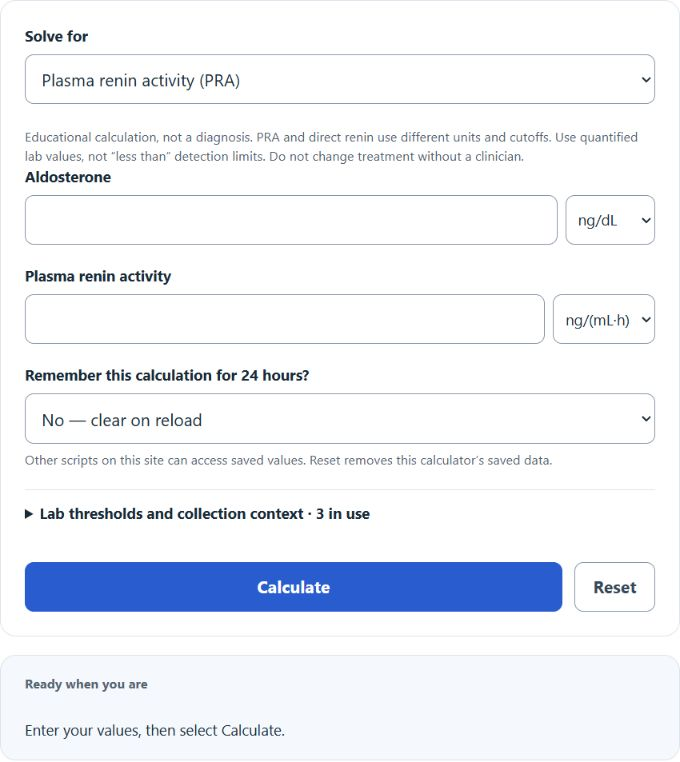
Calculate aldosterone-to-renin ratio (ARR) and its reciprocal (RAR) using method-specific units. Optional comparisons use your laboratory’s thresholds; they do not assign a diagnosis.
Medical disclaimer: This calculator is for educational purposes only and is not medical advice or a diagnosis. ARR/RAR interpretation depends on the lab method/units and clinical context (including medications and sample collection conditions). Do not change medications or treatment based on this result—review results with a licensed clinician.
Clinical context (important)
- ARR is commonly used as a screening metric for primary aldosteronism, but cutoffs vary by assay, units, and lab reporting. Further testing may be needed depending on the results and clinical context; interpretation belongs with a clinician.
- Many factors can change renin/aldosterone results (for example: diuretics, ACE inhibitors/ARBs, beta blockers, mineralocorticoid receptor antagonists, posture/time of day, sodium intake, pregnancy, and kidney disease).
- Plasma renin can be reported as PRA or direct renin concentration (DRC); they are not interchangeable without method-specific guidance. Check your lab report and discuss with your clinician (see the Endocrine Society guideline for primary aldosteronism screening/diagnosis).
Unit conversion notes
The pmol/L to ng/dL aldosterone conversion used here is based on aldosterone molecular weight (MW ≈ 360.44 g/mol): 1 pmol/L ≈ 0.0360444 ng/dL. If your lab uses different reporting conventions, always follow the lab’s documentation.
- All Health and Medical Calculators
- mmol/L to mg/dL Calculator
- FSH/LH Ratio Calculator
- Reverse T3 Ratio Calculator
- T3/T4 Ratio Calculator
- Glucose to Insulin Ratio Calculator
- ng/dL to nmol/L Calculator
Watch the complete aldosterone-to-renin ratio explanation and transcript
ARR and RAR Formula
The following example problems outline the steps and information needed to calculate the aldosterone-to-renin ratio (ARR) and its inverse, the renin-to-aldosterone ratio (RAR).
Variables:
- ARR is the aldosterone-to-renin ratio (A/R), commonly used for screening (units depend on reporting, e.g., (ng/dL)/(ng/(mL-h))).
- RAR is the renin-to-aldosterone ratio (R/A), the inverse of ARR (RAR = 1/ARR; e.g., (ng/(mL-h))/(ng/dL)).
- A is the mass concentration of aldosterone (e.g., ng/dL).
- R is plasma renin activity (e.g., ng/(mL-h)) or direct renin concentration (e.g., mIU/L), using the corresponding method-specific ARR units and cutoffs.
ARR is calculated by dividing aldosterone by the selected renin measurement (ARR = A/R); PRA and DRC ratios have different units and interpretation. The Renin/Aldosterone ratio shown here (RAR) is the reciprocal (RAR = R/A = 1/ARR).
How to Calculate ARR (and RAR)?
The following steps outline how to calculate ARR and RAR.
- First, determine the mass concentration of aldosterone (A) from your lab report (e.g., ng/dL).
- Next, identify whether your report gives plasma renin activity or direct renin concentration (R), and choose matching units. Do not substitute one method’s cutoff for the other.
- Use the formulas: ARR = A/R and RAR = R/A (= 1/ARR).
- Finally, calculate the ratio(s) and compare with the calculator above.
Example Problem :
Use the following variables as an example problem to test your knowledge.
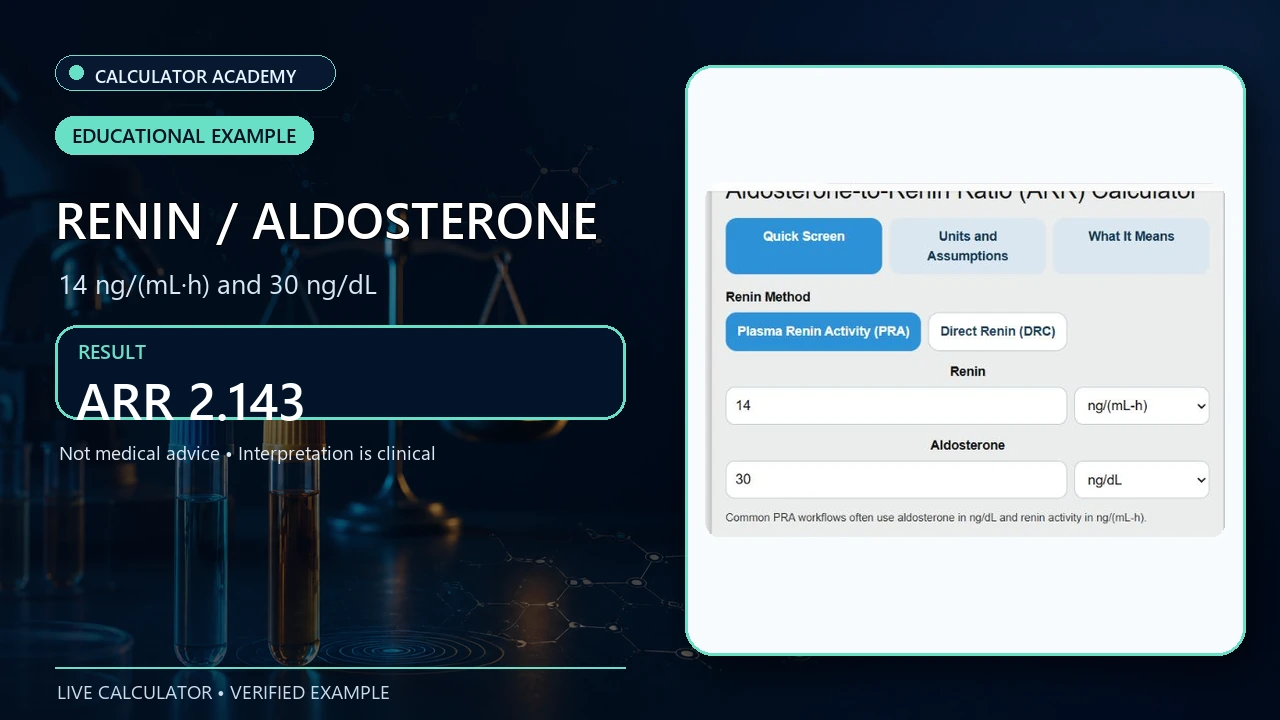
mass concentration of aldosterone (ng/dL) = 30
plasma renin activity (ng/(mL-h)) = 14
ARR = A/R = 30/14 ≈ 2.143
RAR = R/A = 14/30 ≈ 0.467