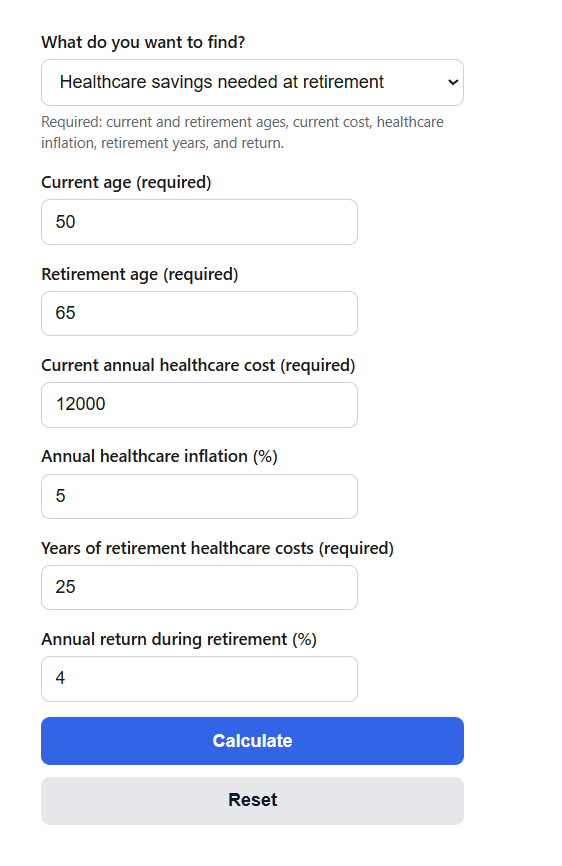
Project first-year healthcare expenses at retirement, nominal lifetime costs, and the savings needed to fund growing healthcare costs through retirement.
Retirement Healthcare Cost Formula
Healthcare costs are projected to retirement with healthcare inflation, then valued as a growing stream during retirement.
Cost in the first retirement year:
FirstCost=CurrentCost*(1+i)^w
Savings needed at retirement:
Savings=P*(1-((1+i)/(1+r))^n)/(r-i)
Total future-dollar cost:
NominalTotal=P*((1+i)^n-1)/i
Variables:
- i is annual healthcare inflation
- r is annual return during retirement
- w is years until retirement
- n is retirement healthcare years
- P is the first-year retirement cost
Savings-needed mode reports the present value at retirement. First-year-cost mode highlights the annual cost when retirement begins.
The model assumes annual costs grow at a constant healthcare inflation rate.
Long-term care and large one-time expenses should be modeled separately when they are not included in the annual estimate.
Healthcare Inflation Illustration
Growth of a $12,000 annual cost before retirement.
| Years | 3% inflation | 5% inflation | 7% inflation |
|---|---|---|---|
| 10 | $16,127 | $19,547 | $23,606 |
| 15 | $18,696 | $24,947 | $33,108 |
| 20 | $21,673 | $31,840 | $46,436 |
Example Problems
Example 1: Project first-year cost.
A $12,000 annual cost growing at 5 percent for 15 years becomes about $24,947 at retirement.
Example 2: Estimate retirement savings.
Discount 25 growing annual costs at the expected retirement return to estimate the amount needed at age 65.
Frequently Asked Questions
Should Medicare premiums be included?
Include expected premiums and out-of-pocket costs not paid from another dedicated source.
Why can savings exceed nominal cost in unusual cases?
It generally should not with nonnegative returns, but very low or negative returns increase present-value needs.
Does this include long-term care?
Only when the current annual estimate and growth assumptions intentionally include it.