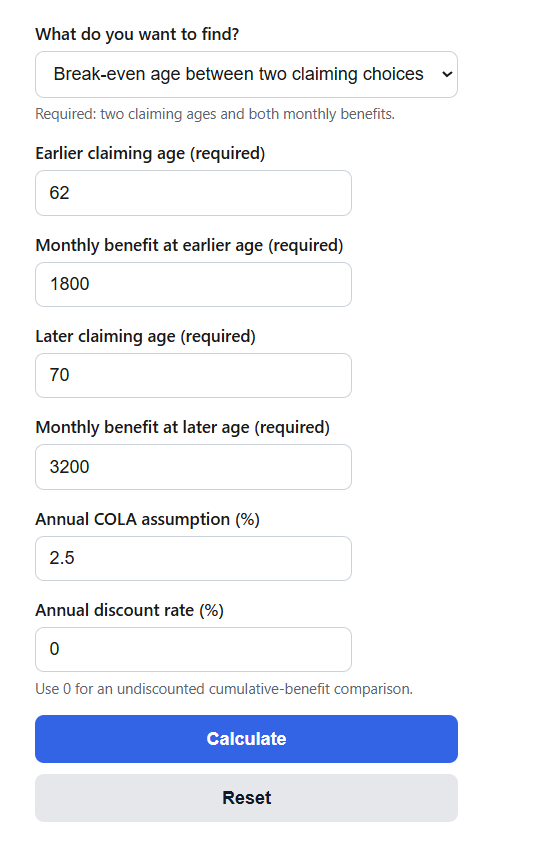
Compare early and delayed Social Security claiming. Calculate the break-even age or the later monthly benefit needed to catch up by a target age.
Social Security Break-Even Formula
The break-even age is when the cumulative value of a later, larger benefit equals an earlier, smaller benefit.
The calculator solves for age A where:
PV_{early}(A)=PV_{late}(A)
Benefits can grow by an assumed COLA:
Benefit_t=Benefit_0*(1+COLA)^{t/12}
Variables:
- PVearly is the value of benefits beginning earlier
- PVlate is the value of delayed benefits
- COLA is annual benefit growth
- t is months since claiming
Break-even-age mode accumulates both streams month by month. Required-benefit mode finds the delayed benefit needed by a selected age.
A zero discount rate compares cumulative dollars; a positive rate gives less weight to later payments.
Claiming decisions may also depend on spouse and survivor benefits, taxes, work, health, and cash needs.
Illustrative Claiming Trade-Offs
These rough examples use fixed starting benefits and no individual earnings record.
| Earlier option | Later option | Waiting period | Rough break-even |
|---|---|---|---|
| $1,800 at 62 | $3,200 at 70 | 8 years | About age 80 |
| $2,000 at 65 | $2,800 at 70 | 5 years | About age 87.5 |
| $2,400 at 67 | $3,000 at 70 | 3 years | About age 85 |
Example Problems
Example 1: Find the break-even age.
Compare $1,800 at age 62 with $3,200 at age 70. The early choice receives 96 payments before the delayed benefit starts.
Example 2: Find the delayed benefit needed.
Enter a target age of 82 and the calculator divides the early strategy's accumulated value by the delayed-payment factor.
Frequently Asked Questions
Does a lower break-even age make delay automatically better?
No. It only means the delayed strategy has paid more cumulatively after that age under the assumptions.
Should COLA be included?
Use the same COLA assumption for both options unless there is a specific reason not to.
Where should benefit estimates come from?
Use claiming-age estimates from the official Social Security record rather than a generic percentage.