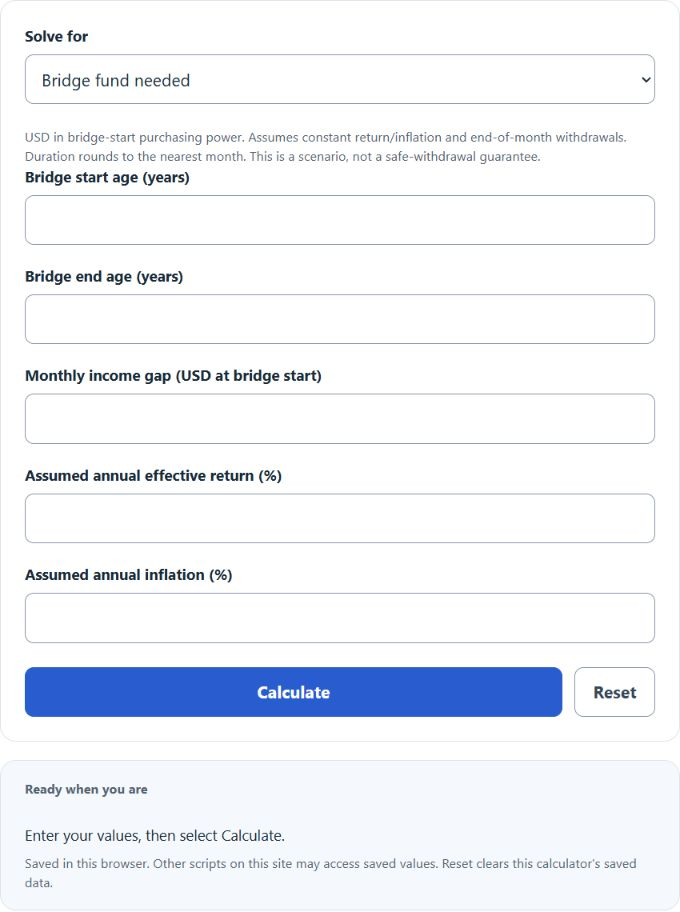
Calculate the fund needed to bridge an early retirement income gap or the monthly spending an available bridge fund can support until benefits begin.
Early Retirement Bridge Formula
A retirement bridge fund covers an income gap between leaving work and the start of Social Security, a pension, or another income source.
Convert nominal return to real return:
r_{real}=(1+r)/(1+i)-1
Present value of end-of-month real withdrawals (use N when the real monthly return is zero):
BridgeFund=MonthlyGap*[1-(1+r_m)^{-N}]/r_m
To solve for supported spending:
MonthlyGap=BridgeFund/AnnuityFactor
Variables:
- r is nominal annual return
- i is annual inflation
- rm is equivalent real monthly return
- N is the start-to-end age difference multiplied by 12 and rounded to the nearest whole month; at least one month is required
Fund-needed mode starts from the monthly gap. Supported-gap mode starts from a known bridge account.
All amounts use purchasing power at the bridge start. Nominal withdrawals rise with the assumed inflation rate while real spending stays level. There is no projection from the current date to a future bridge start.
The fund is measured at the bridge start age, not at the current age when those dates differ.
Illustrative Bridge Needs
Approximate funds for a $3,000 real monthly gap at a 2.44 percent real annual return, with end-of-month withdrawals and all values in bridge-start purchasing power.
| Bridge length | Undiscounted gap | Approximate starting fund |
|---|---|---|
| 3 years | $108,000 | About $104,000 |
| 5 years | $180,000 | About $169,000 |
| 7 years | $252,000 | About $232,000 |
| 10 years | $360,000 | About $320,000 |
Example Problems
Example 1: Calculate the bridge fund.
A bridge from age 60 to 67 lasts 84 months. Discount $3,000 monthly withdrawals using the real monthly return.
Example 2: Calculate supported spending.
Divide a $200,000 fund by the 84-month annuity factor under explicitly entered return and inflation assumptions. Supported spending is rounded down to whole cents; no guarantee of investment performance is implied.
Frequently Asked Questions
What income belongs in the gap?
Subtract reliable bridge-period income from planned monthly spending.
Should the return be conservative?
A constant-return model does not capture sequence risk or determine a safe spending plan. Compare scenarios and consider changing returns, taxes, fees and irregular expenses.
Does the bridge include taxes?
The model does not calculate taxes. Include expected withdrawal taxes and costs in the monthly funding gap and use consistent assumptions; account-specific tax treatment and benefit eligibility need separate analysis.