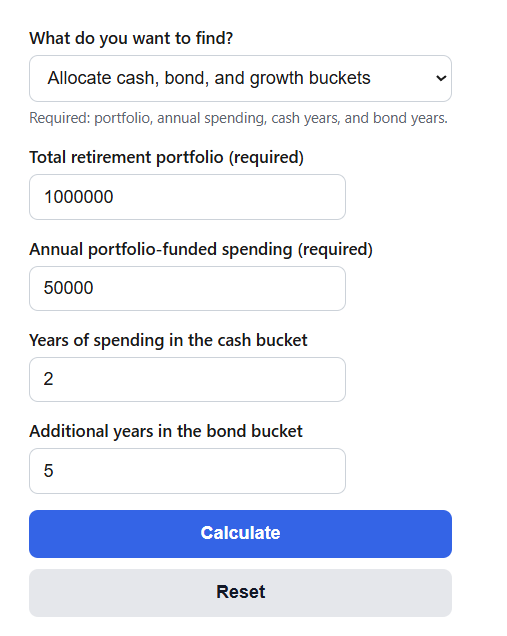
Allocate a retirement portfolio among cash, bond, and growth buckets or calculate how many years of withdrawals existing reserves can cover before rebalancing.
Retirement Bucket Strategy Formula
A simple three-bucket plan assigns near-term withdrawals to cash, intermediate withdrawals to bonds, and the remainder to growth assets.
Cash allocation:
CashBucket=AnnualSpending*CashYears
Bond allocation:
BondBucket=AnnualSpending*BondYears
Growth allocation:
GrowthBucket=Portfolio-CashBucket-BondBucket
Years covered:
CoverageYears=(CashBucket+BondBucket)/AnnualSpending
Variables:
- AnnualSpending is the amount funded from the portfolio
- CashYears is near-term coverage
- BondYears is additional intermediate coverage
- Portfolio is total investable retirement assets
Allocation mode starts from desired coverage years. Coverage mode starts from known bucket amounts.
Only portfolio-funded spending belongs in the formula; subtract Social Security, pensions, and other reliable income first.
The framework does not assume that buckets are spent once and never replenished.
Illustrative $1 Million Bucket Allocation
Assumes $50,000 of annual portfolio withdrawals.
| Cash years | Bond years | Cash bucket | Bond bucket | Growth bucket |
|---|---|---|---|---|
| 1 | 4 | $50,000 | $200,000 | $750,000 |
| 2 | 5 | $100,000 | $250,000 | $650,000 |
| 3 | 5 | $150,000 | $250,000 | $600,000 |
| 2 | 8 | $100,000 | $400,000 | $500,000 |
Example Problems
Example 1: Allocate by years.
Two cash years and five bond years at $50,000 require $100,000 and $250,000, leaving $650,000 for growth.
Example 2: Measure existing coverage.
A $100,000 cash bucket and $250,000 bond bucket cover seven years of $50,000 withdrawals.
Frequently Asked Questions
What belongs in annual spending?
Use the annual gap that must come from the investment portfolio after dependable income.
How many years should each bucket hold?
There is no universal rule; the choice depends on risk tolerance, refill policy, and market assumptions.
Does a bucket strategy eliminate sequence risk?
No. It changes how withdrawals and rebalancing are managed but cannot eliminate market and longevity risk.