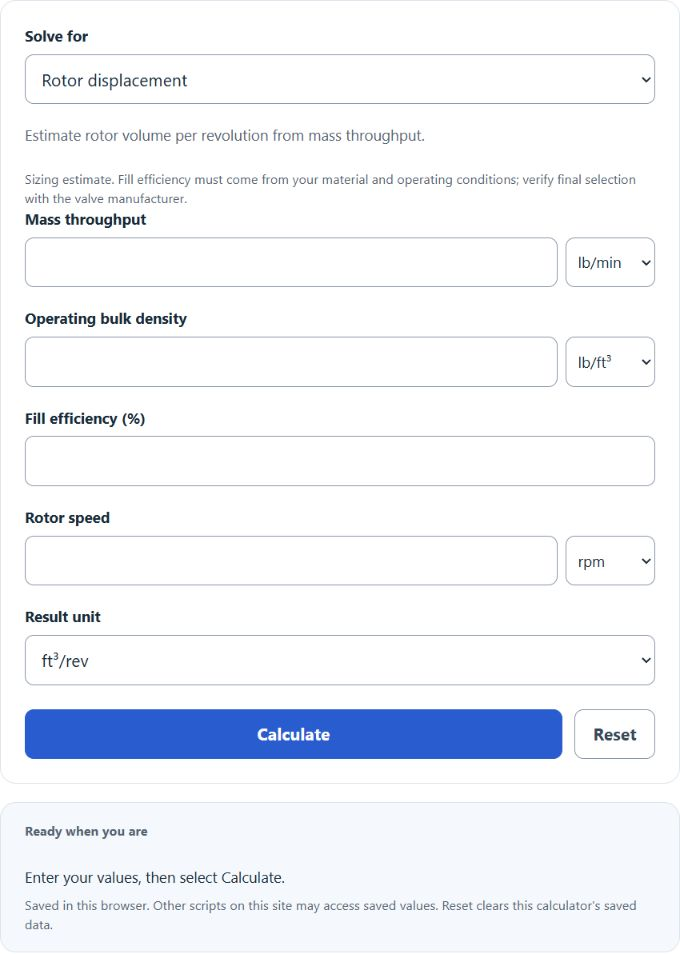
Calculate rotary airlock valve capacity, or solve for conveying rate, product density, valve efficiency, or rotor speed by selecting the value to solve.
- All Construction Calculators
- Screw Conveyor Flow Rate Calculator
- Mass Flow Rate Calculator
- Bulk Density Calculator
- Air Flow Calculator
- CFM to HP Calculator
- TDH Total Dynamic Head Calculator
Rotary Airlock Valve Capacity Formula
This calculator estimates the rotary airlock valve capacity needed from the conveying rate, product density, valve efficiency, and rotor speed. It is useful for feeder sizing, throughput checks, and comparing whether a valve can support the required material flow under actual operating conditions.
In this equation, the calculated value represents rotor displacement per revolution required by the mass-throughput balance. For reliable results, keep all inputs on a consistent basis and use operating bulk density rather than idealized material density.
| Variable | Meaning | Typical Input Basis |
|---|---|---|
| C | Rotary airlock valve capacity | Rotor displacement in ft³/rev (or m³/rev with kg-based inputs) |
| R | Rate of conveying | Mass throughput in lb/min (or kg/min with kg-based inputs) |
| D | Product density | Operating bulk density of the conveyed material |
| E | Valve efficiency | Effective pocket fill percentage from 0 to 100 |
| S | Rotor speed | Revolutions per minute |
Rearranged Equations
Select a solve mode and supply the four required values. On a consistent mass, volume and minute basis, these forms are useful:
How to Calculate Rotary Airlock Valve Capacity
- Determine the required conveying rate for the process.
- Measure or estimate the material’s bulk density at operating conditions.
- Enter the valve efficiency as a percentage. Lower efficiency means more capacity is required to achieve the same throughput.
- Enter the actual rotor speed in RPM.
- Calculate the capacity and compare it to the valve’s available rotor pocket volume or rated handling capability.
The most important part of the calculation is using realistic plant values. Density should reflect the material as it flows, not the true solid density of the particles. Effective fill efficiency should reflect achievable pocket filling under the expected pressure differential; this simple balance does not separately predict leakage, air bypass, torque or slip.
Example
For an arithmetic example only, suppose mass throughput is 100 lb/min, bulk density is 5 lb/ft³, fill efficiency is 75%, and rotor speed is 200 RPM. This speed is not a recommendation.
Under those assumptions, the required rotor displacement is approximately 0.1333 ft³/rev. Compare displacement per revolution with manufacturer data and verify allowable operating speed.
What Affects Rotary Airlock Valve Capacity?
- Bulk density: Lighter materials generally require more valve volume to move the same amount of product.
- Valve efficiency: Pocket fill losses, internal leakage, and air blowback reduce effective capacity.
- Rotor speed: Higher RPM can increase throughput, but excessive speed may reduce fill efficiency and increase wear.
- Material flow behavior: Cohesive, aerated, fragile, or abrasive products often perform differently than free-flowing granular materials.
- Pressure differential: Larger pressure drops across the valve can increase leakage and reduce real-world performance.
- Rotor geometry: Pocket count, pocket depth, rotor diameter, and tip clearance all influence achievable capacity.
Practical Sizing Notes
- Use bulk density, not true particle density.
- Use the actual operating RPM, not only the motor nameplate speed.
- Enter efficiency as a percent, so 75 means 75%, not 0.75.
- If the calculated efficiency would exceed 100%, the inputs are not physically consistent.
- If the required capacity is too high for the selected valve, increase valve size, improve efficiency, or adjust rotor speed.
Common Input Mistakes
- Mixing unit systems between flow rate, density, and capacity.
- Using laboratory density values instead of in-process bulk density.
- Ignoring efficiency losses caused by pressure, wear, or poor rotor fill.
- Assuming a higher RPM always improves performance without checking fill quality and product damage.
- Comparing calculated capacity to a vendor rating that was developed under different material conditions.
When used correctly, this calculator gives a fast estimate for feeder sizing and performance checks, helping determine whether a rotary airlock valve can support the desired conveying rate with the available speed and efficiency.