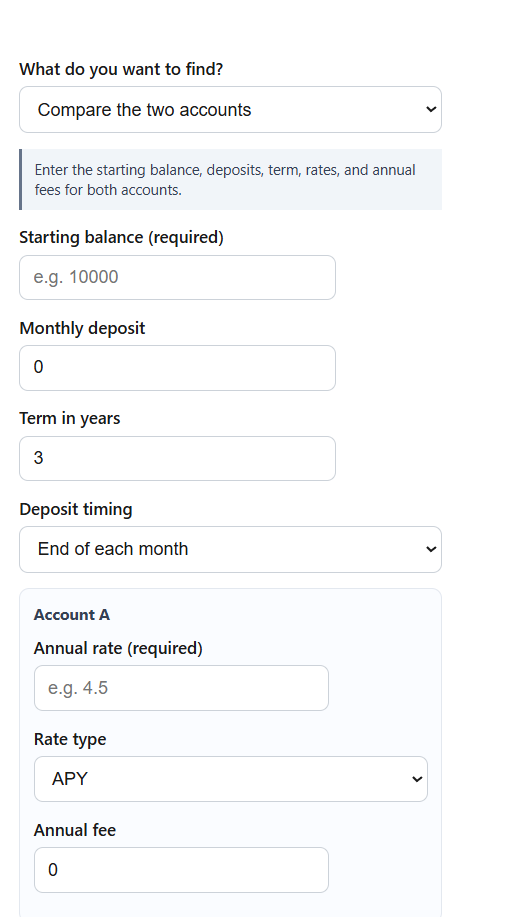
Use the Savings Interest Rate Comparison Calculator to compare APY, APR, monthly deposits, fees, ending balances, and break-even rates.
Savings Interest Rate Comparison Formula
To compare savings accounts fairly, convert each quoted rate to a monthly rate, apply monthly deposits and fees, and project the ending balance over the same term. When a rate is entered as APY, the monthly effective rate is:
i_month = (1 + APY)^(1 / 12) - 1
When a rate is entered as a nominal APR compounded monthly:
i_month = APR / 12
For each month, the calculator applies the selected deposit timing, credits interest, and subtracts one-twelfth of the annual fee:
Balance_next = Balance * (1 + i_month) - Annual Fee / 12 + Deposit
When deposits occur at the beginning of the month, the deposit is added before interest instead of after it.
Variables:
- APY is the effective annual percentage yield
- APR is the nominal annual rate compounded monthly
- imonth is the monthly rate
- Deposit is the recurring monthly contribution
- Annual Fee is the recurring account cost
The calculator can compare two known accounts or solve for the annual rate Account B needs to match Account A’s projected ending balance. Rate, fee, deposit timing, and term are all held consistent with the selected scenario.
Savings Interest Rate Comparison Reference Table
These examples use a $10,000 starting balance, $250 deposited at the end of each month, a three-year term, APY rates, and no fees unless shown.
| Account terms | Projected ending balance | Net interest after fees |
|---|---|---|
| 3.00% APY, no fee | $20,326.79 | $1,326.79 |
| 4.00% APY, no fee | $20,783.91 | $1,783.91 |
| 4.50% APY, no fee | $21,015.30 | $2,015.30 |
| 4.75% APY, no fee | $21,131.70 | $2,131.70 |
| 4.75% APY, $60 annual fee | $20,938.94 | $1,938.94 |
| 5.00% APY, no fee | $21,248.58 | $2,248.58 |
A higher advertised rate is not automatically better. In this example, a $60 annual fee makes the 4.75% account finish below the no-fee 4.50% account.
Example Problems
Example 1: Compare two no-fee accounts.
Account A pays 4.50% APY and Account B pays 4.75% APY. With a $10,000 starting balance and $250 monthly deposits for three years, Account A ends near $21,015.30 and Account B near $21,131.70. Account B is ahead by about $116.40.
Example 2: Measure the effect of a fee.
Keep Account B at 4.75% APY but add a $60 annual fee. Its projected ending balance falls to about $20,938.94, which is about $76.36 below the no-fee 4.50% account. The extra yield is not enough to offset the fee in this scenario.
Frequently Asked Questions
Should I enter APY or APR?
Use the label shown by the bank. APY already includes the effect of compounding over one year. A nominal APR does not, so the calculator divides it into monthly periods when that rate type is selected.
Why does deposit timing matter?
A deposit made at the beginning of a month earns interest for that month. A deposit made at the end does not begin earning until the next period. The difference becomes more noticeable with larger deposits, higher rates, and longer terms.
What account rules are not included?
The projection assumes a constant rate and regular monthly fee. It does not include promotional expirations, variable-rate changes, minimum-balance tiers, withdrawal penalties, transaction limits, taxes, or irregular contribution dates.