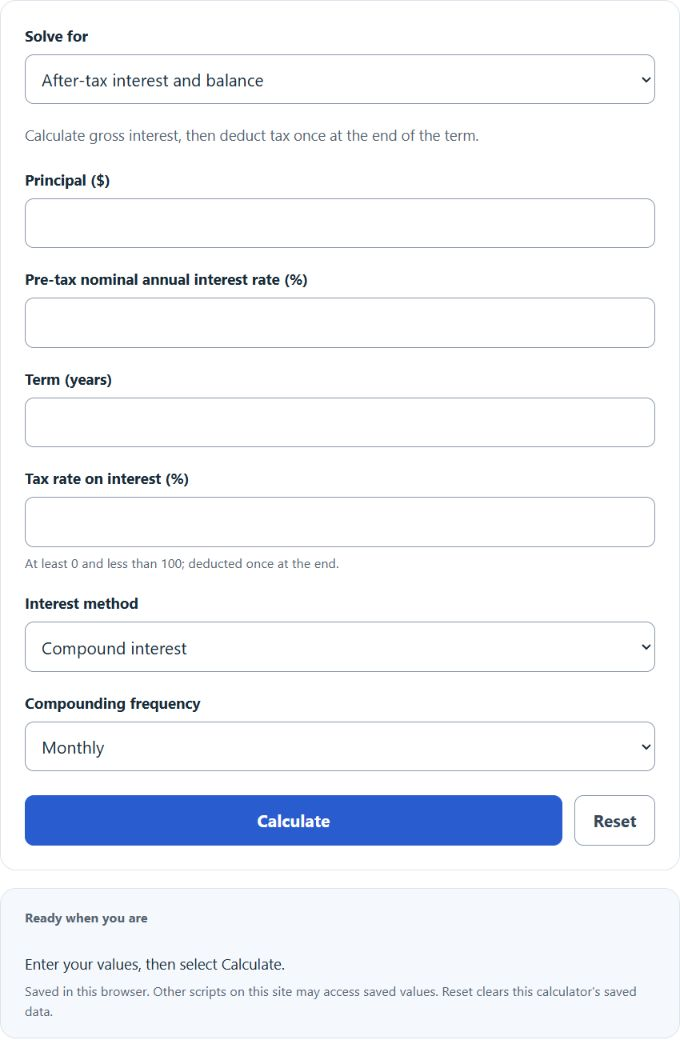
Calculate after-tax interest from principal, rate, term and your tax rate, or find the after-tax yield, the principal needed or the rate required.
After-Tax Interest Formula
After-tax interest starts with the gross interest produced by the account or investment. For simple interest:
Gross Interest = P * r * t
For periodic compounding:
Gross Interest = P * ((1 + r / m)^(m*t) - 1)
Estimated tax and after-tax interest are then:
Tax = Gross Interest * T
 After-Tax Interest = Gross Interest * (1 - T)
Variables:
- P is the starting principal
- r is the pre-tax annual interest rate as a decimal
- t is the term in years
- m is the number of compounding periods per year
- T is the tax rate applied to interest income
The calculator also solves for principal, a required pre-tax nominal annual rate, after-tax yield, pre-tax yield, or an implied tax rate. Yield modes use after-tax yield = pre-tax yield × (1 − tax rate). A zero pre-tax yield cannot identify a unique tax rate, and reversing a 100% tax rate is undefined. Negative yields assume proportional tax relief for losses as a mathematical model. The interest modes use nonnegative rates and deduct tax once at the end of the term; the annualized return uses the ending balance and elapsed years.
After-Tax Interest Reference Table
This table uses a $10,000 principal earning 5% simple interest for one year. Gross interest is $500 before taxes.
| Tax rate | Estimated tax | After-tax interest | After-tax rate |
|---|---|---|---|
| 0% | $0 | $500 | 5.00% |
| 12% | $60 | $440 | 4.40% |
| 22% | $110 | $390 | 3.90% |
| 24% | $120 | $380 | 3.80% |
| 32% | $160 | $340 | 3.40% |
| 37% | $185 | $315 | 3.15% |
This is a planning estimate, not a tax return calculation. The actual tax owed may depend on federal, state, and local rules, account type, deductions, timing, and the taxpayer's broader income.
Example Problems
Example 1: Find after-tax interest.
A $25,000 deposit earns 5% compounded monthly for two years. Gross interest is about $2,623.53. At a 24% tax rate, estimated tax is $629.65 and after-tax interest is about $1,993.89. The after-tax ending balance is about $26,993.89.
Example 2: Find the principal needed.
You want $1,000 of after-tax simple interest in one year at a 5% pre-tax rate and a 24% tax rate. Each dollar of principal produces 0.05 * (1 - 0.24) = $0.038 of net interest. Required principal is $1,000 / 0.038 = about $26,315.79.
Frequently Asked Questions
Which tax rate should I enter?
Use the marginal rate you expect to apply to the interest, including state or local tax when relevant. A blended effective rate may be more appropriate when different portions of income are taxed at different rates.
Is interest in a retirement account taxed the same way?
Not necessarily. Tax-deferred, tax-exempt, and taxable accounts can treat interest differently. This calculator assumes the entered percentage is applied directly to all gross interest, so adjust the tax rate to match the planning scenario.
Does the calculator assume taxes are paid every year?
No. It calculates gross interest for the full term and deducts the estimated tax at the end. Paying taxes annually can reduce the amount left to compound, so a year-by-year tax model may produce a lower net ending balance.