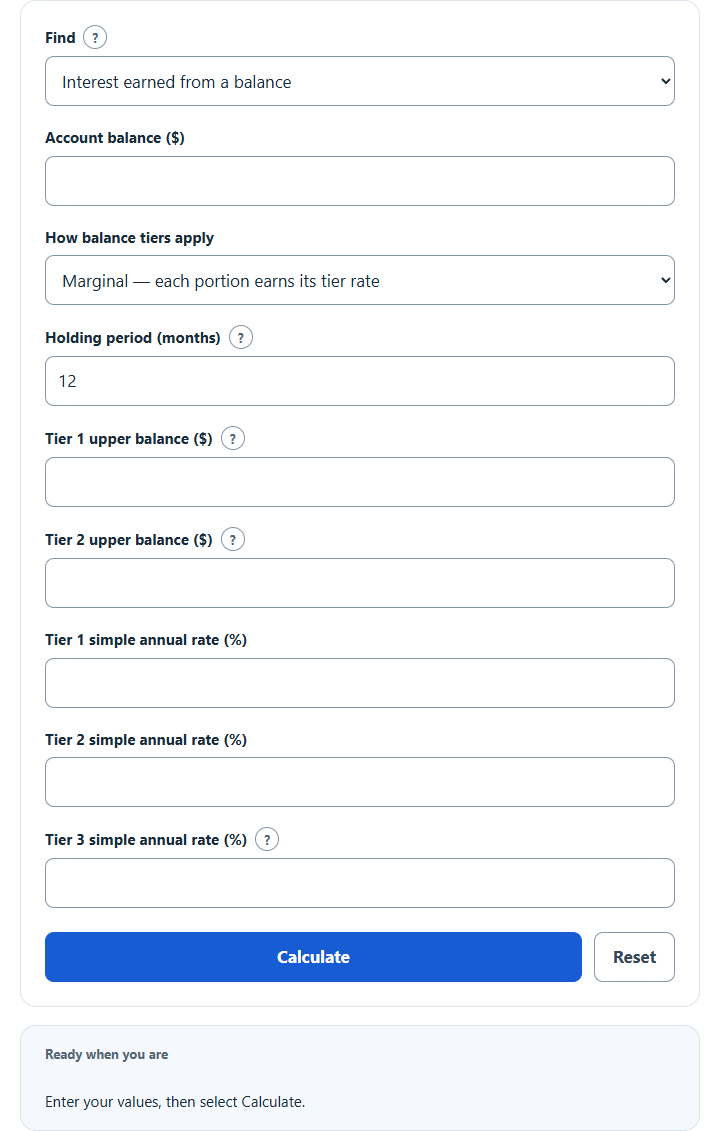
Calculate interest on a tiered savings account from your balance and each tier’s rate, with marginal or whole-balance tiers, or find the balance needed.
Tiered Interest Formula
Tiered accounts can apply rates in two different ways. Under a marginal balance-tier structure, each portion of the balance earns the rate assigned to its tier. For three tiers, annual simple interest is:
For a holding period shorter or longer than one year, the calculator prorates that annual interest:
Under a whole-balance structure, the balance determines one applicable rate and that single rate applies to the full balance:
Variables:
- B is the account balance
- T1 and T2 are the upper balance thresholds for Tiers 1 and 2
- r1, r2, and r3 are simple annual interest rates written as decimals in the formulas; enter percentages in the calculator. These rates exclude compounding and are not APY.
- I is annual interest in the marginal-tier expression; Iperiod is interest over the selected holding period.
The solve-for selector can calculate interest from a known balance or find the earliest balance that reaches a positive interest target. Whole-balance bands here are $0 through T1 inclusive, strictly above T1 through T2 inclusive, and strictly above T2. Each band is evaluated separately, including schedules with falling rates. A jump just above a threshold can provide only a strict lower bound, with no attained minimum continuous balance; the threshold itself still uses the lower band. Unreachable targets are reported explicitly. An attained minimum is displayed as an approximation, with its exact fraction in the details; a rounded monetary amount may miss the target or cross into a different band. Actual account boundary and balance-increment rules must be checked.
Tiered Interest Reference Table
This example uses marginal tiers: 1.5% on the first $10,000, 2.0% on the next $40,000, and 2.5% above $50,000. The table assumes a 12-month holding period and a constant balance.
| Balance | Annual interest | Blended annual rate |
|---|---|---|
| $5,000 | $75 | 1.50% |
| $10,000 | $150 | 1.50% |
| $25,000 | $450 | 1.80% |
| $50,000 | $950 | 1.90% |
| $75,000 | $1,575 | 2.10% |
| $100,000 | $2,200 | 2.20% |
The blended rate is total annual interest divided by the full balance, and is undefined at zero balance. With the increasing marginal rates in this example, it approaches the final tier rate as the balance grows but does not immediately jump to it.
Example Problems
Example 1: Calculate marginal-tier interest.
A $75,000 balance uses the tier schedule above. The first $10,000 earns $150, the next $40,000 earns $800, and the final $25,000 earns $625. Total annual interest is $1,575, for a blended rate of 2.10%.
Example 2: Prorate interest for six months.
Using the same $75,000 balance and rates, annual interest is $1,575. For six months, multiply by 6 / 12. The estimated interest is $787.50.
Frequently Asked Questions
What is the difference between marginal and whole-balance tiers?
Marginal tiers apply each rate only to the portion of the balance inside that band. Whole-balance tiers apply one rate to the entire balance after the account reaches a stated threshold. The disclosure should state which method is used.
Why can a higher balance have a lower blended rate than the top tier rate?
With increasing marginal rates, lower portions of the balance continue earning lower rates. The final rate applies only to the amount above the highest threshold, so the overall blended rate is a balance-weighted average of the rates on occupied portions. Entered rates may also decline or equal zero.
Does the calculator include compounding or changing balances?
No. It prorates stated simple annual interest rates by months / 12 while holding the balance constant until interest is credited. This equal-month convention is not an actual-day or legal APY calculation. Deposits, withdrawals, compounding during the period, fees, minimum-balance tests, and rate changes can alter actual interest.