Calculate sensitivity analysis for profit, NPV, coefficients, diagnostic test accuracy, and E-values from your baseline and scenario inputs.
- All Statistics Calculators
- Fixed Cost Calculator
- Net Change Calculator
- Rate of Change Calculator
- Arc Elasticity Calculator
- Percentage Difference Calculator
Sensitivity Analysis Formula
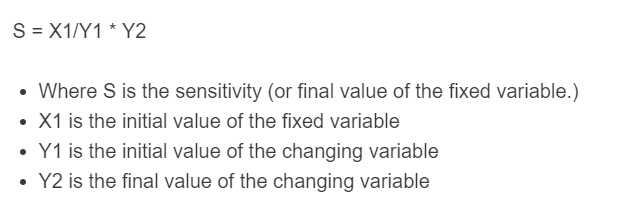
The following formula is used in the Proportional Sensitivity tab to estimate a new output when the input changes, assuming the output is directly proportional to the input (a linear relationship through the origin).
- Where O2 is the estimated output final value.
- O1 is the output initial value.
- I1 is the input initial value.
- I2 is the input final value.
To estimate the new output under this proportional assumption, divide the input final value by the input initial value, then multiply by the output initial value.
Sensitivity Analysis Definition
A sensitivity analysis is a method used in finance, engineering, and modeling to determine how changes in one or more input variables (assumptions) affect an output or result. It is not necessarily an “over time” calculation; it can be applied to any scenario where inputs may vary.
Sensitivity Analysis Example
How to perform a sensitivity analysis?
- First, determine the baseline output.
Determine the baseline (starting) value of the output you care about.
- Next, determine the baseline input.
Determine the baseline (starting) value of the input/assumption you plan to change.
- Next, choose the new input value.
Choose the new (scenario) value of the input.
- Finally, compute the impact on the output.
Calculate the new output (for example, using proportional scaling or a sensitivity coefficient), then compare it to the baseline.
FAQ
A sensitivity analysis is a quantitative technique used to measure how a change in one or more inputs (assumptions) affects an output (result). For example, you can model how profit, demand, or break-even units change when you adjust selling price or costs. The result depends on the relationship or model you assume between the variables.
There is no single universal formula. For simple cases, you can use proportional scaling (when you assume the output is directly proportional to an input), or compute a sensitivity coefficient such as ΔOutput ÷ ΔInput. More complex analyses use full models (e.g., spreadsheets or simulations) that change multiple variables at once.