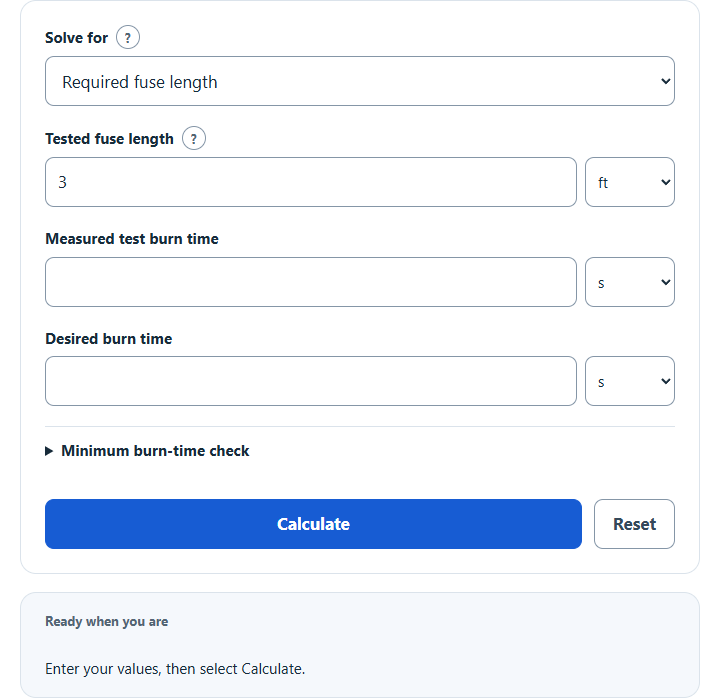
Calculate time fuse length from a test burn, or the expected burn time or burn rate, using the tested length and its measured burn time.
- All Construction Calculators
- Fusing Transformer Calculator
- Burn Time Calculator
- Average Rate Calculator
- Rate of Reaction Calculator
- Fuel Time Calculator
Calculator Functions
| Function | What it does | What it requires |
|---|---|---|
| Required fuse length | Finds the length of time fuse that burns for a desired time, from a timed test burn | Requires the tested fuse length, the measured test burn time and the desired burn time |
| Expected burn time | Finds how long a planned length of fuse will burn, from a timed test burn | Requires the tested fuse length, the measured test burn time and the planned fuse length |
| Measured burn rate | Converts a timed test burn to a burn rate in seconds per foot | Requires the tested fuse length and the measured test burn time |
Lengths can be entered in ft, in, cm or m and times in seconds or minutes. The tested length starts at 3 ft and can be changed to the length that was burned. Every result shows the burn rate in seconds per foot and what the answer becomes if that rate is 5% faster or slower. Required fuse length and Expected burn time can also compare the burn time with a minimum burning time from 30 CFR 56.6502.
Time Fuse Length Formulas
| L | Required fuse length, in the unit of the tested length |
| Lt | Length of the test piece that was burned |
| Tt | Measured burn time of the test piece (s) |
| T | Desired burn time (s) |
The test piece gives the burn speed of that spool, and the speed multiplied by the desired time is the length to cut. U.S. mine safety rules require the burning rate of each spool of safety fuse to be measured before use [1], which is why the calculation starts from a test burn and not from a rate printed on a label.
Required fuse length
The main formula applies directly. A 3 ft test piece that burns in 120 seconds, with a desired burn time of 160 seconds, gives 3 ÷ 120 × 160 = 4 ft. A 36 in test piece that burns in 180 seconds needs 36 ÷ 180 × 270 = 54 in for 270 seconds.
Expected burn time
L is the planned fuse length. With the same 3 ft, 120 second test, a 2 ft length burns for 2 × 120 ÷ 3 = 80 seconds.
Measured burn rate
With the time in seconds and the length in feet, the rate is in seconds per foot: 120 ÷ 3 = 40 s/ft. The result also gives seconds per meter and the burn speed in inches and centimeters per second.
Minimum burning time check
When safety fuse is lit one at a time with handheld lighters, 30 CFR 56.6502 sets a minimum burning time by the number of holes in a round [1]. The calculator compares the burn time with the row that is selected, and the check can be switched off.
| Holes in a round | Minimum burning time |
|---|---|
| 1 | 2 min (120 s) |
| 2 to 5 | 2 min 40 s (160 s) |
| 6 to 10 | 3 min 20 s (200 s) |
| 11 to 15 | 5 min (300 s) |
The rule gives its own example for one hole: at least 36 in of 40 s/ft fuse, or 48 in of 30 s/ft fuse [1]. The table is from the edition revised as of July 1, 2025, and applies to surface metal and nonmetal mines in the United States.
Limits of This Estimate
- Burn rate varies between spools and with storage conditions, so each spool needs its own test burn. The 5% band in the results is an illustration of that spread, not a tolerance from a standard.
- The arithmetic assumes the fuse burns at a steady rate along its whole length, the same as the test piece did.
- The minimum burning times apply only to safety fuse lit individually with handheld lighters under 30 CFR 56.6502. Other lighting methods, underground mines, military use and other countries have their own rules.
- This is a calculation aid. It does not replace blaster training, the fuse maker’s instructions or the site’s blasting procedures.
Sources
- U.S. Code of Federal Regulations, 30 CFR 56.6502, Safety fuse (Mine Safety and Health Administration): measuring the burning rate of each spool, and Table E-1 of minimum burning times with its example