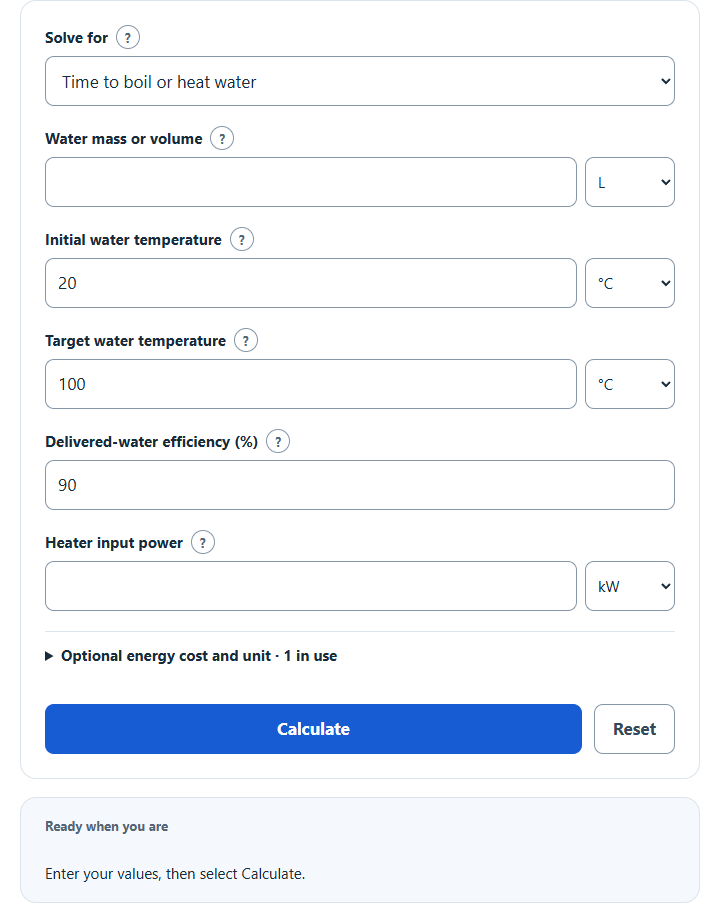
Calculate how long it takes to boil water from the amount, starting temperature and heater power, or find the energy, watts or hot-water flow needed.
Related Calculators
- Total Energy to Heat Water Calculator
- Boiling Point Calculator
- Water Heater Size Calculator
- Specific Heat Calculator
- Heat Transfer Time Calculator
- Water Temperature Calculator
- All Everyday Life and Education Calculators
Time To Boil Water Formula
The equation below is a special case for heating liquid water from 20°C to 100°C with 100% efficiency, using approximate density 1 kg/L and constant specific heat 4,186 J/(kg·°C). It estimates reaching approximately the ordinary-pressure boiling temperature, not turning water into steam:
- T is the modeled time in seconds to heat from 20°C to 100°C under these special-case assumptions.
- WV is the water volume (liters)
- P is constant heater input power in watts, with 100% of it assumed to heat the water in this special case.
The factor 334,880 J/L equals 1 kg/L × 4,186 J/(kg·°C) × 80°C. Multiply the liters by this factor and divide by positive power in watts only for that 20°C-to-100°C, 100%-efficiency case. The calculator’s general model uses the temperatures and efficiency you enter.
For the general model, useful heat Q = m × 4,186 × ΔT in joules, with mass m in kilograms and temperature rise ΔT in °C. If η is the entered efficiency divided by 100, heater input energy is Q/η, heating time in seconds is Q/(η × input watts), and required input watts are Q/(η × target seconds). For a positive temperature rise, continuous mass flow in kg/s is η × input watts ÷ (4,186 × ΔT); multiplying by 60 gives L/min under the 1 kg/L density assumption.
Choose energy, time, power, or continuous flow. Water amount supports liters, kilograms, US gallons, or pounds; each temperature supports °C or °F; power supports W or kW; time supports minutes or hours. Energy outputs support kWh, MJ, or BTU (IT), and flow supports L/min or US gal/min. The IT Btu conversion is 1,055.05585262 joules. Unit conversion constants do not make the fixed physical-property model exact.
Water amount, temperature, power, and target-time measurements start blank; enter your own values. Efficiency must be above 0% and no more than 100%. The target temperature cannot be below the initial temperature. For a batch with no temperature rise, heat and required power are zero, and heating time is zero if input power is positive. Positive heat with zero input power has no finite heating time; zero heat with zero power does not identify a unique heating time. For continuous flow, zero temperature rise gives no finite thermal flow limit, while zero power with a positive rise gives zero flow.
The optional electricity price is in US dollars per kWh. Leaving it blank omits cost; entering 0 is a valid zero-price scenario. Cost uses input energy, not only useful heat. When browser storage is available, the last successful input snapshot is saved and validated and recomputed on return. Edits retain a marked previous result until Calculate is selected again. Reset clears this calculator’s saved state, blanks user measurements and price, and restores documented settings including the editable 20 °C start, 100 °C target and 90% efficiency defaults.
| Water Volume (L) | Time (s) @ 1000 W | Time (s) @ 1500 W | Time (s) @ 2000 W |
|---|---|---|---|
| 0.20 | 67 | 45 | 33 |
| 0.25 | 84 | 56 | 42 |
| 0.33 | 111 | 74 | 55 |
| 0.40 | 134 | 89 | 67 |
| 0.50 | 167 | 112 | 84 |
| 0.60 | 201 | 134 | 100 |
| 0.75 | 251 | 167 | 126 |
| 0.80 | 268 | 179 | 134 |
| 1.00 | 335 | 223 | 167 |
| 1.20 | 402 | 268 | 201 |
| 1.25 | 419 | 279 | 209 |
| 1.50 | 502 | 335 | 251 |
| 1.70 | 569 | 380 | 285 |
| 1.80 | 603 | 402 | 301 |
| 2.00 | 670 | 447 | 335 |
| 2.20 | 737 | 491 | 368 |
| 2.50 | 837 | 558 | 419 |
| 3.00 | 1005 | 670 | 502 |
| 3.50 | 1172 | 781 | 586 |
| 4.00 | 1340 | 893 | 670 |
| Formula: t (s) = V(L) × 334,880 / P(W), rounded to the nearest second. This constant-property model assumes 20°C to 100°C and 100% efficiency, without container heating or other heat losses. It reaches approximately the ordinary-pressure boiling temperature; it does not include energy to vaporize water. Reference rates: ~335 s/L @ 1000 W, ~223 s/L @ 1500 W, ~167 s/L @ 2000 W. | |||
What is Time To Boil Water?
Definition:
Heating time depends on water mass, temperature rise, heater input power, and delivered-water efficiency. This calculator models sensible heating of liquid water between 0°C and 100°C (32°F and 212°F), including equal initial and target temperatures. It does not model freezing, melting ice, steam, latent heat, a pressure-dependent boiling point, or the time needed to vaporize water. Actual boiling temperature and water properties vary with conditions.
How to Calculate Time To Boil Water?
Example Problem:
This example heats liquid water from 20°C to 100°C at an assumed 100% efficiency. It uses the special-case equation above; change the calculator’s editable efficiency assumption from 90% to 100% to reproduce it.
First, determine the water volume. In this example, 2 liters of water is used.
Next, determine the power of the heating element. In this example, the power is 1500 watts.
With a temperature rise of 80°C and 100% efficiency, calculate the heating time using the formula above:
T = (2 * 334880) / 1500
T = 669760 / 1500
T ≈ 446.5067 seconds
FAQ
What factors can affect the time to boil water?
Actual heating depends on initial and target temperatures, water mass, available heater input, container heating, ambient losses, and equipment behavior. The entered efficiency is a delivered-water model assumption; the 90% starting value is editable and is not a universal equipment rating. Constant specific heat and density are approximations.
Can I use this calculator for liquids other than water?
No. The model fixes liquid-water specific heat at 4.186 kJ/(kg·°C) and volume-to-mass density at approximately 1 kg/L. It does not provide other liquids’ properties or temperature-dependent water properties. Do not apply it to ice, steam, or phase changes.
How can I reduce the boiling time?
Within the model, more delivered heating power or less water reduces time for the same positive temperature rise. Sensitivity rows change one stated input assumption at a time; they are not equipment-performance forecasts or installation guidance. Follow the equipment’s operating instructions and use an appropriate engineering assessment for heater sizing or continuous-flow design.