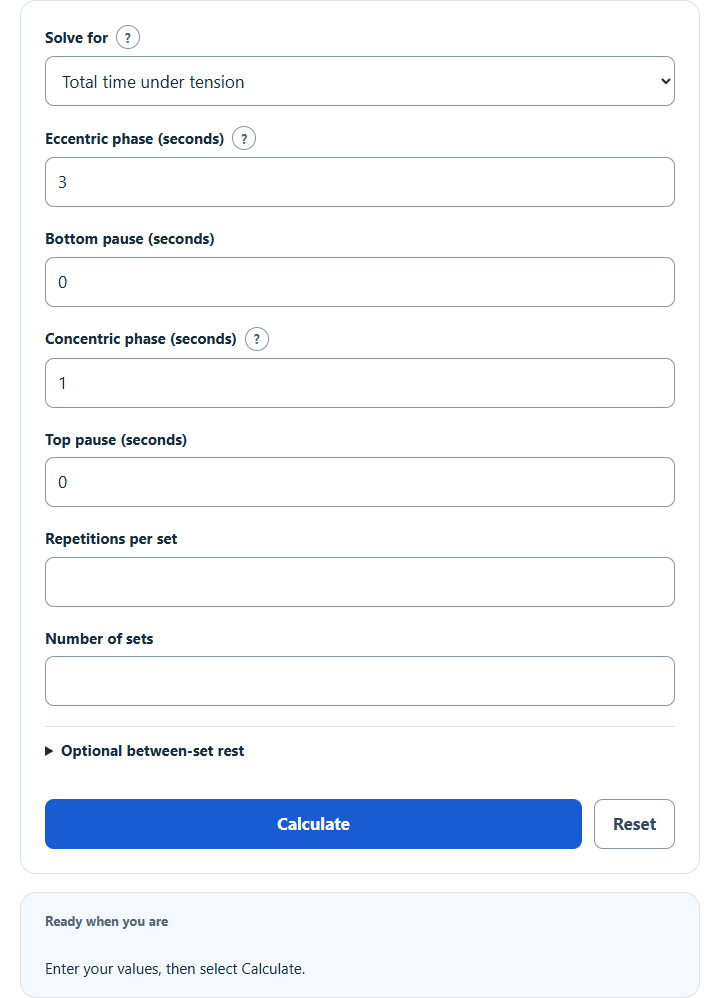
Calculate time under tension from your lifting tempo, reps and sets, or find the reps that reach a target set time. A common 3-0-1-0 tempo is prefilled.
How the Time Under Tension Calculator Works
A tempo such as 3-1-1-0 means three seconds eccentric, one second at the bottom, one second concentric, and zero seconds at the top. Adding those phases gives timed seconds per rep. Multiplying by reps and sets gives a timing proxy for time under tension, assuming the included phases maintain the intended loading. A pause or lockout can be partly or fully unloaded; elapsed phase time alone cannot measure muscle force or mechanical tension. Optional between-set rest is reported separately.
Formula or method: seconds per rep = eccentric + bottom pause + concentric + top pause; set TUT = seconds per rep x reps; exercise TUT = set TUT x sets
Choose the Inputs That Match Your Goal
Enter numeric seconds for all four phases in eccentric–bottom pause–concentric–top pause order; use an explicit 0 for a phase with no deliberate duration, rather than an ambiguous X. All phases must be nonnegative and at least one must be positive. Forward mode requires positive whole reps and sets. Reverse mode requires a positive target set duration and takes the ceiling of target duration divided by seconds per rep, giving the minimum whole repetition count that meets or exceeds the target.
| Phase | Seconds per rep | Share of each rep | Time in one 10-rep set |
|---|---|---|---|
| Eccentric | 3 sec | 60% | 30 sec |
| Bottom pause | 1 sec | 20% | 10 sec |
| Concentric | 1 sec | 20% | 10 sec |
| Top pause | 0 sec | 0% | 0 sec |
| Total | 5 sec | 100% | 50 sec |
Read the Result in Context
Forward mode leads with total exercise timing, then shows seconds per rep, timing per set, phase totals, and optional rest and block duration. Reverse mode leads with minimum whole reps and shows the mathematical rep equivalent, achieved set duration, and seconds above target. The whole-rep ceiling uses the entered values before display rounding; rounding the displayed equivalent down can miss the target.
Worked Example
At 3-1-1-0 for 10 reps and 4 sets, the entered tempo totals 5 seconds per rep, 50 seconds per set, and 200 seconds across the exercise. These are timed phase totals, used as a tension-duration proxy under the stated loading assumption. With 90 seconds between sets, three rest events add 270 seconds, making the full block 470 seconds, or 7 minutes 50 seconds.
Optional rest between sets is used only in the forward exercise-duration mode. Leaving it blank omits the rest and block-duration outputs; entering 0 includes an explicit zero-rest scenario. For S sets there are S − 1 between-set rests, with no added rest after the last set. Numeric measurements start blank, so enter your own values.
Calculate updates results manually. When browser storage is available, the last successful input snapshot is saved and validated and recomputed on return. Editing values keeps a marked previous result until Calculate is selected again. Reset clears this calculator’s saved state, blanks its numeric inputs, and restores the documented initial mode.
Assumptions and Practical Limits
Between-set rest is excluded from the tempo timing proxy. The arithmetic assumes the entered tempo is maintained on every repetition and the included phases retain the intended loading. It does not measure actual muscle tension, movement range, force, velocity changes, or unloaded lockouts, and it cannot predict hypertrophy or prescribe an appropriate tempo. Interpret timing alongside the exercise, load, range of motion, technique, rest, and other training conditions.
Sources
Brad Schoenfeld, Dan Ogborn, and James Krieger, Effect of Repetition Duration During Resistance Training on Muscle Hypertrophy.
Giuseppe Coratella, Appropriate Reporting of Exercise Variables in Resistance Training Protocols: Much More than Load and Number of Repetitions.