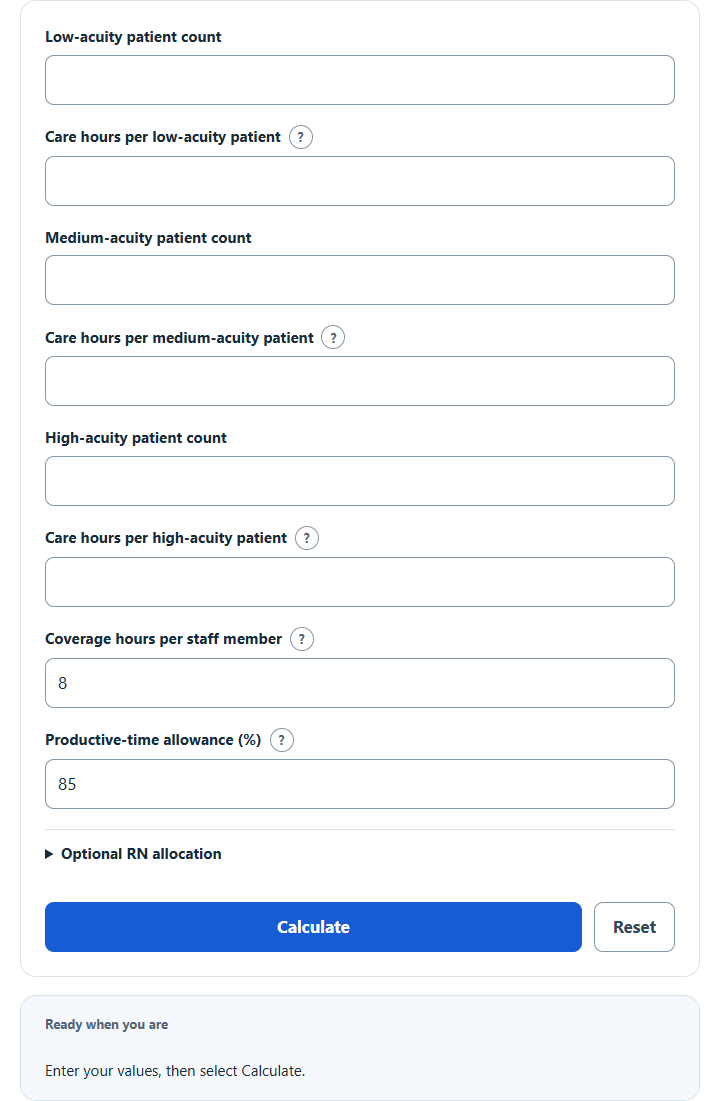
Calculate acuity-based nurse staffing: enter the patients and care hours for each acuity level to get total care hours and the staff needed per shift.
Acuity-Based Staffing Formula
This planning calculator converts user-selected care-hour targets into a coverage-period staff requirement.
Total planned care hours = Σ (patients in each acuity group × care hours per patient).
Unrounded staff requirement = total planned care hours ÷ [coverage hours per staff member × productive-time allowance]. The whole planned staff result rounds this value up. The RN percentage only allocates the calculated requirement for planning; it does not establish a mandatory skill mix.
How to Use the Result
Enter nonnegative whole patient counts, your organization’s care-hour targets, the relevant coverage period, and a productive-time allowance. Keep every input tied to the same period. Review the unrounded staff equivalents before using the rounded planning count. A blank RN allocation omits that output. A care-hour target may be blank only when its patient count is zero.
Safety limitation: This is administrative planning arithmetic, not a validated patient-acuity tool, staffing standard, or legal ratio. Safe staffing also depends on changing patient needs, admissions and discharges, staff competence and skill mix, unit layout, available resources, and applicable law and policy.
Example
Ten low-acuity patients at 2 hours, eight medium-acuity patients at 4 hours, and four high-acuity patients at 6 hours require 76 planned care hours. With 8 coverage hours and an 80% productive-time allowance, the requirement is 11.875 staff equivalents, rounded up to 12 planned staff.
Annual Nursing FTE Formula
Select Annual nursing FTEs to estimate annual workload capacity from nursing hours per patient day (HPPD), average daily census, service days in the year and productive hours per FTE per year. HPPD uses a 24-hour patient day. The care-hour targets in Shift staffing refer to its selected coverage period and are not automatically daily HPPD.
Patient days = average daily census × service days. Annual care hours = HPPD × patient days. Annual nursing FTEs = annual care hours ÷ productive hours per FTE per year. Use matching staff groups and productive-hour definitions throughout; CDC’s nurse-staffing indicator protocol explains nursing hours and patient-day measures.
The editable 1,872-hour example is 2,080 paid hours × 90% productive time; it is not a staffing standard. Replace it with your organization’s annual productive capacity after leave, training and other nonproductive time. Apply an absence or productivity allowance once. Use 365 service days for an ordinary full year, 366 for a leap year, or the actual annual service days.
For illustration, 6 HPPD × 20 average patients × 365 days = 43,800 annual care hours. Dividing by 1,872 productive hours gives approximately 23.397436 FTE. This is fractional annual workload capacity, not 23.4 people on each shift. Shift coverage, patient changes, competence, skill mix and local requirements need separate review.