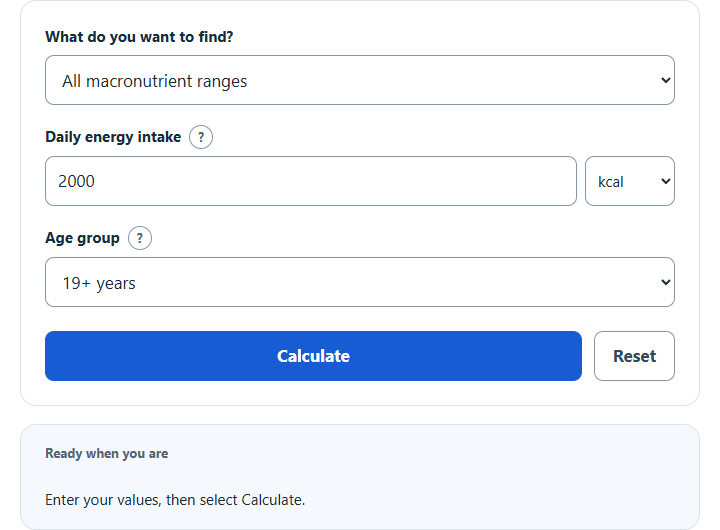
Calculate daily carbohydrate, protein, and fat AMDR ranges in grams and calories from your energy intake, with age-specific guidance and kcal or kJ input.
Note: This calculator provides general informational estimates, not medical advice. If you’re under 18, pregnant/breastfeeding, have a medical condition that affects diet (e.g., diabetes, kidney or heart disease), or a history of eating disorders, consult a clinician or registered dietitian before making dietary changes.
- All Food and Cooking Calculators
- Mifflin St Jeor Calculator
- Macro Calculator
- Calorie Calculator
- AMR (Active Metabolic Rate) Calculator
- REE (Resting-Energy-Expenditure) Calculator
- Weight Loss Calculator
AMDR Formula
The AMDR ranges are described in the Dietary Reference Intakes (DRIs) from the National Academies. Verify the age-specific percentages in their AMDR guidance, Table 3-1. The formulas below use the adult ranges for ages 19 and older; select the relevant age group in the calculator for children. Last reviewed: October 2026.
C = 45–65% × Dkcal ÷ 4
P = 10–35% × Dkcal ÷ 4
F = 20–35% × Dkcal ÷ 9
- Where C is the number of grams of carbohydrates
- P is the number of grams of protein
- F is the number of grams of fat
- Dkcal is the daily calories used for the calculation (your estimated daily calorie needs (TDEE) or a calorie target set with a clinician/dietitian)
AMDR Definition
What is AMDR?
AMDR, short for Acceptable Macronutrient Distribution Range, is a term used in nutrition science to describe typical healthy ranges for how your total daily calories may be distributed among carbohydrates, protein, and fat. These ranges are expressed as a percentage of total calorie intake. Carbohydrate and protein provide 4 calories per gram and fat provides 9 calories per gram.
Example Problem
How to calculate AMDR?
First, determine the height, weight, age, gender, and activity level of the individual. For this example, the person is 70 inches tall, 204 lbs, 21 years old, male, and lightly active.
Next, determine the total number of calories the person needs per day. Using the illustrative Mifflin–St Jeor calculation and activity multiplier of 1.375, round the estimate once to whole calories for this example: — calories.
Finally, calculate the acceptable macronutrient distribution ranges using the adult formulas above:
C = 45–65% × Dkcal ÷ 4 = —g – —g
P = 10–35% × Dkcal ÷ 4 = —g – —g
F = 20–35% × Dkcal ÷ 9 = —g – —g