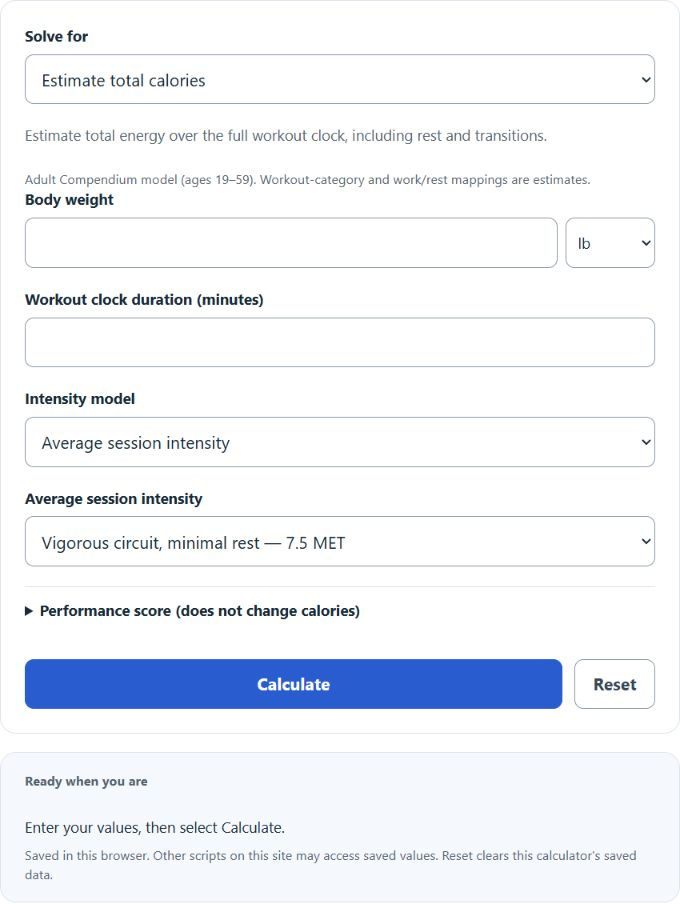
Estimate calories for an as-many-rounds-as-possible workout from body weight, time, and either average session intensity or a work-and-recovery model.
AMRAP Calorie Formula and Methods
AMRAP is a timed format in which a participant completes as many rounds or repetitions as possible before the clock ends. A score records completed work, but it does not reveal the time spent moving, resting, or transitioning at each intensity. This calculator therefore bases energy on body mass, clock duration, and a transparent intensity model.
Average-Intensity Method
The recommended method applies one session-average MET value across the full AMRAP clock:
Preset choices use 2024 Adult Compendium conditioning values. They range from a 5.0-MET moderate mixed circuit to an 11.0-MET vigorous HIIT session. The chosen value should describe the average demands of the entire clock, including ordinary transitions and pauses.
Work-and-Recovery Method
The segmented method is useful when the active share of the clock is reasonably known. It blends a work MET with a standing or slow-walking recovery MET:
Quiet standing is modeled at 1.3 MET; very slow strolling below 2 mph is modeled at 2.3 MET. The Adult Compendium targets ages 19–59. Matching an AMRAP or a work segment to these circuit/HIIT categories is an approximation; the 7.5-MET category includes minimal rest. The result depends on the entered work share and does not detect work and rest from a round score.
Score and Calories Measure Different Things
Two athletes can post the same number of rounds with different movement speeds, loads, transitions, and recovery patterns. Conversely, different scores can occur at a similar average metabolic demand. Optional rounds and repetitions are shown only as session-specific performance context. They do not alter the calorie formula and are not converted into a reusable calories-per-repetition constant.
Solving for Equivalent Time
Target mode rearranges the same constant-rate equation. It divides target total calories by estimated calories per minute. The displayed duration means time at the same assumed average intensity; it is not a workout prescription or a suggestion to continue a fixed workout.
Worked Examples
For a 70 kg person, 20 minutes at 7.5 MET produces 183.75 total kcal and 159.25 above-rest kcal. If the same clock is modeled as 80 percent work at 7.5 MET and 20 percent standing recovery at 1.3 MET, the weighted average is 6.26 MET and the estimate becomes about 153.37 total kcal.
Safety, Assumptions, and Method Sources
The MET conversion is a population-level planning equation, not an individual measurement. Mixed movements, external load, training status, technique, anaerobic contribution, temperature, and fatigue can change actual expenditure. The calculator does not add post-exercise afterburn and cannot reproduce a wearable or laboratory measurement.
Browse the complete Cardio & HIIT calculator collection or return to the Sports & Fitness Calculators hub.
Sources
CrossFit LLC. CrossFit Terms Explained. Current online edition.
Herrmann SD et al. 2024 Adult Compendium of Physical Activities. 2024 edition.