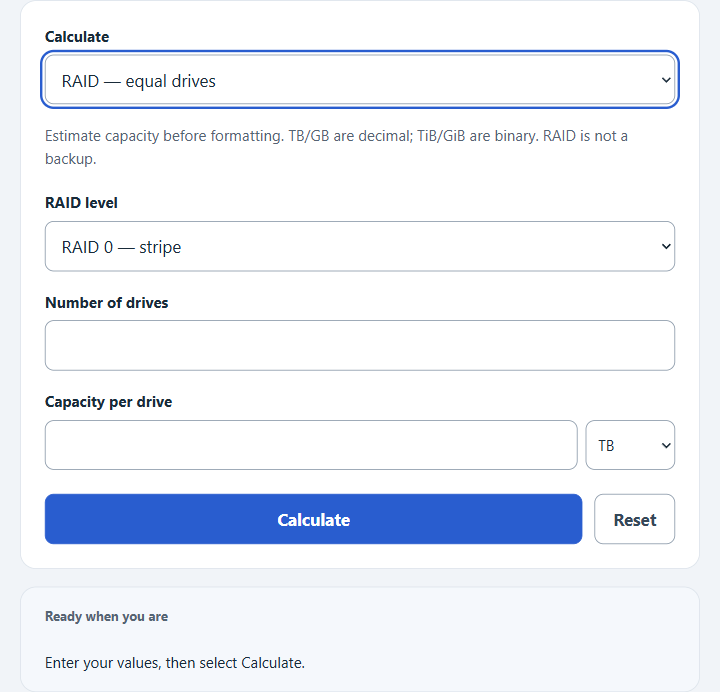
Calculate RAID array usable capacity, redundancy, efficiency, and fault tolerance, plus memory and file-storage estimates for arrays.
- All Miscellaneous Calculators
- Drive Capacity Calculator
- Backup Capacity Calculator
- Storage Percentage Calculator
- Data Size Calculator
- Video File Size Calculator
Array Capacity Formula
For a programming array with no overhead or padding, the following formula gives total memory. Choose Memory for an array or Elements that fit in memory above. RAID and file-storage estimates use their respective modes.
Variables:
- C is the total capacity in bytes
- N is the number of elements
- S is the size of each element in bytes
Multiply element count by element size for the simple total. With metadata and alignment, round each element plus its overhead up to the alignment multiple, then multiply by the count and add fixed overhead. To find how many whole elements fit, subtract fixed overhead from capacity and divide by the padded stride, rounding down. GB and TB use powers of 1000; GiB and TiB use powers of 1024. RAID estimates exclude filesystem and controller overhead, distinguish redundancy from unused mixed-drive space, and are not a substitute for backups.
What is an Array Capacity?
Array capacity refers to the total amount of memory allocated for an array in a computer program. This capacity is determined by the number of elements the array can hold and the size of each element. Understanding array capacity is crucial for efficient memory management and avoiding issues such as buffer overflows or memory wastage. Arrays are commonly used in programming to store collections of data, and knowing their capacity helps in optimizing performance and resource utilization.
How to Calculate Array Capacity?
The following steps outline how to calculate the Array Capacity.
- First, determine the number of elements in the array (N).
- Next, determine the size of each element in bytes (S).
- Finally, calculate the total capacity using the formula C = N * S.
- Select Memory for an array, enter the values, leave overheads blank (zero) and alignment blank (1 byte), and select Calculate.
Example Problem :
Use the following variables as an example problem to test your knowledge.
Number of elements in the array (N) = 100
Size of each element (S) = 4 bytes
Total Capacity (C) = 400 bytes