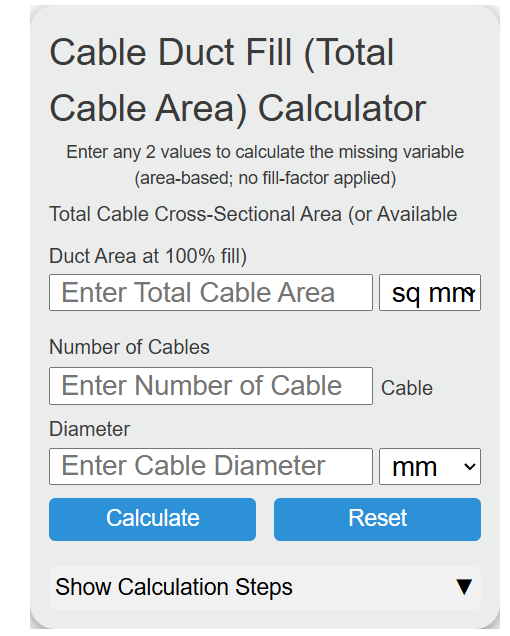
Calculate cable duct capacity, fill percentage, maximum cable count, or minimum square duct size using cable outside diameter and metric or imperial units.
Related Calculators
- Cable Tray Fill Calculator
- Cable Tray Capacity Calculator
- Electrical Box Size Calculator
- Inverter Cable Size Calculator
- Transformer Wire Size Calculator
- Current Capacity Calculator
- Hoffman Enclosure Temperature Calculator
- All Construction Calculators
Cable Duct Fill (Total Cable Area) Formula
This calculator uses the circular area of each cable based on its outside diameter, then multiplies by the number of cables. It is area-based only and does not apply a duct fill factor or spacing allowance.
- Atotal = total cable cross-sectional area
- N = number of cables
- D = cable outside diameter
- pi = 3.14159…
If you enter the number of cables and the cable diameter, the calculator finds the total cable area. If you enter the total area and diameter, it finds the theoretical number of cables that fit by area. If you enter the total area and number of cables, it finds the cable diameter that would produce that total area.
Area and Diameter Unit Conversions
The calculator converts inputs to square millimeters and millimeters internally, then converts the result back to the selected output unit.
| Unit | Equivalent |
|---|---|
| 1 in | 25.4 mm |
| 1 sq in | 645.16 sq mm |
| 1 sq ft | 92,903.04 sq mm |
| 1 sq m | 1,000,000 sq mm |
| 1 sq yd | 836,127.36 sq mm |
Common Cable Diameters and Circular Areas
| Cable outside diameter | Area of one cable |
|---|---|
| 5 mm | 19.63 sq mm |
| 10 mm | 78.54 sq mm |
| 15 mm | 176.71 sq mm |
| 20 mm | 314.16 sq mm |
| 25 mm | 490.87 sq mm |
Example Calculations
Example 1: Find total cable area
You have 12 cables, and each cable has an outside diameter of 10 mm.
The total cable cross-sectional area is 942.48 sq mm.
Example 2: Find the number of cables
You have 1,000 sq mm of total available area and cables with a 10 mm outside diameter.
The area-based result is 12.73 cables. In practice, you would round down to 12 whole cables before applying any required fill rule or installation allowance.
FAQ
Does this calculator apply a duct fill percentage?
No. It calculates total cable area only. If you need to apply a duct fill percentage, multiply the duct’s internal cross-sectional area by the allowed fill percentage first, then use that value as the available area.
Should cable diameter mean conductor diameter or outside cable diameter?
Use the full outside diameter of the cable, including insulation, jacket, or sheath. Duct fill is based on the physical space the cable occupies, not just the metal conductor size.
Why can the number of cables result be a decimal?
The formula gives a theoretical area-based count. Since you cannot install part of a cable, round the result down to the nearest whole number. You may also need to reduce the count further for code requirements, bends, pulling difficulty, heat, or manufacturer guidance.