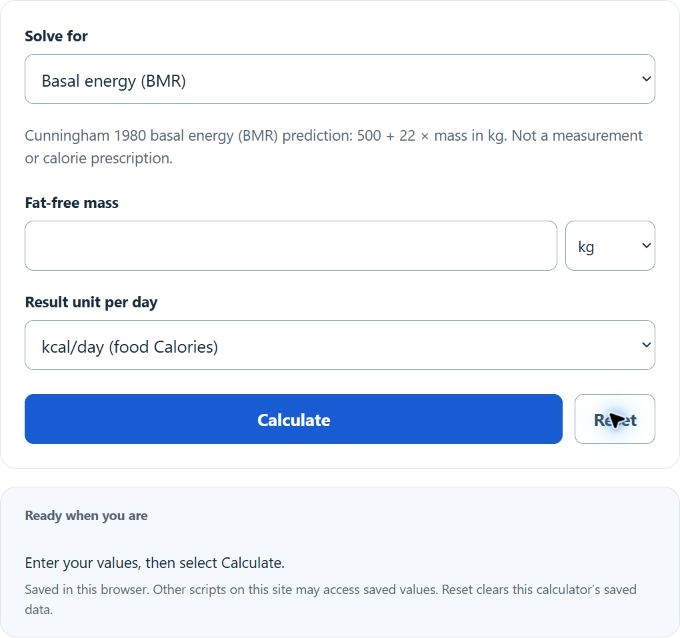
Estimate adult resting energy with Cunningham’s 1980 equation from fat-free mass, or apply a broad activity multiplier for an activity-adjusted planning estimate.
Disclaimer: This adult calculator provides predictive estimates only, not a metabolic measurement, body-composition measurement, calorie prescription, or medical advice. Fat-free-mass measurement error carries directly into the result. Do not use calorie targets without individualized guidance for pregnancy, breastfeeding, eating-disorder history, or a medical condition or medication affecting energy needs.
Cunningham 1980 Resting-Energy Formula
Variables:
- BMR is the basal metabolic rate (kcal/day)
- FFM is the fat-free mass (kg)
To predict adult resting energy, multiply fat-free mass by 22 and add 500. The 1980 analysis used estimated lean body mass from 223 subjects in the Harris-Benedict data; modern body-composition methods and the terms lean mass and fat-free mass are not perfectly interchangeable.
How to Calculate BMR Using the Cunningham Equation?
Select the requested calculation in the widget, enter the known quantity and its unit, then select Calculate. The basal-energy mode uses the Cunningham 1980 equation below; activity-adjusted modes also use the selected planning multiplier. All Calories Calculators.
- First, determine the fat-free mass (kg).
- Next, gather the formula from above: BMR (kcal/day) = 22*FFM + 500.
- Finally, calculate BMR (kcal/day).
- After inserting the variables and calculating the result, check your answer with the calculator above.
Example Problem :
Use the following variables as an example problem to test your knowledge.
fat-free mass (kg) = 60
BMR (kcal/day) = 22*60 + 500 = 1820 kcal/day
Sources & Limitations
The Cunningham equation is a population-based prediction from a body-composition input. DEXA, BIA, skinfolds, and other methods can give different fat-free-mass values. Reverse-solving fat-free mass from an entered BMR or TDEE is algebra only and does not measure body composition. Activity multiplication is a planning heuristic, not a measured TDEE.
Frequently Asked Questions
What is Fat-Free Mass (FFM)?
Fat-Free Mass (FFM) refers to the total mass of all tissues in the body except fat. This includes muscles, bones, organs, and water content. It’s a key variable in estimating basal metabolic rate (BMR) using the Cunningham equation.
Why is the Cunningham Equation important?
The Cunningham Equation is used to estimate Basal Metabolic Rate (BMR) based on fat-free mass. It’s important for athletes and individuals looking to optimize their diet and exercise regimen by understanding how many calories they burn at rest (typically expressed as kcal/day).
How can I measure my fat-free mass?
Fat-free mass can be measured through various methods such as Dual-Energy X-Ray Absorptiometry (DEXA) scans, bioelectrical impedance analysis (BIA), and skinfold measurements. Each method has its advantages and limitations in terms of accuracy and accessibility.
Can the Cunningham Equation be used for weight loss?
It can provide a resting-energy starting estimate, but it does not determine a safe calorie deficit or predict a rate of weight change. Use individualized professional guidance when calorie restriction could pose risk.